
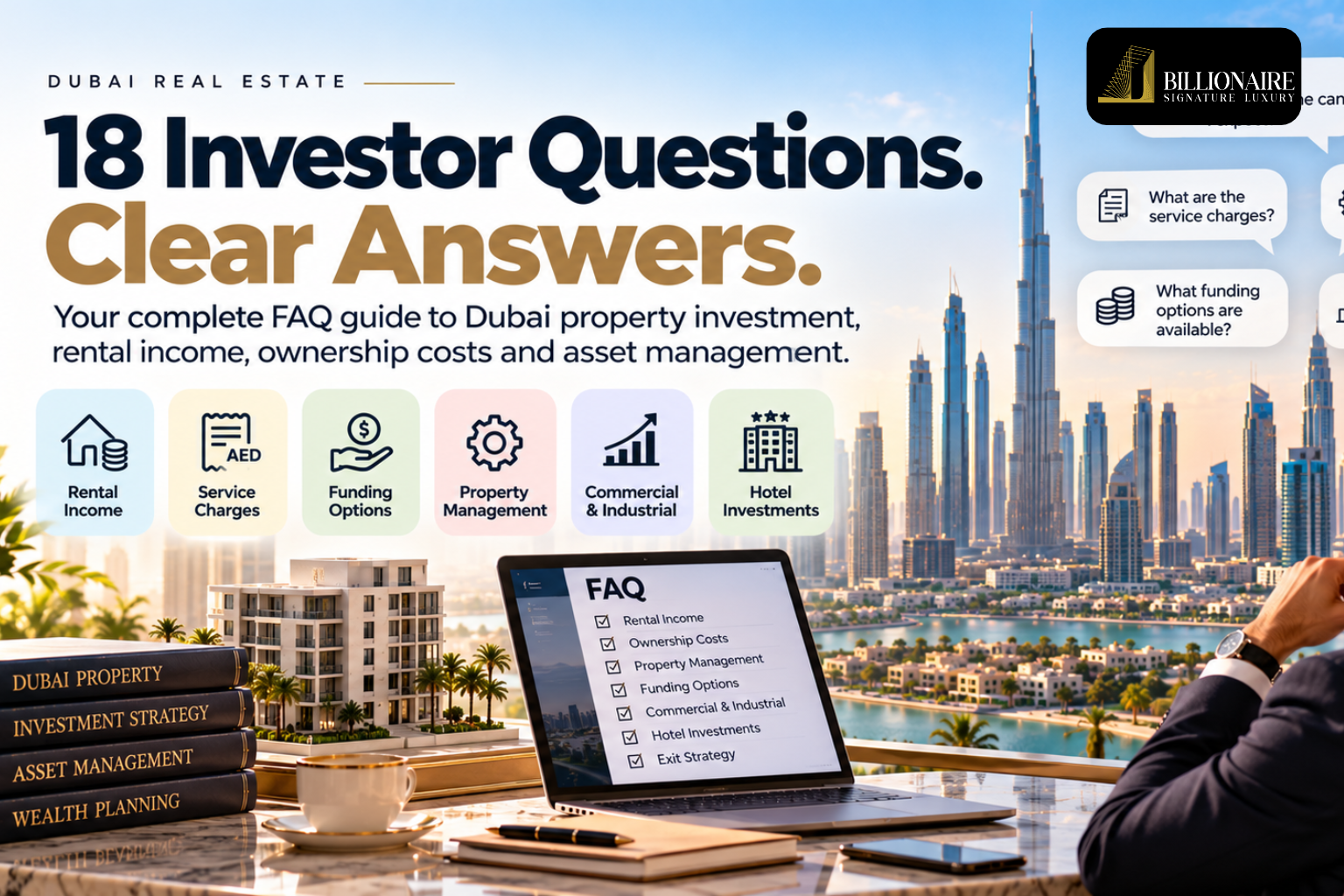
Investing in Dubai real estate involves more than selecting a property and completing a transaction. Investors must also understand recurring ownership costs, rental income, property management, financing requirements and the decisions that affect an asset’s long-term performance.
These considerations can become more complicated for overseas investors who cannot visit their properties regularly or coordinate local operations themselves.
This guide answers common Dubai real estate investor FAQs, focusing on practical ownership and investment questions that go beyond the initial purchase.
Whether you own a rental apartment, are considering a commercial property or are evaluating a warehouse or hospitality asset, these answers provide a starting point for making more informed decisions.
Dubai Property Ownership FAQs
1. What costs should I budget for after buying property in Dubai?
The costs depend on the property type, building, ownership structure and intended use.
Potential recurring and operational expenses include:
- Service charges for jointly owned properties
- Repairs and routine maintenance
- Property management fees
- Insurance, where applicable
- Utilities during vacancy or between tenants
- Leasing and tenant onboarding expenses
- Financing costs, where applicable
- Major repairs and future capital expenditure
Owners should distinguish one-time acquisition costs from recurring expenses. A property that appears affordable based on its purchase price may require a larger ongoing budget than expected.
Review the relevant building’s approved service charge information through the Dubai Land Department before finalising your financial assumptions.
2. How can I check service charges for a property in Dubai?
The Dubai Land Department provides a Service Charge Index for checking approved service fees for relevant jointly owned properties.
Use the applicable project, property usage and financial year to review the available information. Do not assume that charges for another building or community will apply to your property.
The official Service Charge Index is a useful starting point. You should also review the property’s actual statements and confirm any outstanding amounts with the appropriate party.
3. Who is responsible for property maintenance in Dubai?
Responsibility depends on the lease, the nature of the repair, applicable law and any relevant building or management arrangements.
An owner should distinguish between maintenance within the individual unit, repairs to shared facilities and work covered by a developer or contractor warranty.
Review the lease and relevant agreements before deciding who must pay. Where responsibility is disputed, seek qualified legal advice rather than relying on an informal assumption.
4. Can I own property in Dubai without living in the UAE?
Yes. Non-residents can own property in Dubai in designated ownership areas, subject to applicable rules and the specific property.
However, owning property remotely still requires arrangements for documentation, maintenance, rental matters and other ownership responsibilities.
Overseas owners should establish a clear process for receiving updates, approving expenses and responding to urgent issues. The Dubai Land Department provides official property-related information and services.
Dubai Rental Property FAQs
5. How do I estimate rental income from a Dubai property?
Start by researching comparable properties with similar locations, sizes, conditions and facilities.
Then estimate the income you could reasonably expect, taking into account the property’s likely occupancy and rental terms. Avoid using advertised asking rents as guaranteed achievable income.
Your calculation should also account for service charges, maintenance, leasing costs, vacancy and management expenses.
The Dubai Land Department’s Real Estate Data portal provides access to available property and rental information that can support your research.
6. What is the difference between gross rental yield and net rental yield?
Gross rental yield compares annual rental income with the purchase price.
Formula:
Gross rental yield = Annual rental income ÷ Purchase price × 100
Net operating yield accounts for relevant operating expenses before financing costs and other excluded items.
For example, suppose a property costs AED 2,000,000 and generates AED 140,000 in annual rent. If annual operating expenses are AED 30,000:
- Gross yield: AED 140,000 ÷ AED 2,000,000 × 100 = 7%
- Illustrative net operating yield: (AED 140,000 − AED 30,000) ÷ AED 2,000,000 × 100 = 5.5%
This is a hypothetical example, not a market estimate. It excludes acquisition costs, financing costs, taxes where applicable and other potential expenses.
Investors can use BSL’s ROI and yield calculator to explore their own assumptions.
7. What should I do if my Dubai property remains vacant?
First, identify why the property is not attracting a suitable tenant.
Possible factors include pricing, property condition, presentation, marketing quality, location, competing supply or restrictions affecting the intended use.
A practical review should include:
- Comparing the asking rent with similar properties
- Checking photographs and listing descriptions
- Reviewing the property’s condition and presentation
- Confirming that viewing arrangements are convenient
- Assessing the target tenant profile
- Calculating the financial impact of continued vacancy
Avoid reducing the rent automatically without understanding the cause. A targeted improvement to presentation, pricing or marketing may be more appropriate.
8. How can I manage a Dubai rental property from another country?
Remote ownership works best when there is a defined process for tenant communication, maintenance, expense approval and reporting.
Before appointing a property manager, confirm the service scope, fees, response arrangements and reporting frequency.
BSL Group UAE offers property management services covering tenant coordination, maintenance oversight, rent and payment tracking, leasing support and owner reporting.
The appropriate arrangement depends on the property and the responsibilities agreed between the owner and service provider.
9. What should I look for when choosing a Dubai property management company?
Evaluate the provider’s service scope rather than comparing fees alone.
Consider whether the company can support:
- Tenant enquiries and ongoing communication
- Rent tracking and renewal coordination
- Maintenance scheduling and contractor follow-up
- Property inspections and condition reporting
- Leasing preparation and viewing coordination
- Clear financial and operational reporting
Ask how expenses are approved, how emergencies are handled and what happens when the property becomes vacant.
The management agreement should clearly define responsibilities, fees, reporting and termination arrangements.
Dubai Property Funding and Investment FAQs
10. Can I obtain private funding for a Dubai real estate investment?
Private funding may be an option for certain real estate acquisitions, development projects or short-term capital requirements. Availability depends on the asset, documentation, funding purpose, timeline and repayment plan.
BSL Group UAE’s Private Funding service describes support for selected acquisitions, development capital, bridge solutions and asset-backed funding pathways.
Funding is not automatic or guaranteed. Investors should review the proposed terms, costs, security requirements and repayment obligations carefully before committing.
11. When might bridge funding be considered for a property transaction?
Bridge funding is generally considered when a borrower has a short-term capital requirement and an identifiable plan for repayment, such as a sale or refinancing.
Potential situations include a time-sensitive acquisition, a transitional funding gap or a development-stage requirement.
The decision requires careful assessment of the asset, funding costs, repayment timeline and what happens if the expected sale or refinancing is delayed.
Read BSL’s guide to real estate bridge financing in Dubai for a more detailed discussion.
12. How should investors evaluate a commercial property in Dubai?
Commercial property requires analysis of both the asset and the business activity it needs to support.
Investors should consider:
- Location and accessibility
- Tenant demand and comparable rents
- Lease terms and tenant obligations
- Permitted use and relevant approvals
- Building condition and future maintenance
- Vacancy risk and tenant concentration
- Acquisition and financing costs
- Potential resale demand
A warehouse, office building and hotel should not be evaluated using exactly the same assumptions. Each asset type has distinct operating requirements and risk factors.
13. What should investors consider before buying a warehouse in Dubai?
Warehouse investors should examine the property’s suitability for its intended operation as well as its financial potential.
Key considerations include access for commercial vehicles, loading facilities, clear height, power availability, storage configuration, permitted use and the needs of prospective tenants.
Also review the property’s condition, lease arrangements, operating expenses and competing supply.
Explore BSL’s Warehouse and 3PL opportunities for industrial and logistics-related real estate requirements.
14. What should investors assess before acquiring a hotel asset?
Hotel investments require an assessment of the real estate and the hospitality operation associated with it.
Depending on the opportunity, investors may need to review occupancy and revenue records, operating costs, refurbishment requirements, location, competitive positioning and the operator’s arrangements.
It is also important to distinguish between purchasing a hotel property, acquiring a hospitality business and investing through a particular ownership or operating structure.
BSL’s hotel asset opportunities cover selected hospitality properties, buyer mandates, asset positioning and related transaction opportunities.
Dubai Real Estate Strategy FAQs
15. Should I invest in one property or diversify across several assets?
There is no universal answer. The decision depends on available capital, investment objectives, liquidity requirements, risk tolerance and the investor’s ability to manage different assets.
One property may be easier to oversee, but it can create concentration risk. Multiple assets may diversify exposure, while also increasing administrative responsibilities and operating costs.
Diversification should be assessed across relevant factors, including location, asset type, tenant exposure, financing and investment horizon. It does not eliminate risk.
16. When should I sell a Dubai investment property?
A sale may be worth evaluating when the property’s financial performance, market position or role in your portfolio no longer aligns with your objectives.
Before making a decision, consider:
- Current market evidence and potential sale proceeds
- Outstanding financing and transaction costs
- Rental income and operating expenses
- Upcoming capital expenditure
- Alternative investment opportunities
- The time and cost required to hold the property
Compare the expected outcome of selling with the realistic alternatives, including continuing to hold, improving the asset or refinancing where suitable.
17. What is off-market real estate in Dubai?
An off-market opportunity is a property or transaction offered through private channels rather than conventional public marketing.
Such opportunities may appeal to investors who require confidentiality or have specific acquisition criteria. However, off-market status does not itself indicate that a property is underpriced or a better investment.
Investors should still conduct appropriate legal, technical and financial checks and independently evaluate the proposed price and transaction terms.
BSL’s Private Office Advisory supports selected high-value opportunities, private introductions, investment structuring and strategic real estate requirements.
18. How can I compare two Dubai property investment opportunities?
Use a consistent comparison framework.
Evaluate both opportunities against the same criteria:
- Total acquisition cost
- Realistic rental or operating income
- Recurring expenses
- Expected capital expenditure
- Financing requirements
- Vacancy or operating risks
- Potential liquidity and exit options
- Management requirements
Avoid choosing an asset solely because it advertises a higher gross yield. Differences in expenses, risk, financing and future demand may materially change the overall result.
Final Thoughts: Make Better-Informed Dubai Real Estate Decisions
Dubai real estate investors face different questions at different stages of ownership. Understanding costs, rental performance, management requirements and funding options can help them evaluate opportunities more systematically.
The key is to use reliable data, realistic assumptions and advice suited to the particular asset. No calculation, property category or investment strategy guarantees a positive return.
For investors who need support with selected real estate opportunities, funding requirements or ongoing property oversight, explore the BSL Group UAE services overview.
Have a specific real estate requirement in Dubai? Contact BSL Group UAE to discuss your objectives with the advisory team.
Disclaimer: This article is for general informational purposes only and does not constitute legal, tax, financing or investment advice. Property investments involve risks, and income or returns are not guaranteed. Verify relevant information with official sources and qualified professionals before making investment decisions.
Frequently Asked Questions
Is Dubai real estate suitable for overseas investors?
It may suit some overseas investors, depending on their objectives, finances, risk tolerance and understanding of local ownership requirements. Non-residents should assess the property, recurring costs, management arrangements and relevant regulations before investing.
How can I check Dubai property and rental data?
The Dubai Land Department’s official Real Estate Data portal provides access to available market information. Use comparable assets and verify the period and relevance of the data.
How can I reduce the operational burden of owning rental property in Dubai?
Set up a clear process for tenant communication, maintenance, expense approvals, lease renewals and reporting. A suitable property management arrangement may help coordinate these responsibilities.
What is the most important factor when evaluating property returns?
No single factor is sufficient. Consider net operating income, recurring costs, financing, vacancy, capital expenditure and exit assumptions together rather than relying on gross yield alone.
Where can I find help with a Dubai real estate investment?
BSL Group UAE offers selected real estate advisory, private funding, property management, warehouse and 3PL opportunities, and hotel asset opportunities. Suitability depends on the client’s requirements and the service scope agreed.