
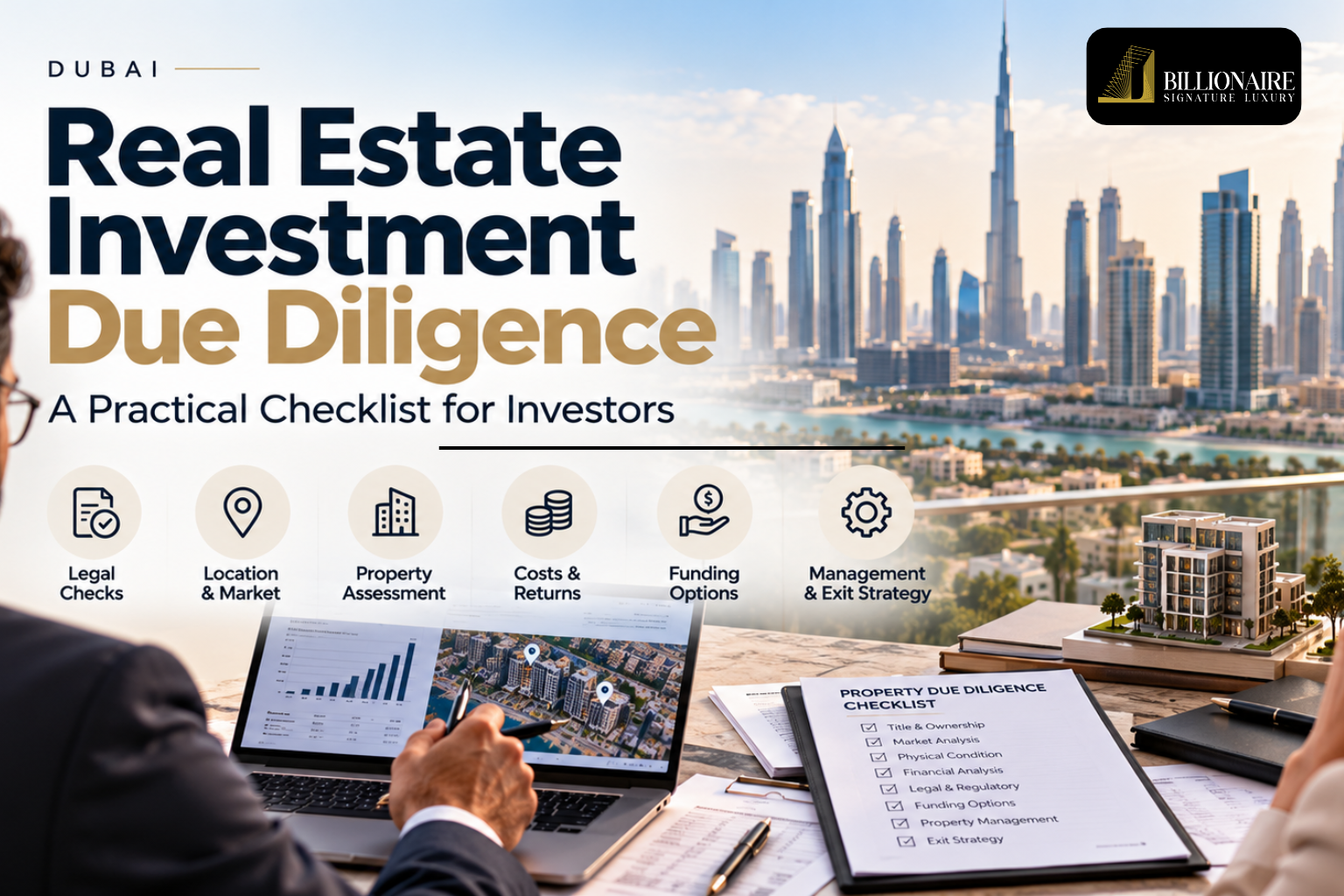
Dubai continues to attract property investors, developers, family offices and international buyers looking for residential, commercial and income-generating real estate opportunities. However, choosing the right asset requires more than comparing asking prices or projected returns.
Real estate investment due diligence in Dubai helps investors understand what they are buying, what the property may cost to operate, how the investment will be funded and which risks could affect its long-term performance.
Whether you are evaluating a commercial building, a warehouse, a hotel asset or a development plot, a structured review can help you make a more informed investment decision.
This guide outlines the essential checks investors should consider before committing capital to Dubai real estate.
Why Is Due Diligence Important for Real Estate Investment in Dubai?
A property can look attractive on paper but perform differently once acquisition costs, financing, maintenance, vacancy and other operating expenses are considered.
Due diligence helps investors assess the asset beyond its headline price. It also supports better decisions about negotiations, financing, future management and exit planning.
For investors considering high-value property transactions in Dubai, the review should cover six core areas:
- Legal ownership and documentation
- Location and market demand
- Property condition and permitted use
- Rental income and operating costs
- Financing and cash-flow requirements
- Exit strategy and long-term asset value
The level of investigation should reflect the property type, transaction value and intended use. A leased warehouse, a luxury hotel and a residential investment property will each require a different assessment.
1. Verify Ownership and Property Documentation
The first step is to confirm that the seller has the legal authority to transfer the property and that the relevant documentation is consistent.
Depending on the transaction, investors may need to review:
- Title deed and ownership records
- Property identification and registered details
- Existing mortgages, liens or other encumbrances
- Lease agreements and tenant obligations
- Outstanding service charges or other liabilities
- Relevant approvals, permits and transaction documents
Investors should verify applicable requirements with the relevant authorities and qualified legal professionals. Do not rely solely on marketing materials, verbal assurances or copies of documents that have not been independently checked.
The Dubai Land Department is an important starting point for official property-related services and information.
2. Research the Location and Local Market
Location influences tenant demand, accessibility, liquidity and the range of potential buyers at resale.
However, the best location depends on the asset’s purpose. A warehouse serving distribution operations has different location requirements from a luxury hotel or a premium residential property.
Before proceeding, assess:
- Access to major roads and transport links
- Proximity to relevant commercial districts and business hubs
- Existing and planned competing developments
- Demand from likely tenants, operators or end users
- Comparable transactions and rental evidence
- The potential supply of similar properties
Use the Dubai Land Department’s Real Estate Data portal to investigate available transaction, rental, valuation, land and property information.
Compare similar assets in the same area wherever possible. A citywide average may not accurately represent a specific building, plot or property segment.
3. Assess the Property’s Physical Condition and Permitted Use
A property’s purchase price does not reveal its full condition or suitability for the intended investment.
A technical review may identify defects, upcoming capital expenditure or restrictions that affect the asset’s usefulness and value.
For commercial and industrial properties, examine:
- Structural condition and building systems
- Electrical capacity and other utility requirements
- Fire safety and relevant compliance documentation
- Loading access, circulation and parking
- Fit-out requirements and expected maintenance
- Permitted use and any required approvals
For warehouses, additional considerations may include loading bays, clear height, storage configuration, vehicle access and suitability for the intended logistics operation.
For hotel assets, the review may need to cover building condition, room inventory, facilities, refurbishment requirements and operating considerations.
For development land, confirm zoning, permitted development parameters, infrastructure access and the approvals required for the proposed project.
The aim is to establish whether the asset can support the intended use without unexpected costs or regulatory obstacles.
4. Calculate the Real Investment Cost and Potential Return
A sound investment assessment looks beyond the purchase price and projected rental income.
Prepare a complete cost estimate that includes, where applicable:
- Purchase price
- Transfer and registration costs
- Brokerage and professional fees
- Financing and arrangement costs
- Renovation or fit-out expenditure
- Service charges, insurance and maintenance
- Property management expenses
- Vacancy and tenant turnover allowances
- Expected capital expenditure
Next, assess the property’s income potential using realistic assumptions.
Example: Calculating rental yield
Consider a hypothetical commercial property with the following figures:
- Purchase price: AED 5,000,000
- Expected annual rental income: AED 400,000
- Estimated annual operating expenses: AED 80,000
Gross rental yield
Annual rental income ÷ Purchase price × 100
AED 400,000 ÷ AED 5,000,000 × 100 = 8%
Illustrative net operating yield
(Annual rental income − Operating expenses) ÷ Purchase price × 100
(AED 400,000 − AED 80,000) ÷ AED 5,000,000 × 100 = 6.4%
These figures are illustrative, not a market forecast. They exclude acquisition costs, financing costs, taxes where applicable, and other potential expenses. The actual result will depend on verified income and the full cost structure.
Investors can also use BSL’s ROI and yield calculator as a starting point for evaluating property returns. Validate the inputs before relying on the result.
5. Review Funding Options Before Making an Offer
Financing can affect both the affordability and the risk profile of a real estate investment.
Before committing, calculate the equity required, expected financing costs, repayment schedule and liquidity available after the acquisition. Consider what happens if the transaction takes longer than expected or the property generates less income than forecast.
Depending on the transaction, investors may explore conventional financing, acquisition funding, development capital or short-term bridge funding.
BSL Group UAE offers private funding support for selected real estate acquisitions, development requirements, bridge capital and other project-stage needs.
A funding discussion should consider the asset, documentation, purpose of the funds, timeline and repayment plan. Availability, eligibility, pricing and terms are subject to assessment and agreement.
Investors should also review the relevant licensing and transaction requirements. The Dubai Land Department’s real estate licensing information explains the categories of real estate activities covered by its licensing service.
6. Match the Due Diligence Process to the Asset Type
Different property categories create different investment considerations. A tailored review is more useful than applying the same checklist to every opportunity.
Commercial and industrial property
Assess tenant demand, lease terms, building suitability, access, maintenance liabilities and the potential for future leasing. For warehouse investments, operational requirements can be as important as the location itself.
Explore BSL’s Warehouse and 3PL opportunities for industrial and logistics-related real estate requirements.
Hotel and hospitality assets
Review the property’s physical condition, operating model, occupancy and revenue information where available, refurbishment needs and potential positioning. Understand the distinction between owning a property and investing in a hospitality business.
BSL’s hotel asset opportunities cover selected hotel and hospitality assets for buyers, sellers and investors.
Residential and premium real estate
Evaluate comparable sales, rental demand, ongoing ownership costs, building quality, service charges and the likely resale audience. For premium assets, consider how location, property condition and buyer profile may affect liquidity.
Development land and joint ventures
Confirm ownership, permitted use, infrastructure availability, development feasibility, capital requirements, partner responsibilities and the proposed exit structure.
Investors evaluating complex or high-value opportunities may benefit from BSL’s Private Office Advisory, which supports selected off-market opportunities, asset evaluation, investment structuring and transaction planning.
7. Understand the Ongoing Property Management Requirements
Due diligence should not end when the purchase is completed.
Investors need a practical plan for maintaining the property, handling tenants, managing expenses and protecting the asset’s condition over time.
Consider the following questions:
- Who will oversee maintenance and repairs?
- How will tenants and lease renewals be managed?
- What reporting will be available to the owner?
- Which recurring costs could increase over time?
- What capital expenditure may be needed in the next few years?
- How will performance be reviewed against the investment plan?
For investors who require ongoing oversight, BSL provides property management services. The appropriate management arrangement will depend on the property, ownership structure and services agreed.
Factoring management into the original investment analysis can provide a more realistic picture of the asset’s long-term economics.
8. Prepare an Exit Strategy Before Investing
An investment should have a clear rationale for both acquisition and eventual exit.
Depending on the asset and market conditions, an investor may plan to hold for rental income, sell after improving the property, refinance, reposition the asset or pursue a development exit.
Before purchasing, consider:
- The likely future buyer or tenant profile
- Potential resale demand and transaction costs
- The impact of vacancy or falling rental income
- Planned refurbishment and capital expenditure
- Financing maturity and repayment obligations
- Conditions that would justify holding, selling or refinancing
No exit strategy can eliminate market risk. However, defining the assumptions and decision points in advance can help investors respond more systematically when circumstances change.
How BSL Group UAE Supports Real Estate Investors
BSL Group UAE positions itself as a private real estate advisory platform for investors, entrepreneurs, family offices and developers seeking selected property opportunities and long-term value creation.
Its service areas can support different stages of the investment process:
- Private Office Advisory: For selected high-value opportunities, off-market access and investment structuring.
- Private Funding: For eligible acquisition, development and bridge funding requirements.
- Warehouse and 3PL Opportunities: For industrial, warehousing and logistics-related property requirements.
- Hotel Asset Opportunities: For selected hospitality property acquisitions, sales and strategic opportunities.
- Property Management: For ongoing property oversight, subject to the agreed service scope.
- ROI and Yield Calculator: For preliminary analysis of investment assumptions.
Explore the BSL Group UAE services overview to understand its broader real estate offering.
For a complex acquisition, the objective is to connect the property’s commercial fundamentals with its funding requirements, management plan and long-term investment strategy.
Final Checklist Before Investing in Dubai Real Estate
Before moving forward with a property transaction, confirm that you have:
- Verified the ownership and relevant legal documentation.
- Reviewed local market evidence and comparable assets.
- Checked the property’s condition and permitted use.
- Estimated the complete acquisition and operating costs.
- Tested rental, vacancy and financing assumptions.
- Evaluated the funding structure and repayment capacity.
- Planned ongoing property management.
- Defined a realistic exit strategy.
- Obtained independent legal, technical and financial advice where needed.
The right due diligence process depends on the asset, the investor’s objectives and the transaction structure. A disciplined review can help identify issues early, improve negotiations and support more informed decisions.
Considering a real estate investment in Dubai? Contact BSL Group UAE to discuss your property requirements, funding considerations or selected investment opportunities.
Disclaimer: This article is for general informational purposes only and does not constitute legal, tax, financing or investment advice. Property investments involve risk, and returns are not guaranteed. Verify transaction details with relevant authorities and qualified independent advisers before making an investment decision.
Frequently Asked Questions
What is real estate investment due diligence in Dubai?
It is the process of reviewing a property’s legal documentation, physical condition, location, income potential, costs, financing and risks before completing an investment.
How can I check property transaction data in Dubai?
The Dubai Land Department provides a Real Estate Data portal with available transaction, rental, valuation and property information. The relevance of the data depends on the property and filters selected.
What should I check before buying commercial property in Dubai?
Review ownership, permitted use, building condition, tenant agreements, comparable market evidence, operating costs, expected capital expenditure, financing and resale prospects.
How do I calculate rental yield for a Dubai property?
Gross rental yield is annual rental income divided by the purchase price, multiplied by 100. Net yield should account for relevant operating expenses. Financing, acquisition costs and other exclusions should be considered separately.
Can I explore private funding for a Dubai property investment?
BSL Group UAE offers private funding support for selected real estate acquisitions, development requirements and bridge funding needs. Any funding proposal is subject to assessment, eligibility, terms and agreement.
Why should property management be considered before purchasing?
Management costs, maintenance, tenant turnover and recurring expenses can affect net income and the long-term condition of an asset. Including these factors in the initial assessment gives investors a more realistic view of potential performance.