
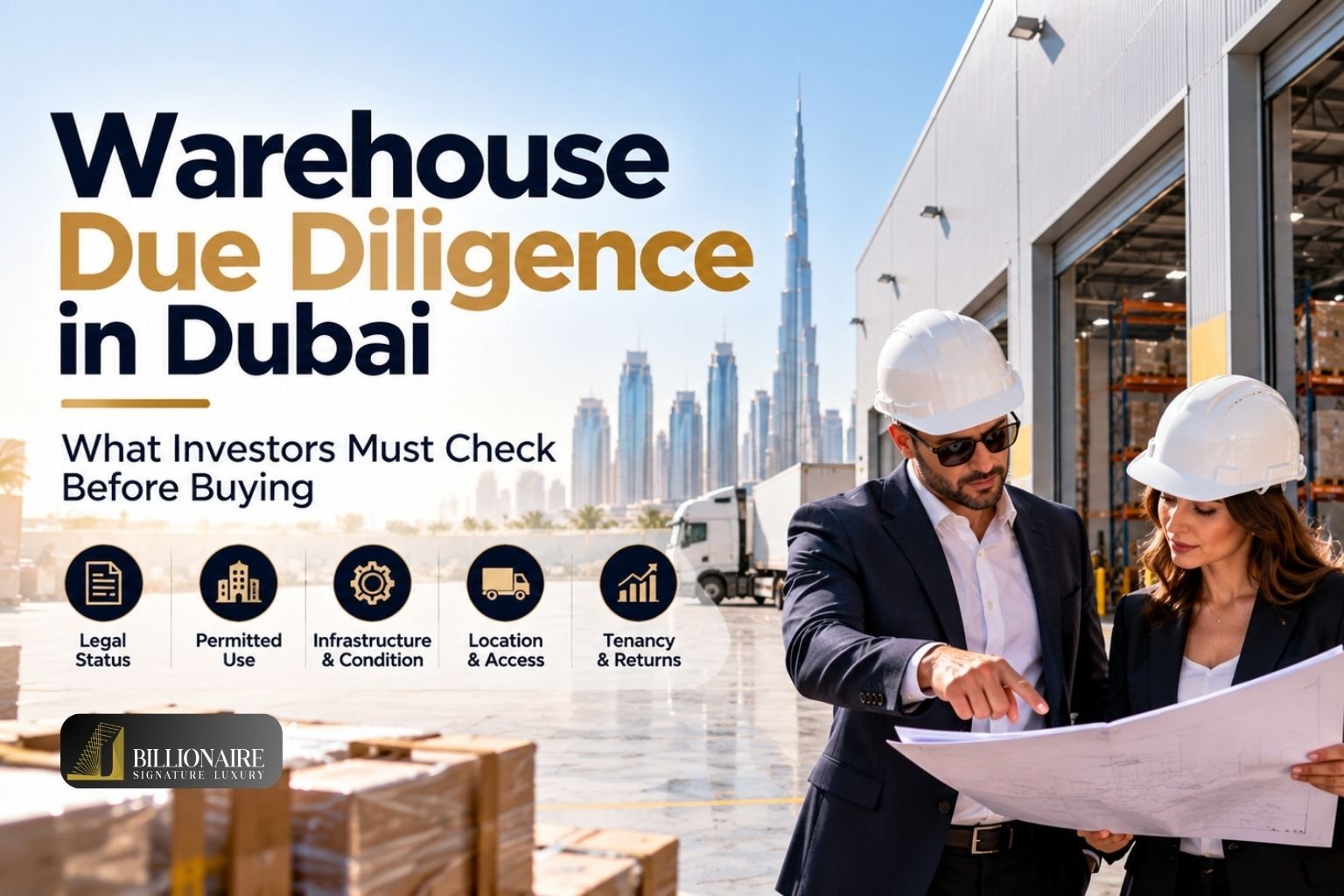
Buying a warehouse in Dubai involves more than comparing asking prices, floor areas and projected rental yields. The property’s permitted use, technical condition, access, infrastructure, tenancy and legal status can all affect its investment value.
For investors, developers and logistics operators, warehouse due diligence in Dubai is the process of checking whether a property is legally suitable, physically fit for its intended use and financially viable before committing capital.
The need for careful assessment is becoming more important as Dubai’s industrial and logistics market evolves. Knight Frank reported 12.3 million sq ft of new industrial and logistics requirements in Dubai during H1 2026, while also noting that demand and rental performance increasingly vary by location and asset quality. This makes property-specific evaluation more useful than relying on broad market trends alone. Read Knight Frank’s UAE Industrial and Logistics Market Review.
Whether you are considering a warehouse for rental income, distribution, manufacturing or long-term asset ownership, the following checks can help identify risks before a transaction proceeds.
1. Verify Ownership, Title and Property Rights
Legal due diligence should begin before detailed financial projections or negotiations create a false sense of certainty.
Confirm exactly what the seller is offering. Depending on the property and ownership structure, the transaction may involve a freehold interest, a leasehold interest or another form of property right. Do not assume that purchasing a warehouse automatically means acquiring the underlying land.
Review the relevant documents to establish:
- The registered owner and property identification details.
- The nature and duration of the ownership or land rights.
- Existing mortgages, registered security interests or other encumbrances.
- Any restrictions on transfer, leasing, modification or permitted use.
- Outstanding obligations, disputes or other matters that could affect the transaction.
Where applicable, verify the relevant property records through the Dubai Land Department and obtain independent legal advice.
Why it matters: An attractive warehouse can become a poor investment if the buyer misunderstands the rights being acquired or discovers restrictions after committing funds.
2. Confirm That the Intended Activity Is Permitted
A warehouse that works for one business may be unsuitable for another.
General storage, food distribution, cold storage, light manufacturing and specialised industrial operations can have different technical, licensing and safety requirements. The property’s existing use should not be treated as proof that every proposed activity is permitted.
Before proceeding, establish:
- The property’s designated and approved use.
- The competent authority responsible for the location.
- Whether the intended business activity can be licensed at that site.
- Whether additional approvals are required for machinery, storage systems or building modifications.
- Whether the existing layout and alterations match the approved documentation.
Requirements may differ between mainland industrial areas and free zones. Confirm the exact requirements with the relevant authority rather than relying solely on a broker’s description or the name of the industrial district.
For investors, this check can prevent the costly mistake of acquiring a property that cannot support its intended tenant or business.
3. Inspect the Warehouse’s Physical Condition
A warehouse is an operational asset. Its roof, structure, floor, drainage and building services can influence both future expenditure and the property’s attractiveness to tenants.
A qualified technical inspection should assess the building’s condition and identify defects that could require repair or replacement.
| Area to inspect | What to establish |
|---|---|
| Roof and waterproofing | Leaks, deterioration, drainage and repair history |
| Structural condition | Visible damage, movement, cracking and other concerns requiring specialist assessment |
| Floor slab | Condition, levelness, cracking and suitability for the intended loading |
| Electrical systems | Existing capacity, equipment condition and upgrade feasibility |
| Plumbing and drainage | Leaks, blockages and suitability for the proposed activity |
| Ventilation and cooling | Existing performance and requirements for the intended operation |
| Fire and life safety | Applicable approvals, system condition and maintenance records |
| External areas | Yard condition, drainage, vehicle circulation and loading access |
A visual inspection alone may not be sufficient. Depending on the building, further structural, electrical, mechanical or fire-safety assessments may be necessary.
The objective is to understand the likely cost of making the warehouse operationally suitable, not merely to establish whether it looks well maintained.
4. Check Clear Height, Floor Loading and Storage Capacity
For logistics operators and industrial occupiers, usable capacity can matter more than the advertised floor area.
Clear height
Check the actual clear height below beams, lighting, sprinklers and other obstructions. The highest point of the roof does not necessarily represent the usable height available for racking.
A warehouse intended for high-rack storage or automated systems may require a different specification from a property used for basic storage.
Floor loading
Obtain reliable information about the floor slab’s load capacity and confirm whether it can accommodate the intended racks, machinery, forklifts and stored goods.
Do not infer structural capacity from the warehouse’s age or appearance. Engineering verification may be necessary.
Loading bays and vehicle access
Inspect the dimensions and number of loading doors, dock arrangements, ramps, turning areas and truck access.
Consider the vehicles that will actually use the facility. A site may appear close to a major road on a map but still create operational difficulties because of its entrance, yard layout or approach route.
Power and specialist infrastructure
Manufacturing, refrigeration and automated logistics can require significant electrical capacity. Confirm the existing supply, potential upgrade requirements, estimated cost and lead time.
For cold storage, also assess refrigeration systems, insulation, temperature control, backup arrangements and the consequences of equipment failure.
These specifications should be checked against the intended operation before the buyer assumes the warehouse is ready for immediate use.
5. Review Fire Safety and Regulatory Compliance
Fire-safety requirements can materially affect whether a warehouse can operate as intended.
The appropriate review depends on the property, its use, the goods stored, the racking arrangement and the relevant authority requirements.
Check the applicable documentation and inspect relevant systems, including:
- Fire alarms and detection equipment.
- Sprinklers, hydrants and other required firefighting systems.
- Emergency exits, escape routes and emergency lighting.
- Fire pumps and associated equipment, where applicable.
- Maintenance, inspection and approval records.
- Any changes to the building layout or storage configuration that may affect compliance.
A previous approval does not automatically establish that the current layout or proposed activity complies with all applicable requirements.
Use qualified specialists to verify the property’s actual position and identify any outstanding work. Include the cost and timing of necessary remedial measures in the acquisition assessment.
6. Assess Location and Logistics Connectivity
Location affects more than rental price. It can influence delivery schedules, labour access, transport costs and the range of businesses willing to occupy the property.
Dubai’s industrial and logistics market includes established and emerging industrial areas, each with different access conditions, property specifications and cost considerations.
Evaluate the warehouse against the actual requirements of the intended tenant or operation.
Consider:
- Access to major roads and relevant transport corridors.
- Travel times to suppliers, customers, ports or airports where relevant.
- Truck entry, exit and manoeuvring conditions.
- Availability of labour and supporting services.
- Distance from the business’s distribution network.
- The practical suitability of the location for the intended operating hours.
Do not choose a location solely because it is associated with strong rental growth. A lower-cost property in the wrong location can create higher operating costs or a narrower tenant pool.
Knight Frank’s 2026 review highlights the increasing variation in rental performance across Dubai’s industrial submarkets. This reinforces the need to assess the specific property rather than assume that all warehouses benefit equally from market demand.
7. Examine the Tenant and Lease Agreement
For a tenanted warehouse, the quality of the income stream is just as important as the condition of the building.
A property with a tenant is not automatically a low-risk investment. The lease may contain obligations, restrictions or renewal conditions that materially affect the owner’s returns.
Review the following:
Lease term and renewal: Establish the remaining term, renewal provisions, rent-review mechanism and any break rights.
Rental evidence: Verify the agreed rent, payment history, outstanding amounts and any incentives or concessions.
Repair obligations: Understand which party is responsible for routine maintenance, major repairs, equipment replacement and reinstatement.
Permitted activity: Confirm that the tenant’s activity is consistent with the property’s permitted use and applicable approvals.
Security and guarantees: Review deposits, guarantees and other protections, where applicable.
Vacancy exposure: If the tenant leaves, estimate how long it could take to secure a replacement and what work may be needed before reletting.
For a vacant warehouse, assess realistic market demand and the likely costs of preparing the property for occupation. Avoid assuming that the advertised rental rate will be achieved immediately.
8. Calculate the True Investment Cost and Net Return
The purchase price is only one part of the financial commitment.
A warehouse may require repairs, technical upgrades, professional fees, insurance, maintenance and leasing expenditure before it generates the expected income.
Before proceeding, prepare a complete acquisition and operating budget.
Include, as applicable:
- Purchase price and transaction-related expenses.
- Legal, valuation and technical due-diligence fees.
- Financing charges and related costs.
- Immediate repairs and compliance upgrades.
- Insurance and recurring property expenses.
- Maintenance and future capital expenditure.
- Vacancy, leasing commissions and tenant incentives.
- Management costs and other owner obligations.
Then estimate net income rather than relying only on the advertised rent.
Illustrative example
Assume a warehouse is offered for AED 8 million and the expected annual rental income is AED 640,000.

However, suppose annual operating expenses and a provision for maintenance total AED 100,000. Before financing costs, transaction expenses, taxes where applicable and other unbudgeted items, the remaining annual income would be AED 540,000.
Using the same purchase price, that represents a simplified net operating yield of 6.75%.
These figures are hypothetical and are not a market estimate or an investment recommendation. The example demonstrates why investors should calculate income after realistic property expenses and verify all assumptions for the individual asset.
A proper financial model should also test lower rents, a longer vacancy period, unexpected repairs and changes in financing costs.
9. Investigate Hidden Capital Expenditure
Some of the most expensive issues are not immediately visible during a routine viewing.
Deferred maintenance, outdated building services, water ingress, non-compliant modifications and insufficient electrical capacity may require substantial expenditure after completion.
A technical due-diligence report should distinguish between:
- Immediate repairs required before occupation.
- Work required to meet the intended operational specification.
- Compliance-related remedial work.
- Improvements that may be commercially desirable but are not immediately essential.
- Future replacement costs for major building systems.
Where possible, obtain estimates from qualified contractors or technical consultants rather than relying on informal allowances.
Research from RLB’s regional industrial real estate guidance highlights risks including fire-safety deficiencies, inadequate floor specifications, roof defects and ageing mechanical, electrical and plumbing systems. These are examples of issues that can materially affect an industrial asset’s cost and operational readiness.
Read more: RLB’s guidance on technical due diligence for industrial real estate.
10. Build a Warehouse Due-Diligence Checklist Before Making an Offer
Before paying a non-refundable deposit or committing to an acquisition, organise the review into clear workstreams.
| Workstream | Evidence to obtain |
|---|---|
| Legal | Ownership records, property rights, encumbrances and relevant agreements |
| Permitted use | Approved use, intended-activity compatibility and required licences |
| Technical | Inspection report, structural condition and major defects |
| Infrastructure | Electrical capacity, floor loading, clear height and loading access |
| Compliance | Applicable fire-safety approvals and other required records |
| Commercial | Comparable rental evidence, tenant demand and realistic vacancy assumptions |
| Financial | Total acquisition cost, operating expenses and sensitivity analysis |
| Tenancy | Lease terms, payment history, repair obligations and renewal conditions |
| Exit strategy | Likely future buyers or tenants, resale constraints and marketability |
The checklist should be adapted to the property and intended use. A cold-storage facility, a manufacturing warehouse and a standard distribution unit will not require identical assessments.
The purchase agreement should also be reviewed by qualified legal advisers to establish appropriate due-diligence conditions, deadlines and deposit protections.
Why Warehouse Due Diligence Matters in Dubai’s Current Market
Dubai’s industrial and logistics sector continues to attract attention from manufacturers, distribution businesses and investors. However, demand at the market level does not guarantee that an individual warehouse is appropriately priced, compliant or suitable for its intended use.
Knight Frank’s H1 2026 review recorded 12.3 million sq ft of new industrial and logistics requirements in Dubai. It also reported that rental performance varied by submarket and asset quality, while newly completed stock was giving occupiers more choice.
For buyers, this creates a reason to be selective. The key questions are not simply whether industrial property is in demand, but whether the specific asset can attract the intended occupier, meet operational requirements and generate an acceptable return after costs.
A well-located, compliant warehouse with appropriate infrastructure may be better positioned than a cheaper property that requires substantial upgrades or has a restricted range of possible uses.
How BSL Group UAE Can Help Identify Suitable Warehouse Opportunities
BSL Group UAE supports clients exploring warehouse and third-party logistics opportunities as part of its wider real estate and private investment offering.
For investors evaluating an industrial asset, the initial assessment should establish the intended use, preferred location, required specifications, budget and investment objectives.
This helps narrow the search towards properties that are more relevant to the buyer’s requirements.
Depending on the engagement, the evaluation process may involve considering:
- The suitability of the location for the intended operation.
- The warehouse’s physical specifications and infrastructure requirements.
- The property’s ownership and available documentation.
- The likely acquisition and improvement costs.
- The potential tenant profile and rental-income assumptions.
- The information that requires independent legal, technical or financial verification.
Specialist inspections and formal approvals should be obtained from appropriately qualified professionals and relevant authorities. Property suitability, rental performance and investment outcomes cannot be guaranteed.
To explore relevant opportunities, visit BSL Group UAE’s Warehouse & 3PL service.
Final Thoughts
Warehouse due diligence in Dubai should establish whether a property is legally suitable, technically fit for purpose and financially viable before an investor commits capital.
The most important checks cover ownership, permitted use, building condition, power capacity, storage specifications, fire safety, logistics access, tenancy and total ownership cost.
These factors should be assessed together. A warehouse with attractive headline pricing may become expensive if it needs major upgrades, while a more expensive asset may offer better value if it is operationally suitable and supported by reliable income.
For investors, the objective is straightforward: understand the property, quantify the risks and make the decision using verified evidence rather than assumptions.
Considering a warehouse or logistics property in Dubai? Contact BSL Group UAE to discuss your requirements and explore relevant opportunities.
Explore Warehouse & 3PL Opportunities
Frequently Asked Questions
What is warehouse due diligence in Dubai?
Warehouse due diligence is the process of reviewing a warehouse’s legal status, permitted use, physical condition, infrastructure, compliance, tenancy and financial performance before purchase or investment.
What documents should I check before buying a warehouse in Dubai?
The relevant documents may include ownership or property-right records, approved plans, use and licensing information, applicable safety approvals, utility details, lease agreements, maintenance records and statements of outstanding obligations. The exact requirements depend on the asset and transaction.
Why is permitted use important when buying a warehouse?
The approved use and applicable licensing requirements determine which activities may be carried out at a property. A warehouse suitable for ordinary storage may not automatically be suitable for manufacturing, cold storage or specialised goods.
What technical checks matter most for a warehouse?
Key checks include roof and structural condition, floor loading, clear height, electrical capacity, loading bays, truck access, drainage, ventilation and applicable fire-safety systems. Qualified specialists should assess the requirements for the intended operation.
How do I calculate warehouse investment yield?
Start with annual rental income and calculate gross yield against the relevant acquisition price. For a more useful investment assessment, subtract realistic operating expenses and account for vacancy, maintenance, capital expenditure, financing and transaction costs.
Is a tenanted warehouse always a better investment?
No. A tenant can provide income, but the investment also depends on the tenant’s financial reliability, lease terms, permitted activity, property condition and the owner’s obligations. A tenanted asset still requires legal, technical and financial due diligence.
How can BSL Group UAE help with warehouse investments?
BSL Group UAE offers warehouse and 3PL-related opportunities. Investors can discuss their preferred location, property requirements, intended use and investment objectives to explore relevant options. Independent due diligence remains essential before completing a transaction.