Dubai’s off-plan property market has become exceptionally good at selling one thing:
Flexibility.
40/60.
60/40.
80/20.
Post-handover plans.
Low initial deposits.
For investors, payment plans are attractive because they reduce the amount of capital required upfront.
But in Dubai’s 2026 property market, there is a more important question emerging:
Who is actually going to deliver the property, and when?
That question matters because Dubai is entering a much larger delivery cycle.
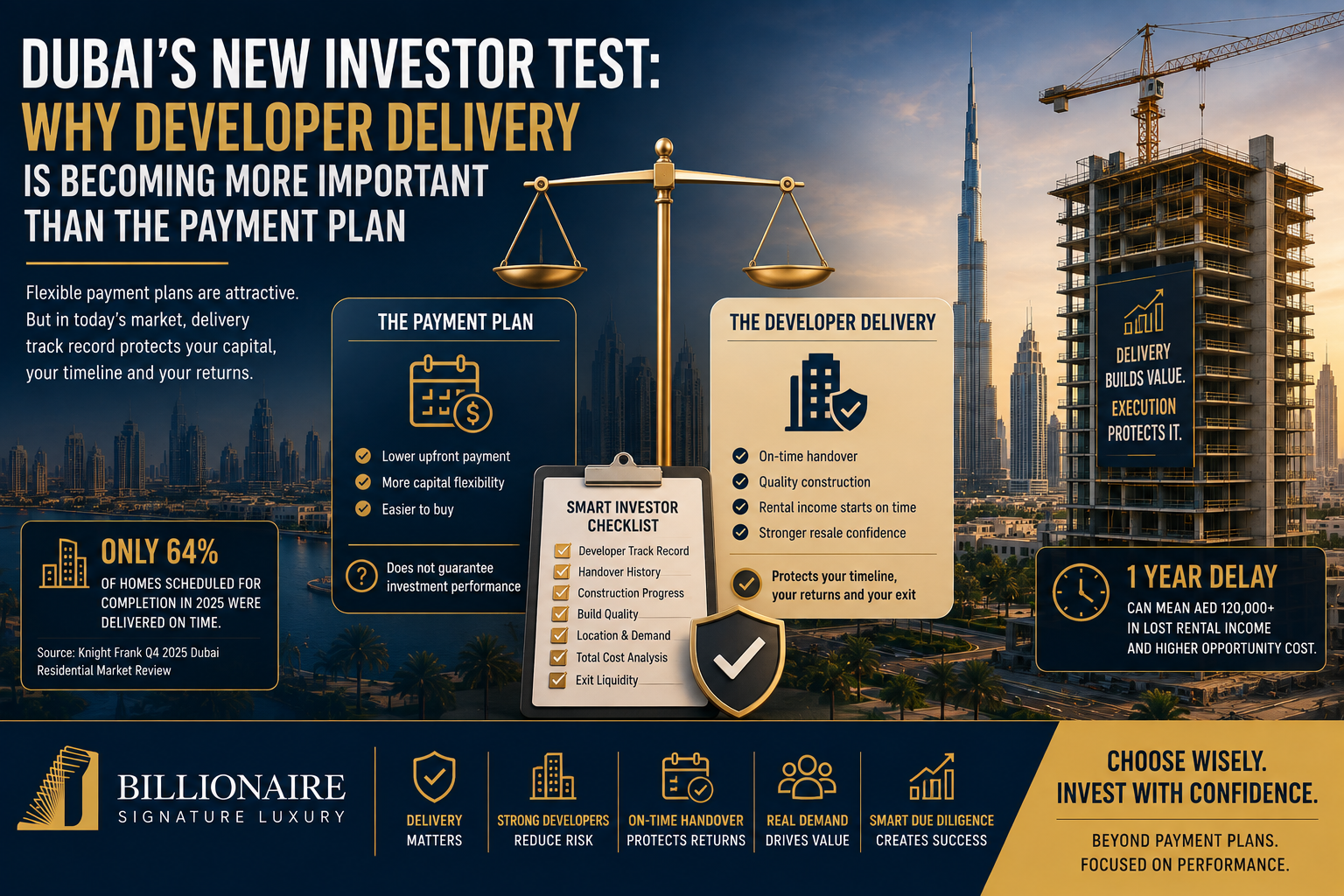
Knight Frank’s Q1 2026 research identified more than 160,000 residential units in the registered development pipeline, with the actual completion rate expected to be considerably lower than the headline number. The consultancy reported that only 64% of homes scheduled for completion in 2025 were delivered on time, following 50% in 2024.
At the same time, off-plan sales remain a major part of Dubai’s property market.
This creates a new test for investors.
A developer offering a better payment plan is not necessarily offering a better investment.
In many cases, delivery track record may matter more than whether you pay 40% or 60% before handover.
The Payment Plan Is Not the Investment
Imagine two developers offering similar apartments for AED 2 million.
Developer A offers:
20% during construction + 80% on handover
Developer B offers:
60% during construction + 40% on handover
At first glance, Developer A looks more attractive.
You keep more of your capital available for longer.
But now imagine Developer A delivers 12 months late.
Your capital remains tied up.
Your rental income starts later.
Your exit timeline moves.
Your financing assumptions may change.
And if the market has moved sideways during that period, the attractive payment plan may suddenly look much less attractive.
Developer B, meanwhile, delivers on time and the property enters the rental market exactly when expected.
The lesson is simple:
A payment plan manages cash flow. It does not guarantee investment performance.
Delivery determines when the asset becomes real.
Dubai Is Entering a Major Delivery Cycle
The importance of developer execution is increasing because the volume of properties moving through the construction and handover pipeline is substantial.
Knight Frank’s Q1 2026 research shows that some of Dubai’s largest developers have very significant future pipelines. Emaar had approximately 55,025 units in its tracked pipeline, followed by DAMAC with 49,019, Binghatti with 40,560 and Azizi with 40,778.
At the community level, the pipeline is also concentrated.
Knight Frank identified substantial future supply in areas including:
- Jumeirah Village Circle
- Business Bay
- Meydan City
- Dubai Hills Estate
- Damac Lagoons
- Dubai Islands
- Dubailand
- Dubai Investment Park
JVC alone had more than 35,000 units in the tracked pipeline, while Business Bay had nearly 24,000.
That creates an important distinction.
The question is no longer simply:
“Is this developer selling a good project?”
It is:
“Can this developer deliver this project, in this location, at the promised standard and within the expected timeframe?”
The Delivery Gap Is the Real Risk
Dubai’s development pipeline looks enormous when viewed through announced units.
But announced supply and delivered supply are very different things.
Knight Frank’s data demonstrates this clearly.
Only 64% of homes scheduled for completion in 2025 were delivered on time, compared with 50% in 2024. Earlier research also showed significant delays between promised and actual completion dates across the market.
That means investors should not automatically assume that a project advertised for handover in 2028 will actually become an income-producing asset in 2028.
It might.
But that assumption needs to be tested against the developer’s history.
And this is where the developer becomes more important than the brochure.
What Developer Track Record Actually Tells You
A developer’s history can reveal several things that a payment plan cannot.
1. Construction discipline
Does the developer consistently meet construction milestones?
2. Handover reliability
How often are projects completed around their original contractual completion dates?
3. Build quality
Does the finished property resemble the original specifications and expectations?
4. Post-handover management
What happens after buyers receive the keys?
5. Resale reputation
Do completed properties from the developer maintain strong demand in the secondary market?
These factors affect the investment long after the sales agent has finished discussing the payment plan.
The Handover Moment Changes Everything
Before handover, an off-plan property is largely an expectation.
After handover, it becomes an operating asset.
That transition changes the economics.
Before completion, investors are primarily thinking about:
Entry price + payment schedule + expected appreciation.
After completion, the questions become:
Rent + service charges + vacancy + maintenance + resale value.
That is why delivery is such an important investment milestone.
If the developer delays the project, the investor remains in the first category for longer.
If the developer delivers efficiently, the investor can move into the second category sooner.
For a rental investor, that difference can be substantial.
A One-Year Delay Is More Expensive Than It Looks
Consider a hypothetical AED 2 million apartment expected to generate AED 120,000 in annual rent.
A 12-month delay does not simply mean waiting another year to receive the keys.
It can mean approximately AED 120,000 of gross rental income that never arrives during the original investment period.
There may also be:
- Financing costs
- Opportunity costs
- Changes in market rents
- Changes in service charges
- Delayed resale opportunities
- Portfolio allocation problems
And if the investor intended to sell the property after three years, a one-year construction delay could reduce the effective holding period after handover.
This is why time is part of the return calculation.
A property delivering in 2027 and a similar property delivering in 2028 are not necessarily equivalent investments, even if their purchase prices and payment plans look similar.
Why Escrow Does Not Solve the Delivery Problem
Dubai’s regulatory framework provides important protections for off-plan buyers, including project escrow arrangements.
But investors should understand what those protections actually do.
They help protect buyer funds within the regulated development framework.
They do not magically eliminate:
- Construction delays
- Market risk
- Rental risk
- Resale risk
- Opportunity cost
- Developer execution problems
In other words:
Financial protection and delivery certainty are not the same thing.
That is why developer due diligence remains necessary even when a project has the appropriate regulatory structure.
The Best Payment Plan Can Still Be the Wrong Deal
This is becoming one of the biggest traps for inexperienced investors.
A developer presents an attractive structure:
10% booking
40% during construction
50% post-handover
The investor thinks:
“I only need to commit 50% before I get the property.”
But the correct question is:
Why is the developer offering this structure?
Sometimes the answer is perfectly legitimate.
Developers use payment plans to attract buyers, improve sales velocity and spread construction funding.
But investors should still compare the total economics.
A payment plan can look generous while the underlying property is overpriced relative to comparable completed stock.
For example, an apartment priced at AED 2.2 million with an attractive payment plan may not be better value than a completed comparable property available for AED 2 million.
The payment structure does not compensate for paying too much.
The Developer-Community Combination Matters
A strong developer cannot compensate for every weak location.
And a strong location cannot compensate for every weak developer.
The best investment opportunities usually sit where the two overlap.
Consider a developer with a strong delivery history launching a project in a community with:
- Growing population
- Strong rental demand
- Limited competing completed stock
- Improving infrastructure
- Good transport access
- Strong resale liquidity
That combination is much more compelling than simply finding the longest payment plan.
This is particularly important as Dubai’s supply pipeline becomes increasingly concentrated in specific communities.
Investors need to understand not just how much a developer is building, but where it is building it and what else is being delivered nearby.
Why Handover Competition Could Become a Bigger Issue
The risk is not only that your developer delivers late.
It is also that everyone else delivers at the same time.
Imagine buying an apartment in a community where 3,000 similar units are scheduled for handover within the same 12-month period.
Your developer delivers successfully.
That sounds positive.
But suddenly thousands of owners may be trying to:
- Rent their properties
- Sell their properties
- Furnish them
- Attract tenants
- Compete with one another
That can affect rental growth and resale liquidity.
This is why developer delivery must be analysed alongside community-level supply.
Knight Frank’s research highlights significant future pipelines in several Dubai communities, reinforcing the importance of understanding what competing inventory will exist when a property is handed over.
The Developer Test Every Investor Should Apply
Before signing an SPA for an off-plan property, investors should evaluate at least seven areas.
1. Previous delivery record
How many projects has the developer actually completed?
Not announced.
Not launched.
Completed.
2. Delay history
Look at the original promised handover dates versus actual completion dates.
One delayed project does not automatically make a developer unreliable.
A repeated pattern is different.
3. Current construction progress
Do not rely exclusively on the sales team’s verbal update.
Check the project’s official construction status and available regulatory information.
A project that is 5% complete with a handover date 18 months away should be evaluated differently from a project that is 80% complete with the same stated handover.
4. Escrow and project structure
Understand how the project is registered and how buyer payments are structured.
The payment mechanism matters, but it should be considered as one part of the due diligence process, not the entire process.
5. Completed projects
Visit the developer’s existing properties.
Look at:
- Finishing
- Common areas
- Elevators
- Parking
- Landscaping
- Amenities
- Building management
A developer’s completed work is often more informative than its latest launch brochure.
6. Service charges
A beautiful building with expensive service charges can produce a disappointing rental return.
Calculate the expected net yield, not just the advertised gross yield.
7. Exit liquidity
Ask:
Who will buy this property from me?
If the answer depends entirely on another investor believing prices will rise, the investment deserves additional scrutiny.
Why Bigger Developers Aren’t Automatically Better
There is an important nuance here.
The point is not:
“Always buy from the biggest developer.”
A large developer can still have projects that underperform.
A smaller developer can deliver an excellent project.
What matters is evidence.
Look for:
Track record + financial capacity + construction progress + project quality + location + demand.
The developer’s size is only one variable.
What About Post-Handover Payment Plans?
Post-handover payment plans deserve particular attention.
They can be useful because they reduce the amount of capital required before the property becomes operational.
But investors should not confuse them with a lower purchase price.
Suppose:
Property A: AED 2 million, 60/40 payment plan
Property B: AED 2.1 million, 40/60 post-handover plan
Property B may look easier to purchase.
But the investor is paying AED 100,000 more.
The correct comparison is therefore:
Total acquisition cost + financing/opportunity cost + expected rental income + expected appreciation.
Not simply:
How much do I pay before handover?
The 2026 Market Is Making This Test More Important
Dubai’s residential market remains strong, but the market is also maturing.
Knight Frank expects mainstream price growth to moderate towards the end of 2026, while prime markets are expected to remain more resilient. The consultancy has also highlighted the possibility of a two-speed market as supply increases.
That changes the risk profile of off-plan investing.
During a rapidly rising market, almost every new launch can appear successful because rising prices help cover mistakes.
In a more selective market, execution becomes more visible.
A delayed project cannot rely on market-wide price growth to solve every problem.
An average building cannot necessarily rely on rising prices to attract buyers.
A poor location cannot necessarily rely on speculation.
That is why developer quality becomes increasingly important as the cycle matures.
The New Investor Hierarchy
For years, many off-plan investors effectively used this hierarchy:
Payment plan → price → location → developer.
In 2026, the hierarchy should arguably be reversed.
A more robust approach is:
Developer → location → project → price → payment plan.
The payment plan should come near the end of the analysis.
Why?
Because it answers:
“How do I pay?”
It does not answer:
“Is this a good asset?”
What BSL Group UAE Looks For
At BSL Group UAE, the objective should be to evaluate the complete investment rather than simply identify the most attractive payment plan.
For an off-plan property, that means looking at:
Developer
Who is building it?
Delivery
Can they deliver it?
Location
Who will want to live there?
Supply
What else will compete with it?
Pricing
Is today’s price justified?
Rental
What could the property realistically earn?
Exit
Who will buy it later?
Payment plan
Does the payment structure improve the investment or simply make an expensive property easier to purchase?
This is especially important for international investors who may not be able to visit every project personally or compare completed developments across Dubai.
BSL’s off-plan Dubai property investment guide covers the broader considerations around developer selection, payment structures and exit strategy.
Our analysis of Dubai’s 2026 property handover wave also looks at why completed supply is becoming increasingly important for buyers.
And because developer delivery cannot be separated from community supply, our 2026 Dubai community investment map examines how different areas are responding to changing supply and demand.
The Bottom Line
A payment plan can make a property easier to buy.
A good developer makes it more likely that you will actually receive the asset you bought, when you expected to receive it.
That distinction is becoming increasingly important in Dubai.
With a large residential pipeline moving through construction, handover timing, project quality and developer execution are becoming central investment variables. Knight Frank’s data shows that the gap between scheduled and actual delivery can be significant.
For investors, the lesson is straightforward.
Don’t ask only:
“What payment plan are they offering?”
Ask:
“Who is the developer?”
“What have they delivered before?”
“Are they on schedule?”
“What will compete with my property at handover?”
“What will this property actually be worth and earn when it is completed?”
Only after answering those questions should the payment plan enter the conversation.
Because the cheapest way to buy a property is not necessarily the best way to invest in one.
In Dubai’s next phase, execution may be worth more than flexibility.
Frequently Asked Questions
Why is developer delivery important when buying off-plan property in Dubai?
Delivery determines when the buyer actually receives the asset and can begin using, renting or selling it. Delays can postpone rental income, alter investment timelines and increase opportunity costs.
Is a flexible payment plan a sign of a good Dubai property investment?
Not necessarily. A flexible payment plan can improve cash flow, but it does not prove that the property is fairly priced, the developer is reliable or the project will perform well after handover.
How can I check a Dubai developer’s track record?
Review the developer’s completed projects, previous handover performance, construction progress and reputation in the secondary market. Buyers should also verify project and regulatory information rather than relying solely on sales material.
Are off-plan properties still worth buying in Dubai in 2026?
They can be, particularly when the developer, location, pricing, supply outlook and payment structure all make sense. But as Dubai’s market matures and supply increases, developer selection and project-level due diligence are becoming more important.
What is more important: developer or payment plan?
For most off-plan investments, developer quality should come first. A payment plan determines how capital is deployed, while the developer influences construction, delivery, quality and ultimately the asset you receive.
Should I choose a large Dubai developer?
Not automatically. Large developers can offer strong delivery histories and established brands, but investors should still evaluate the specific project, location, pricing, construction progress and competing supply.
What should I check before signing an off-plan SPA?
Check the developer’s delivery history, project registration, escrow structure, construction progress, contractual handover provisions, service charges, payment schedule, expected rental demand, competing supply and potential exit market.