
For the past few years, Dubai property investors have been trained to watch one number: how many new projects are being launched.
In 2026, another number deserves just as much attention:
How many homes are actually being handed over?
That distinction is becoming important.
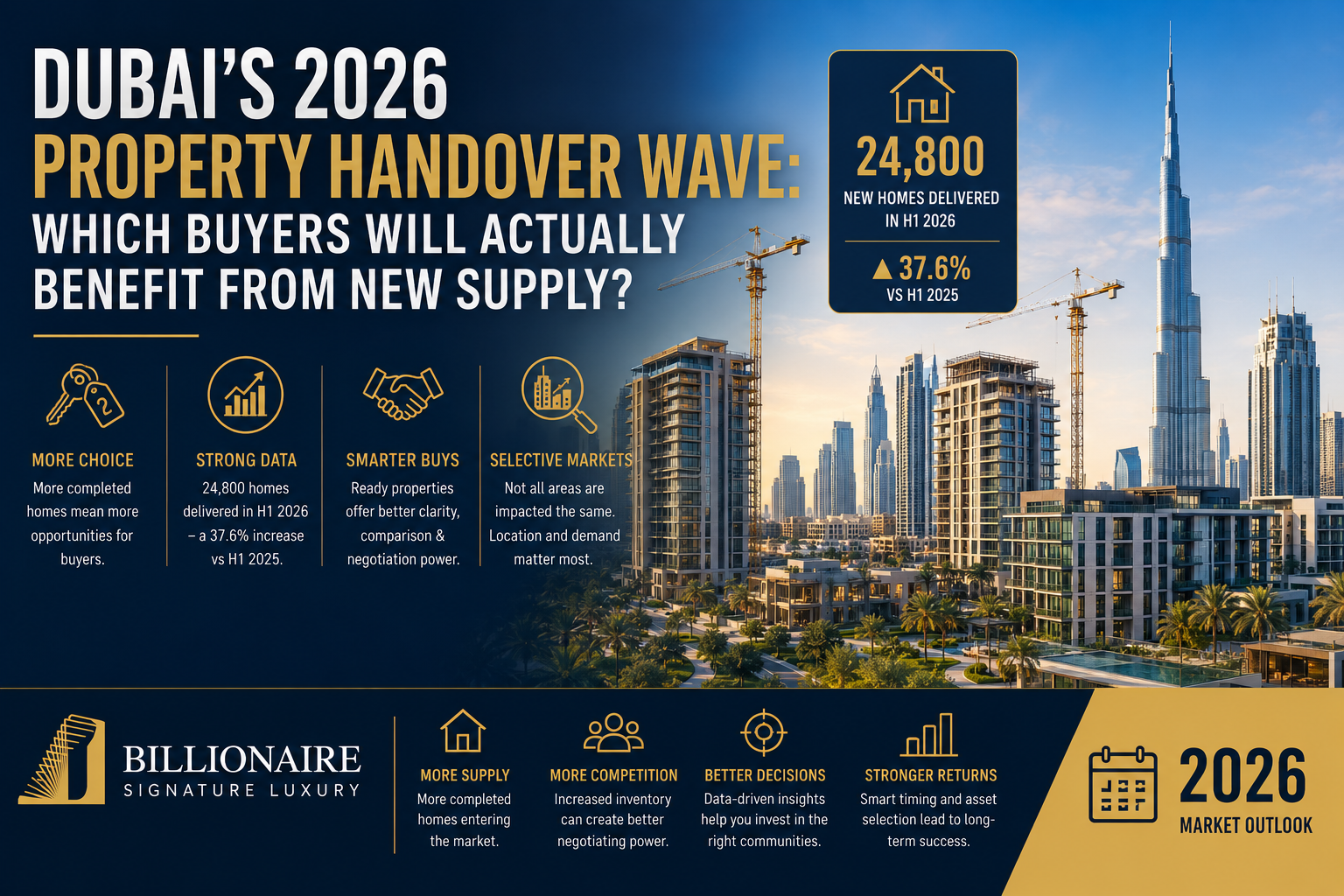
Dubai added around 24,800 new residential units during the first half of 2026, a 37.6% increase compared with H1 2025, according to Cavendish Maxwell data reported by Khaleej Times. Apartments accounted for approximately 18,900 of those deliveries, while villas and townhouses contributed around 5,900.
At the same time, developers dramatically reduced new launches during Q2. Around 27,300 homes were completed during the quarter, while only 5,335 new residential units were launched, compared with more than 45,000 in Q1.
That is a meaningful change.
Dubai is moving from a launch-driven market towards a delivery-driven market.
And that creates very different opportunities depending on whether you are buying a ready home, waiting for an off-plan handover, or investing for rental income.
The Supply Wave Is Real — But the Headline Numbers Need Context
There has been plenty of discussion about a potential oversupply in Dubai.
The concern is understandable.
Knight Frank’s earlier analysis of Dubai’s registered project pipeline indicated that more than 160,000 residential units could potentially enter the market during 2026. But the same research highlighted a critical point: actual completion rates have historically been much lower than the registered pipeline. In 2025, only 64% of scheduled homes were completed on time, compared with 50% in 2024.
Knight Frank’s Q1 2026 research subsequently estimated that around 95,649 units were likely to be completed on time, rather than the 144,888 previously forecast, based partly on construction progress. It also noted that 34% of units due in 2026 were still below 20% completion.
So investors need to separate three things:
Announced supply.
Scheduled supply.
Actual delivered supply.
Only the third changes the number of homes available to buyers and tenants immediately.
And that is exactly why the H1 2026 handover figure matters.
24,800 New Homes Have Already Entered the Market
The H1 delivery figure is significant because it represents completed homes rather than theoretical pipeline.
According to Cavendish Maxwell’s latest market data, Dubai delivered approximately 24,800 homes between January and June 2026, almost 38% more than in H1 2025.
The composition is also important.
Approximately:
- 18,900 apartments
- 5,900 villas and townhouses
That means apartments are absorbing the majority of the new inventory.
This has an obvious consequence.
An investor buying an apartment in a high-delivery community may soon have considerably more competition from:
- Newly handed-over apartments
- Investors exiting off-plan units
- Developers offering incentives
- Landlords competing for tenants
- Resale owners trying to match newer stock
For a buyer, however, this can also be good news.
More completed inventory means more choice and potentially more negotiating power.
The handover wave is therefore not automatically bad for investors.
It simply changes who has the advantage.
The Biggest Beneficiaries May Be Ready-Home Buyers
One of the most interesting consequences of increased handovers is that buyers who prefer completed properties suddenly have more options.
For years, Dubai’s off-plan market has dominated transaction activity. But a completed property offers something an off-plan purchase cannot:
You can see exactly what you are buying.
You can inspect:
- The building
- The view
- The finishing
- The facilities
- The surrounding community
- The actual rental demand
- The service charges
- The building’s occupancy
- The quality of neighbouring properties
That becomes increasingly valuable when the market is becoming more selective.
Knight Frank says Dubai’s mainstream market has already seen prices soften by around 5% to 20% depending on location, while prime areas have shown greater resilience.
For a ready-property buyer, that can create an interesting combination:
More completed stock + more motivated sellers + greater ability to compare assets.
That is a very different environment from buying during a market where everything is selling immediately.
But Not Every New Handover Creates the Same Opportunity
This is where investors need to be careful.
A new building entering a community does not automatically make that community more attractive.
The effect depends on the relationship between new supply and existing demand.
Imagine two communities.
Community A
A new development adds 1,000 apartments.
But the area has:
- Strong employment growth
- Growing population
- Good transport connections
- Limited existing rental stock
- High occupancy
The new supply may simply satisfy existing demand.
Community B
Another development adds 1,000 apartments.
But the area already has:
- Hundreds of vacant units
- Multiple competing developments
- Heavy investor ownership
- Weak rental growth
- Several additional projects under construction
The same 1,000 units can create significant pricing pressure.
This is why supply has to be analysed at community level, not simply at Dubai level.
Property Finder’s latest 2026 analysis specifically highlights the importance of handover clusters, noting that concentrated deliveries can increase resale competition and soften buyer sentiment in areas where choice is already broad.
The Communities Where Handover Pressure Matters Most
The impact of new supply is particularly relevant in apartment-heavy markets.
Property Finder’s latest analysis identifies Business Bay, Dubai Sports City and Damac Hills 2 among the areas where Q2 deliveries were adding fresh inventory and potentially increasing near-term competition.
For Q3 and Q4, its risk map shifts towards communities including:
- Dubai Hills Estate
- Palm Jumeirah
- Dubai Land
- Dubai Islands
However, raw delivery numbers do not tell the complete story. Property quality, positioning and buyer demand determine whether new stock becomes a problem or an opportunity.
That is an important distinction.
A premium project delivering into a high-demand community is not equivalent to a large number of standard apartments entering an already competitive district.
Why the Slowdown in New Launches Matters
The other half of the 2026 story is easy to miss.
While handovers increased, new launches slowed sharply in Q2.
Developers launched only around 5,335 residential units during the quarter, compared with more than 45,000 in Q1. Savills’ analysis also indicates that developers are increasingly using phased releases and extending delivery timelines from around three years to four years.
That could be a very important development for the market.
Instead of continually adding new projects at the same pace, developers appear to be becoming more cautious about how quickly new inventory is released.
This creates a potential transition:
2024–2025: Launch aggressively.
2026: Deliver existing pipeline.
Next phase: Adjust new launches according to absorption.
That is healthier than continuing to flood the market with new inventory regardless of demand.
The Rental Investor Has a Different Problem
For landlords, handovers can be both an opportunity and a threat.
The opportunity is obvious.
A newly completed apartment can offer:
- Modern amenities
- Better layouts
- New appliances
- Attractive community facilities
- Lower initial maintenance requirements
But the threat is equally obvious.
If hundreds of similar apartments become available at the same time, landlords may compete by reducing rents or offering incentives.
This is why gross rental yield alone is no longer enough.
An investor should calculate:
Annual rent – service charges – maintenance – vacancy – management costs = actual operating income.
Then compare that with the total acquisition cost.
A property showing an attractive headline yield can look very different once real operating expenses are included.
Villas Are Playing a Different Game
The H1 handover numbers also show a major difference between apartments and villas.
Of the approximately 24,800 homes delivered in H1 2026, only around 5,900 were villas and townhouses.
That relative scarcity matters.
Knight Frank’s latest analysis also points to greater resilience in completed villa-dominated neighbourhoods, while the mainstream apartment market is experiencing more variation.
For families, the appeal is straightforward.
A villa offers:
- More space
- Privacy
- Outdoor areas
- Family-oriented communities
- Different lifestyle characteristics from high-rise apartments
For investors, the question becomes whether the limited supply can continue to support demand.
That does not mean every villa is automatically a better investment.
It means the supply equation is different.
The Handover Date Is Becoming an Investment Metric
For anyone buying off-plan in Dubai, the expected handover date should now be treated as an investment variable rather than simply a construction milestone.
Suppose two projects have similar prices.
Project A is scheduled for completion in six months.
Project B is scheduled for completion in 24 months.
They should not automatically be evaluated in the same way.
Project A gives the investor:
- Earlier rental income
- Earlier occupancy
- Faster visibility on actual property quality
- Less construction uncertainty
Project B may provide:
- Longer payment-plan flexibility
- More time for capital appreciation
- Earlier-stage pricing
- Greater exposure to future market conditions
The correct choice depends on the investor’s objective.
For someone seeking immediate rental income, the first option could be more attractive.
For someone comfortable with a longer horizon, the second may offer a different risk-return profile.
Developers Are Being Judged More Closely
The 2026 handover wave is also putting more attention on developer execution.
That matters because investors are no longer evaluating only the sales brochure.
They can increasingly compare:
What was promised vs what was delivered.
One example is Sobha Realty, which announced plans to hand over 6,819 residential units across five Dubai projects during 2026, representing the developer’s largest annual delivery programme to date. The combined value of those planned handovers is around AED 21.6 billion.
For buyers, this type of delivery record matters.
A developer’s history of completing projects on time, maintaining construction quality and managing post-handover issues can influence both buyer confidence and resale liquidity.
This is particularly important for off-plan investors.
A payment plan may look attractive.
But delivery is what turns the contract into an asset.
So Who Actually Benefits From Dubai’s 2026 Supply Wave?
There are four groups worth watching.
1. Buyers Looking for Ready Properties
They may benefit the most immediately.
More completed stock means more choice and potentially greater negotiating power.
Instead of competing against dozens of buyers for one property, buyers can compare several completed assets and negotiate based on actual condition.
2. Investors Targeting High-Demand Communities
New supply can be absorbed successfully where population and employment growth remain strong.
The key is finding communities where demand is growing at least as quickly as supply.
3. Buyers Looking for Better-Quality Assets
As competition increases, poorly positioned or average properties can struggle more.
That creates an advantage for properties with:
- Better views
- Better layouts
- Stronger buildings
- Better amenities
- Better locations within the community
In a more selective market, quality becomes a pricing tool.
4. Patient Investors With Negotiating Power
Perhaps the biggest opportunity is for investors who do not need to buy immediately.
A motivated seller facing a handover payment, mortgage obligation or portfolio restructuring may be considerably more flexible than a developer selling a fresh launch at an advertised price.
That is where market knowledge becomes valuable.
Who Needs to Be More Careful?
Investors buying purely because a property is scheduled to appreciate after handover should be cautious.
So should buyers who ignore competing supply.
Before purchasing, ask:
How many similar properties will be available when my unit is handed over?
How many are already completed?
What are they renting for?
What are their actual transaction prices?
How many more projects are under construction nearby?
And perhaps most importantly:
Who will buy my property when I want to sell?
That final question is often ignored during an off-plan purchase.
What This Means for BSL Group UAE Clients
At BSL Group UAE, the 2026 handover cycle creates an opportunity to become more selective.
Instead of asking whether Dubai has too much supply, investors should evaluate specific projects and specific communities.
For ready-property buyers, that means comparing actual completed assets.
For rental investors, it means studying achievable rents and competing inventory.
For off-plan buyers, it means assessing the developer, construction progress, payment structure and expected handover environment.
And for investors seeking capital appreciation, it means understanding what the market will look like when the property is actually ready, not just what the market looks like on the day the reservation form is signed.
BSL’s guide to off-plan property investment in Dubai explores the broader decision around payment plans, developers, locations and exit strategy.
The Bottom Line
Dubai’s 2026 handover wave should not be interpreted simply as “more supply equals falling prices.”
The reality is more nuanced.
Around 24,800 homes were already delivered in H1 2026, while developers sharply reduced new launches during Q2.
That means the market is entering a phase where delivery, absorption and property quality matter more than launch volume alone.
For buyers, this can create opportunities.
More ready inventory can mean better choice.
More competition can mean better negotiation.
More completed buildings can make comparisons easier.
But investors still need to understand where supply is arriving, what type of property is being delivered and whether local demand can absorb it.
The smartest question in Dubai’s 2026 property market is therefore not:
“How many homes are coming?”
It is:
“How many comparable homes are coming, where are they coming, and who is going to buy or rent them?”
That is the question that separates a supply headline from an actual investment decision.
Frequently Asked Questions
How many homes were handed over in Dubai in 2026?
Dubai added approximately 24,800 residential units during H1 2026, according to Cavendish Maxwell data reported by Khaleej Times. This represented a 37.6% increase compared with H1 2025.
Will Dubai’s 2026 handovers cause property prices to fall?
Not necessarily. The effect depends heavily on location, property type and demand. Communities receiving large volumes of similar apartments may experience greater competition, while supply-constrained or high-demand areas can absorb new inventory more easily.
Is it better to buy a ready property in Dubai in 2026?
For some investors, yes. Increased handovers provide more completed properties to compare and can create greater negotiating opportunities. Ready properties also allow buyers to inspect the actual building, unit, view, facilities and surrounding community before purchasing.
Will Dubai rents fall because of new property handovers?
Rents could face pressure in communities where large numbers of similar properties become available simultaneously. However, the effect will depend on tenant demand and the amount of competing inventory. A new handover wave does not automatically mean rents will fall across Dubai.
Are villas safer than apartments during Dubai’s 2026 supply wave?
Villas and townhouses have a smaller share of the new supply pipeline than apartments, which can support scarcity in certain communities. However, individual property quality, location, pricing and demand still determine whether a specific villa is a good investment.
What should I check before buying a Dubai property scheduled for handover?
Check the developer’s delivery record, construction progress, expected handover date, service charges, comparable completed properties, rental demand, competing projects and likely resale market. The most important question is what the supply-demand balance will look like when your property is actually handed over.