For years, asking whether Dubai property prices were rising or falling was a reasonable way to understand the market.
In 2026, it is becoming the wrong question.
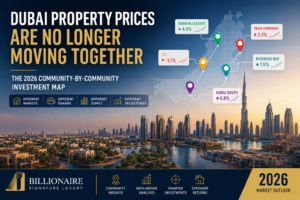
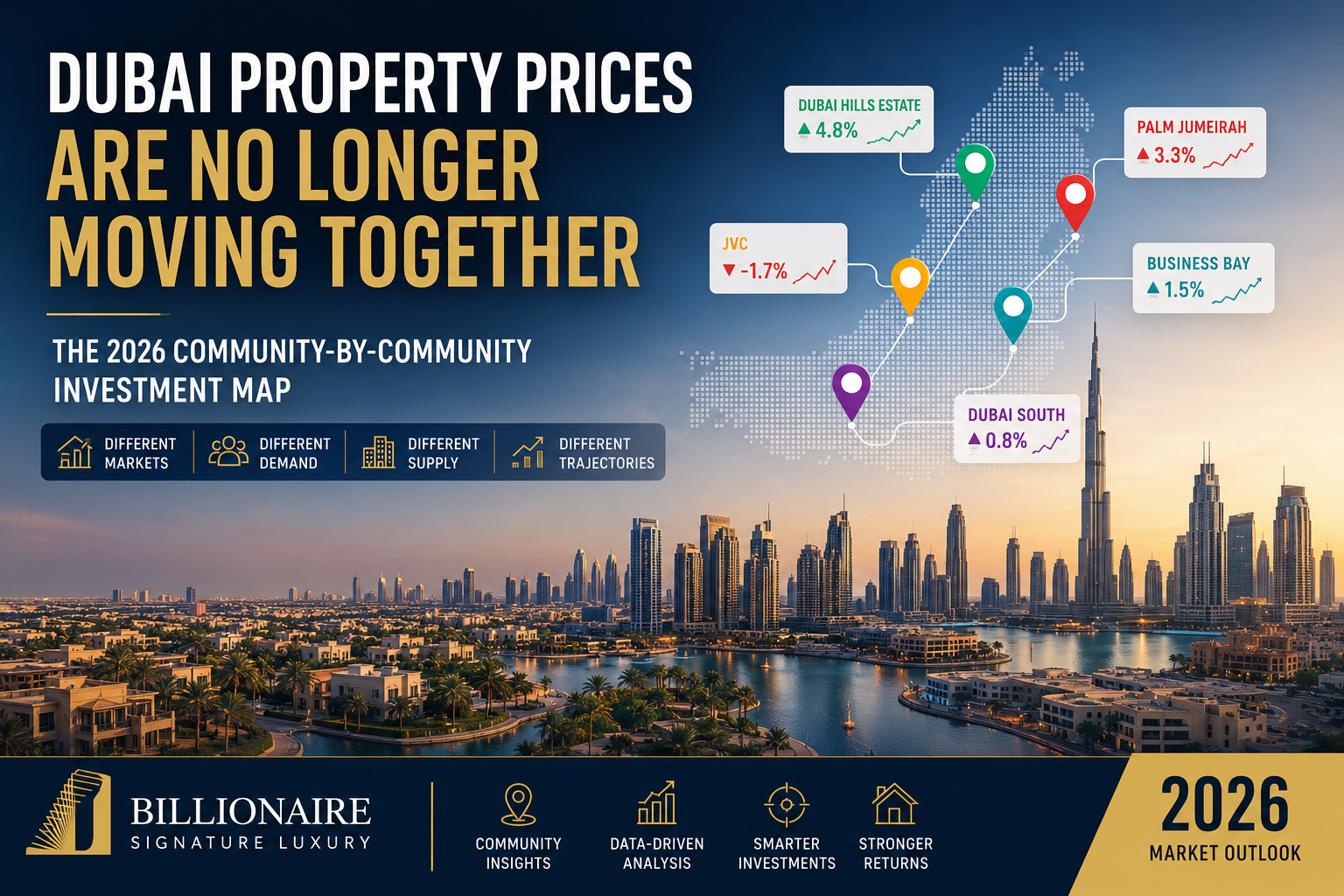
Dubai is increasingly behaving like a collection of smaller property markets. A villa in Dubai Hills Estate, an apartment in Jumeirah Village Circle, a waterfront home on Palm Jumeirah and a new development in Dubai South can all be exposed to the same economy while facing very different supply, demand and pricing conditions.
That divergence is becoming more important as Dubai moves from a broad-based growth phase into a more selective market.
Dubai Land Department recorded AED 252 billion in real estate transactions in Q1 2026, up 31% year on year by value. The market clearly remains active. But strong citywide transaction numbers do not mean every community is moving in the same direction.
For investors, the question is no longer:
“Is Dubai property a good investment?”
It is:
“Which part of Dubai am I actually investing in?”
Dubai Has Become a Micro-Market Story
The latest market research points towards a more selective phase.
Property Finder’s 2026 data shows significant differences in buyer demand between individual communities, while Engel & Völkers notes that villas and low-density communities continue to outperform apartments because of limited supply and lifestyle demand.
That matters because Dubai’s future supply is heavily concentrated in apartments.
Around 55,000 residential units are expected to be handed over during 2026, according to market estimates reported by Khaleej Times. However, actual delivery is expected to be lower than headline development pipelines because not every planned unit reaches completion on schedule.
So the real investment question becomes:
Where is new supply arriving, and where is demand strong enough to absorb it?
1. Dubai Hills Estate: Scarcity Meets End-User Demand
Dubai Hills Estate remains one of the most interesting communities for investors looking beyond short-term price movements.
Its appeal comes from a combination of master planning, family demand, green space, golf-course positioning and a relatively strong lifestyle proposition.
The community is also increasingly relevant at the luxury end. Knight Frank’s H1 2026 analysis recorded 51 residential transactions above US$10 million in Dubai Hills Estate, making it the leading community by transaction count in that segment.
The important point is not that every property in Dubai Hills will outperform.
It is that scarcity and genuine end-user demand can provide a stronger foundation than simply buying into a community because prices have risen previously.
For investors with a longer horizon, that distinction matters.
2. Palm Jumeirah: A Different Supply Equation
Palm Jumeirah operates under a completely different supply model.
There is only a limited amount of land, and the island’s established global reputation creates demand that extends well beyond Dubai’s domestic buyer base.
That scarcity becomes particularly important when the broader market becomes more competitive.
An apartment-heavy community may have hundreds of comparable units available to buyers.
Palm Jumeirah cannot suddenly create hundreds of new plots.
That does not make every Palm property a good investment. Entry price, property condition, service charges, rental performance and exact location still matter.
But it does mean that investors should not evaluate a scarce waterfront market using exactly the same criteria as a high-supply apartment district.
3. JVC: Liquidity Comes With Competition
Jumeirah Village Circle is one of Dubai’s most established apartment investment markets.
Its relatively accessible prices, large tenant base and extensive residential stock make it attractive to investors targeting rental income.
But the same supply depth creates competition.
When tenants have several comparable apartments to choose from, landlords have less pricing power.
And when buyers have plenty of resale and new-build options, sellers have to compete harder.
This is why buying “in JVC” is not an investment strategy by itself.
The specific building matters.
So do:
- Service charges
- Unit layout
- Floor and view
- Building quality
- Rental history
- Nearby competing supply
- Developer reputation
- Purchase price
A cheaper apartment is not automatically better value if five newer buildings are competing for the same tenant.
4. Business Bay: Great Location Does Not Remove Supply Risk
Business Bay has one of Dubai’s strongest structural advantages: location.
It sits next to Downtown Dubai and close to major employment, retail and hospitality destinations.
But Business Bay is also a high-density market with significant apartment inventory.
That creates an important distinction between location quality and investment quality.
A property can have an excellent location and still be overpriced.
It can also have a good rental yield but face significant competition from newer buildings.
For Business Bay investors, the analysis should therefore go deeper than asking price.
Look at:
Purchase price + achievable rent + service charges + vacancy + competing inventory + resale liquidity.
That calculation is far more useful than simply asking whether Business Bay is a “good area”.
5. Dubai South: The Long-Term Infrastructure Bet
Dubai South continues to attract attention because of its proximity to Al Maktoum International Airport, logistics infrastructure and Dubai’s expanding southern growth corridor.
It is also one of the clearest examples of why infrastructure-led investing requires patience.
The opportunity is based on what the area is becoming, not simply what it is today.
That creates potential upside, but also risk.
A large development pipeline can mean future demand growth.
It can also mean more competing properties.
This is why investors should ask two questions:
How much future growth is still available?
And:
How much of that growth is already included in today’s price?
Our previous analysis of Etihad Rail and Dubai property investment looks at the connectivity story in greater detail.
Villas and Apartments Are Becoming Two Different Investment Stories
One of the strongest themes emerging in 2026 is the divergence between villas and apartments.
Property Finder’s market research has highlighted growing demand for villa-led communities, while Engel & Völkers notes that low-density areas continue to outperform apartments because of limited supply and lifestyle demand.
This is important because Dubai’s future residential pipeline remains heavily apartment-led.
That does not mean apartments are a bad investment.
Apartments can offer:
- Lower entry prices
- Larger tenant pools
- Stronger liquidity
- Greater choice
- Attractive rental yields in selected locations
But investors need to account for competition.
A villa in a supply-constrained community may have a very different long-term supply-demand profile from an apartment in a district where thousands of new units are scheduled for delivery.
The property type matters almost as much as the location.
The Real Risk Isn’t “Oversupply”
The word oversupply is used constantly in Dubai property discussions.
It is also often used too broadly.
Dubai can have significant new supply without every community becoming oversupplied.
The better questions are:
What type of property is being delivered?
Where is it being delivered?
At what price?
How quickly is it being absorbed?
What competing stock already exists?
And most importantly:
How much of the announced pipeline will actually be delivered?
That final question matters because headline development numbers can look much larger than actual annual handovers.
For an investor, delivered supply is ultimately more important than a project announcement.
What Should Investors Actually Look For in 2026?
There is no single “best area” in Dubai.
Instead, the right community depends on the objective.
For long-term capital appreciation
Prioritise:
- Limited competing supply
- Strong end-user demand
- Established infrastructure
- Quality developers
- Strong community fundamentals
For rental income
Look closely at:
- Actual achieved rents
- Service charges
- Vacancy
- Tenant profile
- Unit size
- Competing rental stock
A high advertised yield is meaningless if the property struggles to maintain occupancy.
For future growth
Look for:
- Infrastructure investment
- Population growth
- New employment centres
- Improving connectivity
- Development momentum
- Reasonable entry pricing
But don’t pay today’s premium for tomorrow’s promise.
For value opportunities
A market with more inventory can sometimes create better negotiating conditions.
That can mean opportunities to negotiate on:
- Purchase price
- Payment terms
- Seller concessions
- Developer incentives
- Furniture packages
- Transfer-related costs
The key is knowing whether you are buying into temporary competition or permanent oversupply.
The Biggest Mistake Dubai Investors Can Make in 2026
It is not buying an apartment.
It is not buying off-plan.
It is not buying a villa.
It is buying simply because Dubai property is going up.
That is not an investment thesis.
A stronger thesis would be:
This property has sustainable tenant or end-user demand, limited competing supply, a credible developer, a sensible entry price and identifiable reasons for demand to remain strong over my investment horizon.
That can be analysed.
“Dubai is booming” cannot.
What This Means for BSL Group UAE Clients
At BSL Group UAE, we believe property selection should start with the investment objective, not the brochure.
A buyer looking for rental income should not necessarily buy the same property as someone targeting long-term capital appreciation.
Likewise, a family looking for a future home has very different priorities from an investor looking for a five-year exit.
Our role is to evaluate the property within that larger picture:
Community → Property → Developer → Price → Demand → Exit strategy.
That framework becomes increasingly important as Dubai’s market becomes more selective.
For investors considering new developments, our guide to off-plan property investment in Dubai covers developer selection, payment plans and exit considerations.
For investors looking at the top end of the market, our analysis of Dubai’s ultra-luxury property market examines the record activity taking place in the premium segment.
The Bottom Line
Dubai is still one market geographically.
It is no longer one market economically.
The difference between communities is becoming more important as supply increases, buyer behaviour changes and investors become more selective.
Dubai Hills Estate is not JVC.
JVC is not Palm Jumeirah.
Palm Jumeirah is not Dubai South.
And an apartment cannot automatically be evaluated like a villa simply because both are located in Dubai.
The smartest investors in 2026 will not ask:
“Is Dubai going up?”
They will ask:
“Where is demand strongest relative to supply, and am I paying the right price to participate?”
That is the level at which Dubai property investment becomes a strategy rather than a bet.
Frequently Asked Questions
Are Dubai property prices rising or falling in 2026?
The answer varies by community and property type. Dubai’s overall market remains highly active, with DLD recording AED 252 billion in transactions during Q1 2026, but individual communities are experiencing different supply and demand conditions.
Which Dubai areas are strongest for investment in 2026?
There is no universal answer. Dubai Hills Estate and other low-density communities benefit from strong lifestyle and end-user demand, while areas such as JVC and Business Bay can appeal to investors seeking liquidity and rental demand. The right choice depends on price, supply, rental performance and investment horizon.
Is JVC still worth investing in?
JVC can remain attractive for investors seeking relatively accessible entry prices and a large rental market. However, its substantial apartment supply means investors need to be particularly selective about the building, unit and purchase price.
Is Dubai South a good long-term investment?
Dubai South has a compelling long-term infrastructure and development story, particularly because of its proximity to Al Maktoum International Airport and major logistics infrastructure. However, investors should consider the significant future supply pipeline and adopt a longer investment horizon.
Are villas better than apartments in Dubai in 2026?
Not necessarily. Villas benefit from limited supply in many communities and strong lifestyle demand, while apartments can offer lower entry prices and deeper rental markets. The better choice depends on the investor’s objective and the specific property.
Should I buy now or wait for Dubai property prices to fall?
Rather than trying to predict a single Dubai-wide market bottom, investors should evaluate individual communities. Areas with significant new supply may offer greater negotiating opportunities, while scarce properties in established communities may not experience the same level of price pressure.