
Dubai continues to attract property investors looking for rental income, long-term capital appreciation and portfolio diversification. But a property’s advertised price or expected rent does not tell the complete investment story.
A property generating AED 100,000 in annual rent may appear attractive. However, service charges, maintenance, management fees, vacancy periods and acquisition costs can significantly affect the actual return.
This is why investors should calculate both gross rental yield and net rental yield before making a purchase decision.
A Dubai property ROI calculator can help estimate potential returns, compare investment opportunities and understand how different costs affect profitability.
In this guide, we explain how to calculate property ROI in Dubai, which expenses to include and how to assess whether a property makes financial sense.
1. What Is Property ROI?
Return on Investment (ROI) measures the financial return generated by an investment compared with the amount invested.
For real estate, ROI can include rental income, capital appreciation and other financial gains. The calculation depends on the investment strategy and the period being assessed.
For a rental property, investors commonly examine three figures:
- Gross rental yield: Annual rental income compared with the property’s purchase price.
- Net rental yield: Rental income after operating expenses, compared with the total investment cost.
- Total return: Rental income combined with capital appreciation or depreciation, after relevant costs.
These figures answer different questions. Gross yield provides a quick comparison. Net yield offers a more realistic view of recurring rental performance. Total return considers the broader investment outcome.
2. How to Calculate Gross Rental Yield in Dubai
Gross rental yield is the simplest way to compare potential rental income across properties.
The formula is:
Gross Rental Yield = (Annual Rental Income ÷ Property Purchase Price) × 100
Consider this example:
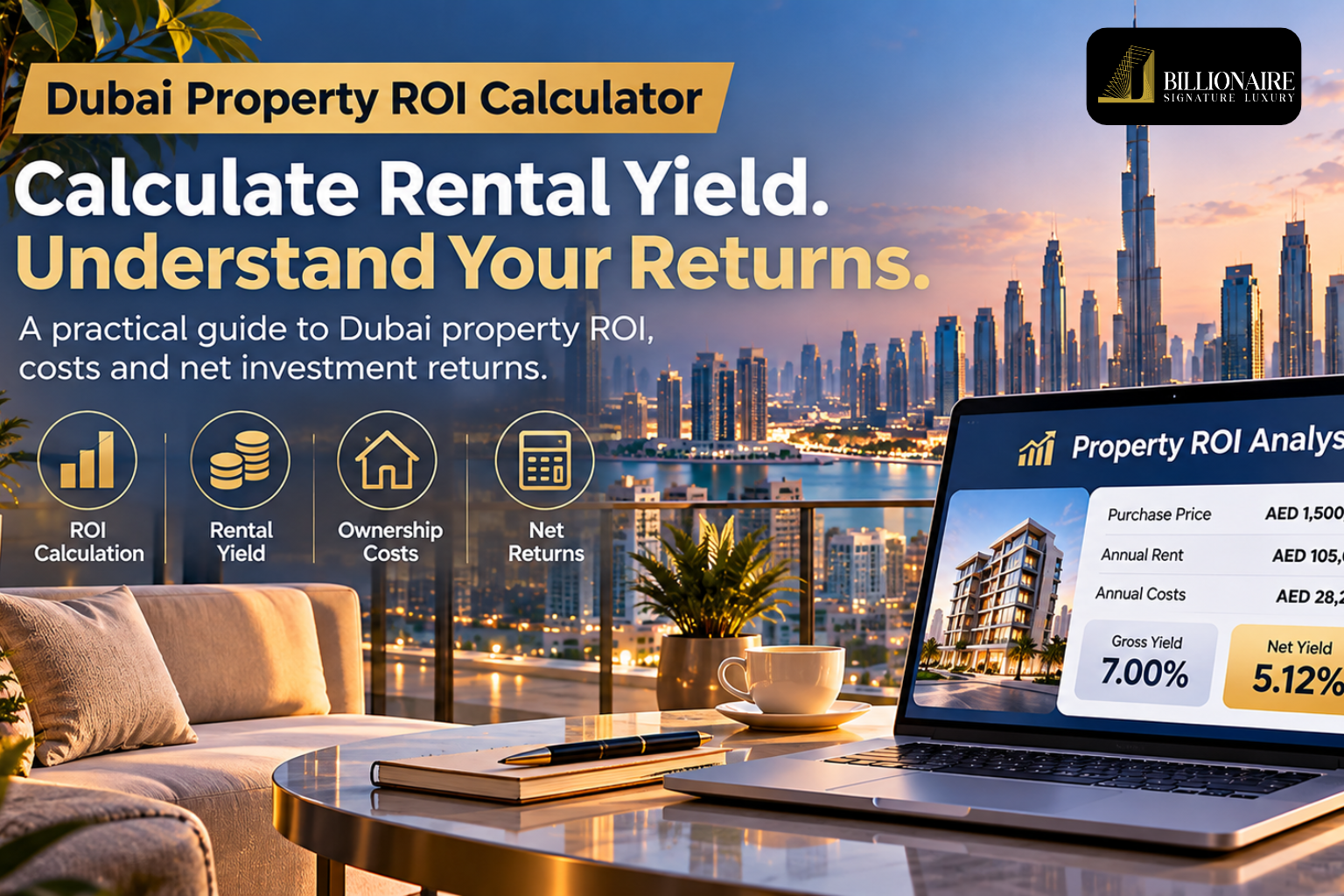
An investor purchases an apartment in Dubai for AED 1,500,000. The expected annual rental income is AED 105,000.
Gross rental yield:
(AED 105,000 ÷ AED 1,500,000) × 100 = 7%
The apartment has an estimated gross rental yield of 7%.
However, this calculation does not include service charges, maintenance, management expenses, vacancy periods or acquisition costs.
It should therefore be treated as an initial comparison rather than the final measure of profitability.
3. How to Calculate Net Rental Yield
Net rental yield gives investors a clearer picture of recurring property income.
It accounts for the expenses associated with owning and operating a rental property.
The formula is:
Net Rental Yield = (Annual Rental Income − Annual Operating Expenses) ÷ Total Investment Cost × 100
Common expenses include:
- Annual service charges.
- Property maintenance and repairs.
- Property management fees.
- Insurance, where applicable.
- Vacancy-related income losses.
- Other recurring ownership expenses.
Acquisition costs should also be considered when calculating the total investment cost.
Worked example: A Dubai apartment investment
Assume an investor purchases an apartment with the following figures:
| Investment detail | Amount |
|---|---|
| Property purchase price | AED 1,500,000 |
| Expected annual rent | AED 105,000 |
| Annual service charges | AED 15,000 |
| Maintenance allowance | AED 3,000 |
| Property management | AED 5,250 |
| Vacancy allowance | AED 5,000 |
| Total operating expenses | AED 28,250 |
Step 1: Calculate annual net rental income
AED 105,000 − AED 28,250 = AED 76,750.
Step 2: Calculate net yield on purchase price
(AED 76,750 ÷ AED 1,500,000) × 100 = 5.12%
The property’s estimated net rental yield is approximately 5.12% before acquisition costs and financing expenses.
If acquisition costs are included in the investment denominator, the net yield will be lower.
This example is illustrative. Actual expenses, rent and vacancy periods depend on the property, building, location and rental strategy.
4. What Costs Should You Include When Calculating Dubai Property ROI?
One of the most common investment mistakes is calculating returns using only the purchase price and expected annual rent.
A more complete assessment should consider the following expenses.
A. Dubai Land Department fees
Property registration and transfer costs form part of the acquisition budget.
Dubai’s real estate transaction fee framework includes a 4% registration fee for a property sale. The applicable allocation between buyer and seller depends on the governing rules and any agreed arrangement.
Investors should also account for applicable title deed, trustee, administrative and other transaction charges.
B. Agency and transaction costs
Brokerage fees, conveyancing-related expenses and other transaction costs may increase the amount required to complete a purchase.
Confirm the applicable charges before calculating the total investment.
C. Annual service charges
Service charges cover the maintenance and management of shared facilities and common areas.
These expenses vary by building, project and property size.
Investors can check approved service charge information through the Dubai Land Department’s Service Charge Index.
D. Maintenance and repairs
Routine maintenance, replacement of equipment and unexpected repairs can reduce rental income.
A realistic investment model should include an annual maintenance allowance instead of assuming that the property will remain expense-free.
E. Property management
Investors who do not manage their properties directly may appoint a property management company.
Management costs should be included in the net yield calculation.
F. Vacancy periods
A property may not generate rental income throughout the year.
A tenant may leave, a new tenant may take time to move in, or the property may require repairs before the next tenancy.
Including a vacancy allowance helps avoid overly optimistic projections.
5. Gross Yield vs Net Yield: Which One Should Investors Use?
Both calculations are useful, but they serve different purposes.
| Factor | Gross rental yield | Net rental yield |
|---|---|---|
| Rental income | Included | Included |
| Service charges | Excluded | Included |
| Maintenance | Excluded | Included |
| Management expenses | Excluded | Included |
| Vacancy allowance | Excluded | Included |
| Acquisition costs | Usually excluded | Included in total investment cost |
| Best use | Initial property comparison | Investment assessment |
Gross yield is useful when screening multiple properties.
Net yield is more useful when deciding whether a particular property can deliver the expected recurring income.
Investors should avoid comparing one property’s gross yield with another property’s net yield. The calculation method must be consistent.
6. How Financing Changes Property ROI
A property purchased through a mortgage requires a separate financial assessment.
Mortgage payments include principal and interest. These affect monthly cash flow differently.
For an investor, it is important to distinguish between:
- Net rental yield: Measures property income after operating expenses.
- Cash flow after debt servicing: Measures what remains after mortgage payments and other expenses.
- Cash-on-cash return: Measures annual pre-tax cash flow against the investor’s actual cash contribution.
For example, a property may have a positive net rental yield but produce limited monthly cash flow if the mortgage repayment is high.
Investors should also account for mortgage arrangement fees, valuation charges, mortgage registration costs and applicable insurance expenses.
A leveraged property investment can increase potential returns on the investor’s cash contribution. It can also increase financial risk, particularly if rental income falls or interest costs rise.
7. Rental Yield Is Not the Same as Total Property ROI
A property can generate rental income and appreciate in value over time. These are separate components of investment performance.
Consider an illustrative scenario:
- Purchase price: AED 1,500,000.
- Annual net rental income: AED 76,750.
- Estimated property value after three years: AED 1,650,000.
The property has generated rental income and an increase in estimated market value.
However, the capital appreciation is not realised until the property is sold. Selling expenses, financing costs and the actual sale price will affect the final outcome.
A complete investment analysis should therefore consider:
- Rental income received.
- Operating expenses.
- Acquisition costs.
- Financing expenses, where applicable.
- Change in property value.
- Selling and exit costs.
Investors should evaluate returns over the intended holding period rather than relying on a single year’s rental yield.
8. How to Use a Dubai Property ROI Calculator
A property ROI calculator simplifies the initial assessment by bringing the main investment figures together.
Before using a calculator, collect the following information:
Property details
- Purchase price.
- Property type.
- Location.
- Estimated annual rental income.
Ownership expenses
- Annual service charges.
- Maintenance allowance.
- Property management fees.
- Expected vacancy allowance.
- Other recurring expenses.
Acquisition and financing
- Applicable DLD and registration charges.
- Brokerage and transaction expenses.
- Initial cash contribution.
- Mortgage amount and repayment details, if applicable.
Once these figures are entered, compare the estimated gross yield, net yield and cash flow.
For a more complete assessment, compare multiple properties using the same assumptions.
Calculate your potential property returns
Use the BSL ROI & Yield Calculator to assess potential property returns.
It can form part of your initial investment assessment before you proceed with a detailed financial and property evaluation.
9. What Makes a Good Property Investment in Dubai?
A high rental yield does not automatically make a property a good investment.
Investors should assess the wider fundamentals behind the numbers.
Location and tenant demand
Consider the area’s connectivity, employment centres, transport access, amenities and suitability for the intended tenant profile.
Building quality and maintenance
Review construction quality, building management, maintenance history and the condition of shared facilities.
Rental assumptions
Compare projected rent with realistic rental evidence. Avoid relying solely on developer projections or optimistic marketing estimates.
Service charges
High recurring service charges can reduce net returns. Check the applicable charges before committing.
Exit potential
Consider the property’s resale appeal, competing supply, buyer demand and likely transaction costs.
Investment horizon
A short-term investment and a long-term rental strategy require different financial assumptions.
The right property is not necessarily the one with the highest advertised yield. It is the one whose risk, costs, income potential and exit strategy align with the investor’s objectives.
10. Why Investors Should Assess Returns Before Buying
Property investment decisions involve more than comparing prices and rental estimates.
A structured assessment helps investors understand how much capital is required, what income a property may generate and how sensitive the investment is to changes in rent, costs and occupancy.
At BSL Group UAE, we recognise the importance of evaluating real estate opportunities through a broader investment perspective.
Our Private Office Advisory and Property Management services support investors seeking a considered approach to property ownership and asset performance.
Whether you are evaluating a residential apartment, a commercial property or a larger real estate opportunity, a clear financial assessment should come before the investment decision.
Explore BSL Group UAE’s real estate advisory services and make your next property investment decision with greater clarity.
Visit BSL Group UAE to learn more.
Frequently Asked Questions
1. How do I calculate ROI on property in Dubai?
Start by calculating annual rental income and subtracting operating expenses. Divide the resulting net income by the total investment cost and multiply by 100 to estimate net rental yield. For total ROI, also consider capital appreciation or depreciation, financing and exit costs over the holding period.
2. What is a good rental yield in Dubai?
There is no single rental yield that makes every Dubai property a good investment. The appropriate return depends on the location, property type, purchase price, service charges, tenant demand, vacancy risk and investment horizon. Compare net yields rather than relying only on advertised gross yields.
3. What is the difference between gross and net rental yield?
Gross rental yield compares annual rent with the property purchase price. Net rental yield deducts operating expenses before comparing the remaining income with the total investment cost.
4. Are DLD fees included in property ROI calculations?
They should be considered when calculating the total amount invested. Dubai’s property sale registration fee framework includes a 4% fee, alongside other applicable transaction and registration charges. The allocation of the fee should be confirmed for the specific transaction.
5. Do service charges affect rental yield in Dubai?
Yes. Service charges are recurring ownership expenses. Higher charges reduce the net rental income and can make a property less attractive from a cash-flow perspective.
6. Does a mortgage affect property ROI?
Yes. Mortgage interest, repayments and related financing expenses affect cash flow and the investor’s return on contributed capital. Investors should assess net rental yield separately from cash-on-cash return.
7. Is rental income enough to evaluate a Dubai property investment?
No. Investors should also consider acquisition costs, maintenance, vacancy, service charges, financing expenses, capital appreciation potential and selling costs.
8. Can I compare two Dubai properties using an ROI calculator?
Yes. Use consistent assumptions for rental income, vacancy, service charges, maintenance, management and acquisition costs. This makes the comparison more meaningful.
Important note: All calculations and examples in this article are illustrative and are not guaranteed investment returns. Actual costs, rental income and property values vary. Investors should verify transaction charges and property-specific expenses before purchasing.