The Dubai property market is entering a phase where Dubai property liquidity may matter almost as much as price growth. In other words, buying a property at a good price is only half the investment decision. Investors also need to ask a harder question: How easily can I sell this property when I want to exit?
That question is becoming more important in 2026 because Dubai’s market is increasingly divided by community, property type, supply pipeline and buyer demand. H1 2026 recorded 80,509 residential sales worth AED 226.5 billion, yet buyers have become more selective about location, pricing, developer reputation, property quality and long-term potential.
At the same time, Dubai Land Department reported AED 252 billion in total real-estate transactions in Q1 2026, up 31% year on year by value.
So this isn’t a story about Dubai becoming illiquid.
It is a story about liquidity becoming uneven.
Some properties can attract several potential buyers quickly.
Others may require a longer marketing period, sharper pricing or negotiation before a transaction happens.
For investors, that distinction can materially affect returns.
What Does Property Liquidity Actually Mean?
In simple terms, property liquidity means how easily an asset can be converted into cash without requiring an excessive discount or an unusually long selling period.
For a publicly traded stock, selling can take seconds.
Real estate is different.
Selling a property involves:
- Finding a buyer
- Agreeing on a price
- Negotiating terms
- Completing due diligence
- Arranging financing if required
- Completing the transfer
- Paying transaction-related costs
So when we talk about a liquid Dubai property, we’re really asking two questions:
1. How quickly can it find a buyer?
2. How close can it sell to its realistic market value?
A property that technically sells after 12 months is not necessarily a liquid investment if the owner had to repeatedly reduce the asking price to achieve the sale.
Dubai’s own market depth remains substantial. But the latest market data increasingly points toward a more selective environment in which pricing, location, quality and product-market fit matter more than simply owning “Dubai property.”
Why Liquidity Matters More in 2026
The Dubai property market has enjoyed several years of strong transaction activity.
But 2026 is showing a more nuanced picture.
Off-plan remains dominant. Engel & Völkers reported that off-plan properties represented 71.3% of residential sales in H1 2026. Meanwhile, the secondary market has become more measured, with buyers increasingly selective.
Betterhomes similarly described Q1 2026 as a more selective market, reporting that secondary-market transactions declined year on year while buyers became more focused on pricing, quality and long-term value.
This creates an important investment question.
If an investor buys a property today, they may eventually compete with:
- New launches
- Recently completed units
- Other resale owners
- Investor exits
- Developer incentives
- Rental properties being converted to sales
The property doesn’t exist in isolation.
It competes with everything else available to the future buyer.
The Biggest Mistake: Confusing Price Growth With Liquidity
A property can appreciate strongly and still be relatively difficult to sell.
Imagine two hypothetical Dubai properties.
Property A
- Purchase price: AED 1.5 million
- Current value: AED 1.8 million
- Limited comparable transactions
- Few similar buyers
- High-end niche product
Property B
- Purchase price: AED 1.5 million
- Current value: AED 1.7 million
- Hundreds of comparable transactions
- Large pool of potential buyers
- Strong rental and end-user demand
Property A has delivered the higher theoretical appreciation.
But Property B may be easier to exit.
That’s the distinction investors need to understand.
Capital appreciation answers:
“How much did the asset increase in value?”
Liquidity answers:
“How easily can I actually realise that value?”
Both matter.
What Makes a Dubai Property Liquid?
There isn’t one magic factor.
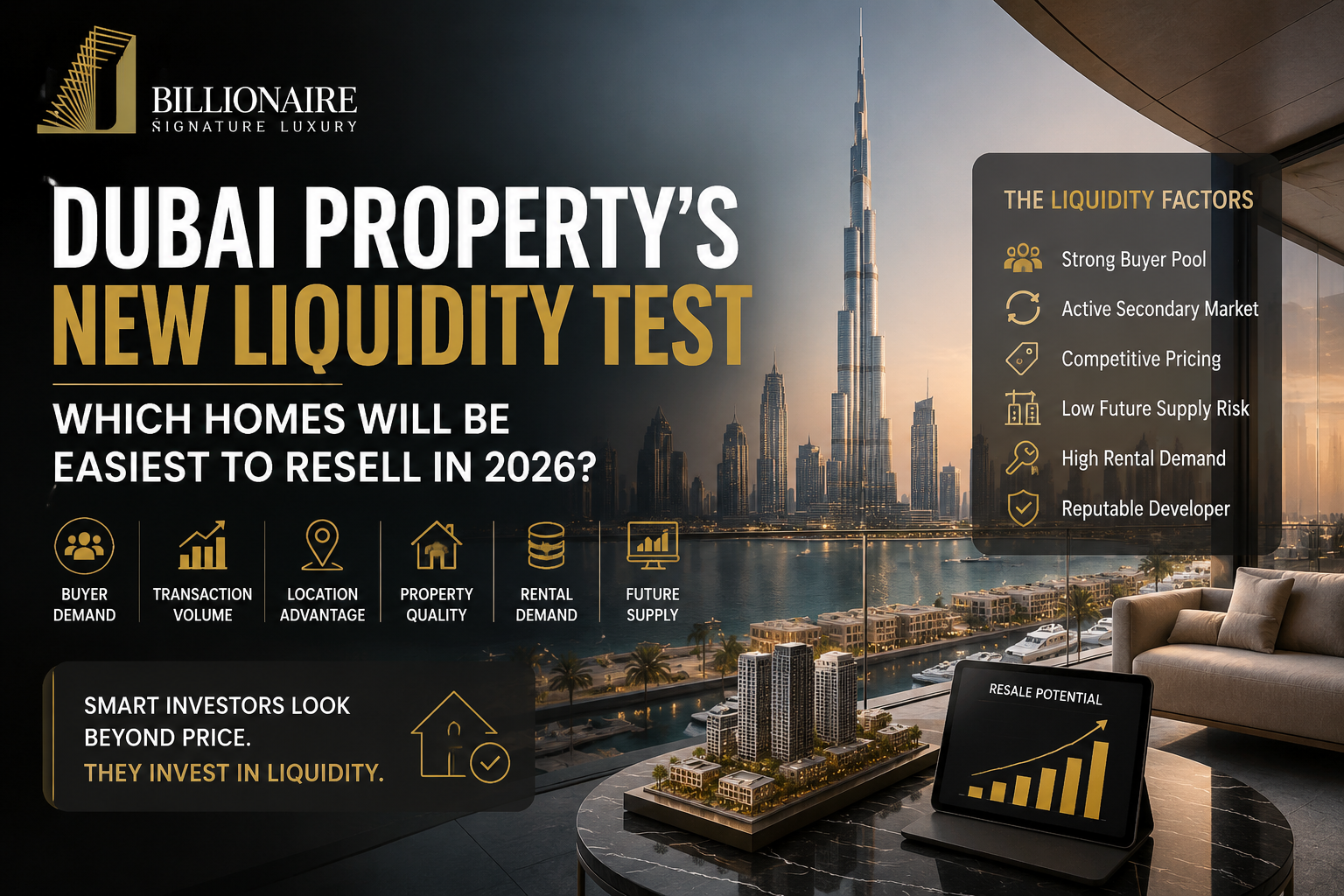
Liquidity usually comes from a combination of:
- Buyer depth
- Transaction volume
- Location
- Price point
- Property type
- Developer reputation
- Unit quality
- Rental demand
- Supply competition
- Pricing accuracy
Let’s examine each.
1. Buyer Depth
The simplest liquidity test is:
How many people could realistically buy this property?
A property with a very narrow buyer pool can take longer to sell.
For example, an unusually large or highly specialised property may appeal to only a small number of buyers.
A well-priced one- or two-bedroom apartment in a highly active community may have a much larger potential audience.
This doesn’t automatically make the apartment a better investment.
It simply means the future buyer pool may be deeper.
2. Transaction Volume
Transaction volume is one of the most useful indicators of market depth.
If thousands of comparable properties are changing hands, investors have more evidence about:
- Current pricing
- Buyer demand
- Comparable properties
- Selling periods
- Negotiation levels
This is important because liquidity is easier to assess when there is an active secondary market.
Recent DLD-based analysis shows substantial variation in completed-home transaction volumes between Dubai communities. JVC, Business Bay, Dubai Marina, Downtown Dubai and JLT, for example, have historically recorded significant secondary-market activity, while lower-volume markets naturally have fewer comparable transactions.
That doesn’t mean the highest-volume community is automatically the best investment.
It means transaction depth should be part of the analysis.
3. Location
Location affects liquidity because buyers aren’t purchasing only the apartment.
They’re purchasing access to:
- Roads
- Metro stations
- Schools
- Offices
- Retail
- Restaurants
- Healthcare
- Parks
- Beaches
- Community amenities
A property with several independent demand drivers can have a broader buyer base.
This is why “good location” should never simply mean:
“It’s in Dubai.”
The more useful question is:
What creates demand for this exact location?
4. Price Point
Price can dramatically change liquidity.
A property priced at AED 800,000 may have a much larger theoretical buyer pool than a comparable property priced at AED 8 million.
But affordability isn’t the only issue.
The property must also be priced correctly relative to comparable inventory.
If three nearly identical apartments are available at:
- AED 1.20 million
- AED 1.18 million
- AED 1.10 million
the AED 1.20 million seller may struggle unless there is something genuinely better about that unit.
Liquidity is therefore closely connected to pricing discipline.
5. Property Type
Different property types attract different buyer pools.
Apartments typically have a broader investor market.
Villas and townhouses may have stronger end-user appeal in certain family-oriented communities.
Luxury properties can have exceptional demand, but the buyer pool is naturally narrower.
This is why comparing a studio apartment with a six-bedroom villa purely on “liquidity” isn’t useful.
The correct question is:
How liquid is this property relative to comparable properties serving the same buyer segment?
6. Developer Reputation
In Dubai’s 2026 market, developer reputation has become increasingly important.
Engel & Völkers specifically reports that buyers are placing greater emphasis on developer reputation, location, property quality, pricing and long-term investment potential.
For an investor, developer reputation can affect both initial demand and future resale confidence.
A future buyer may ask:
- Was the project delivered on time?
- Is the building well maintained?
- Is the developer trusted?
- How is the community performing?
- Are there recurring quality issues?
- Does the project have a good reputation among owners?
The answers can influence how easily another buyer is willing to take over the asset.
7. Actual Property Quality
Two apartments in the same building can have very different resale prospects.
Consider:
- Higher floor vs lower floor
- Better view vs blocked view
- Efficient layout vs awkward layout
- Renovated vs poorly maintained
- Parking vs limited parking
- Balcony vs no balcony
- Better orientation
- Better natural light
When supply is high, buyers have options.
That makes differentiation more important.
A generic unit has to compete primarily on price.
A genuinely desirable unit can compete on value.
8. Rental Demand
Rental demand doesn’t directly equal resale liquidity.
But it can strengthen the investment case.
A property that attracts tenants can potentially appeal to two buyer groups:
Investor
Someone buying for rental income.
End-user
Someone buying to live there.
That broader demand base can help.
A property dependent entirely on one narrow type of buyer may face more volatility.
Dubai’s rental market remains active. Engel & Völkers recorded more than 271,000 tenancy contracts in H1 2026, with average gross residential rental yields of 6.6%.
However, investors should never assume a high advertised yield automatically means high liquidity.
Yield and liquidity are different metrics.
9. Future Supply Can Change Liquidity
This is one of the most important considerations for 2026.
Suppose you own 1,000 similar apartments in a community today.
Now imagine another 3,000 units are scheduled for delivery.
Your future buyer suddenly has more choices.
That doesn’t automatically mean prices will fall.
But it can change:
- Negotiating power
- Buyer urgency
- Rental competition
- Incentives
- Marketing periods
- Resale pricing
Property Finder’s 2026 market analysis explicitly highlights how community-level supply, demand and development pipelines are increasingly shaping individual market performance. It identifies higher-supply areas as more sensitive to buyer choice and competition.
So a liquidity analysis should always ask:
What will the buyer be able to choose from when I want to sell?
Not just:
What can I buy today?
10. Pricing Accuracy
This may be the most underrated liquidity factor.
A great property at the wrong price can be illiquid.
A fairly ordinary property at the right price can sell quickly.
Investors therefore need to distinguish between:
Asking price
What the seller wants.
Market value
What comparable evidence suggests.
Achieved price
What buyers have actually paid.
For resale decisions, achieved transaction prices are far more useful than simply looking at current listing prices.
This is why Dubai Land Department’s real-estate data platform is valuable: DLD provides data covering transactions, rents, projects, valuations, land, buildings, units, brokers and developers.
The 2026 Liquidity Test: 8 Questions Every Investor Should Ask
Before buying a Dubai property, run these eight questions.
1. How many comparable properties actually sell here?
Don’t rely only on listings.
Look at completed transactions.
2. Who is the likely future buyer?
Is the property primarily attractive to:
- Investors?
- Families?
- First-time buyers?
- International buyers?
- Luxury buyers?
- Local end-users?
3. How many competing units will exist when I sell?
Look beyond today’s inventory.
Check upcoming launches and handovers.
4. How differentiated is my unit?
Does it have:
- Better view?
- Better layout?
- Better floor?
- Better condition?
- Better orientation?
- Better amenities?
5. How strong is rental demand?
If investors are part of your future buyer pool, rental performance matters.
6. What is the realistic exit price?
Don’t base the answer on:
“The agent says it will be worth AED X.”
Look at actual comparable transactions.
7. How much negotiation should I expect?
A property isn’t truly liquid if you must discount heavily to achieve a sale.
8. What happens if I need to sell sooner than planned?
This is the stress test.
Imagine needing to exit after:
12 months
instead of:
5 years.
Would there still be buyers?
That question can completely change an investment decision.
The 5-Minute Dubai Property Liquidity Test
Investors can simplify the entire framework into five questions.
Demand
Who will buy this?
Depth
How many comparable properties actually transact?
Competition
What else will my buyer be able to choose from?
Differentiation
Why would they choose my unit?
Exit
Can I sell at a realistic market price without waiting excessively?
If you cannot answer these five questions, you probably haven’t analysed the investment deeply enough.
Are High-Volume Communities Always Better?
No.
This is an important distinction.
High transaction volume can indicate deep market activity.
But it can also mean:
- More competing sellers
- More new launches
- More investor-owned units
- More price comparison
- Greater buyer choice
So liquidity needs to be analysed alongside supply and competition.
A community can be highly active while still being highly competitive.
That’s why investors shouldn’t simply create a ranking:
“Community X has the most transactions, therefore buy there.”
Instead ask:
“Is the transaction depth strong relative to the amount of competing inventory?”
That’s a much more sophisticated question.
Off-Plan vs Resale: Which Is More Liquid?
There is no universal answer.
Dubai’s off-plan market remains exceptionally strong. In H1 2026, off-plan represented 71.3% of residential sales.
Off-plan can offer:
- Payment plans
- Newer specifications
- Developer incentives
- Potential early-entry pricing
- Access to new communities
But resale properties offer something different:
- A physical asset
- Existing rental history
- Observable building quality
- Real-world location
- Established community
- Actual transaction comparables
The important issue is exit timing.
An off-plan investor should ask:
“When I want to sell, who will be competing with me?”
The answer may include:
- The original developer
- Other investors
- Completed owners
- New launches
- Newly handed-over units
That competition can affect future liquidity.
Why Ready Properties Can Have an Information Advantage
A completed property allows an investor to inspect what they are actually buying.
You can evaluate:
- The building
- The view
- The finishing
- The facilities
- The neighbourhood
- Traffic
- Noise
- Rental demand
- Occupancy
- Maintenance
This doesn’t automatically make resale property better.
But it reduces some uncertainty.
For investors focused on future liquidity, observable evidence can be valuable.
What About Luxury Properties?
Luxury property operates under a different liquidity model.
A AED 30 million villa doesn’t need hundreds of buyers.
It needs the right buyer.
Dubai’s luxury market remains strong. DLD reported AED 87.71 billion of luxury real-estate investment in Q1 2026, up 26% year on year. Engel & Völkers also recorded 320 residential sales above US$10 million in H1 2026, up 23% year on year.
So luxury properties can be highly desirable without being high-volume assets.
For this segment, liquidity depends more heavily on:
- Scarcity
- Location
- Brand
- Property quality
- Global buyer demand
- Uniqueness
- Pricing
A rare trophy asset may have fewer potential buyers but still command exceptional demand when the right buyer appears.
Technology Is Also Changing Property Liquidity
Dubai is experimenting with new ways of improving access to real estate.
In February 2026, Dubai Land Department launched Phase II of its Real Estate Tokenisation Project, enabling resale of tokenised real-estate interests in a controlled secondary-market pilot. The project is intended to test market efficiency, transparency, governance and investor protection.
This is not a reason to assume that traditional property liquidity has suddenly disappeared.
It is, however, an indication that Dubai’s real-estate ecosystem is becoming more sophisticated.
Over time, better data, digital transactions and new investment structures could make it easier to understand and potentially access secondary-market liquidity.
What This Means for Dubai Property Investors
The biggest change in 2026 may not be that Dubai property is becoming less attractive.
It is that investors have to become more selective.
The market is large.
Demand remains substantial.
Transaction volumes remain high.
International investment continues.
But the market is increasingly divided into different micro-markets.
Property Finder describes Dubai as moving into distinct community cycles rather than behaving like one unified market, with local supply, demand and development pipelines increasingly influencing performance.
That means an investor should stop asking:
“Is Dubai property a good investment?”
and start asking:
“Is this specific property likely to remain desirable to the next buyer?”
That’s the liquidity test.
How BSL Group Looks at the Exit, Not Just the Entry
A property investment decision shouldn’t stop at:
Purchase price → payment plan → expected appreciation.
A stronger analysis considers:
Entry → rental demand → competing supply → community development → future buyer pool → resale value → exit costs.
This is especially important when evaluating off-plan opportunities.
A payment plan can make a property easier to purchase.
It doesn’t automatically make it easier to sell.
Similarly, a low entry price doesn’t automatically create liquidity.
The asset still needs:
- Demand
- Positioning
- Quality
- Competitive pricing
- A sufficiently deep buyer pool
For investors considering Dubai property, BSL Group can help evaluate opportunities through a broader investment lens rather than looking at the headline price alone.
Final Takeaway: Buy for the Next Buyer, Not Just for Yourself
The smartest question to ask before buying a Dubai property in 2026 isn’t:
“How much could this property be worth?”
It’s:
“Who will want to buy it from me?”
That one question forces investors to examine everything that matters:
- Location
- Price
- Demand
- Rental potential
- Developer reputation
- Property quality
- Future supply
- Comparable transactions
- Buyer depth
- Competition
- Exit timing
Dubai remains a highly active real-estate market. DLD’s Q1 2026 figures show AED 252 billion in total real-estate transactions, while H1 residential sales reached AED 226.5 billion across 80,509 transactions.
But a strong city-wide market does not guarantee equal liquidity for every property.
Liquidity is property-specific.
And as Dubai’s market becomes more selective, investors who understand the difference between price growth and exitability may be better positioned to make disciplined decisions.
The new Dubai property investment question is therefore simple:
Don’t just ask what you can buy. Ask what you can eventually sell — and who will buy it.
Frequently Asked Questions
Property liquidity refers to how easily a property can be sold at a realistic market price without an unusually long marketing period or substantial discount. It depends on factors such as buyer demand, transaction volume, location, pricing, property type and competing supply.
Yes. Dubai remains a highly active real-estate market. DLD reported AED 252 billion in total real-estate transactions during Q1 2026, while H1 2026 residential sales reached AED 226.5 billion. However, liquidity varies significantly between communities and property types.
Strong buyer demand, realistic pricing, good location, a broad buyer pool, established rental demand, quality construction, reputable development and limited competing inventory can all support resale liquidity.
Not necessarily. Luxury properties have smaller buyer pools but can still attract strong demand because of scarcity, location, branding and international buyers. Dubai’s luxury market remained particularly strong during H1 2026.
Not automatically. Off-plan dominates Dubai’s residential market, accounting for 71.3% of H1 2026 residential sales according to Engel & Völkers. However, an off-plan investor should carefully assess future competition from the developer, other investors and newly completed projects before assuming an easy exit.
Transaction volume is one useful indicator, but there is no universal “most liquid” ranking that applies to every property type. Communities such as JVC, Business Bay, Dubai Marina, Downtown Dubai and JLT have historically recorded substantial secondary-market activity. Investors should compare transaction depth with supply, pricing and property type rather than relying on volume alone.
Start by reviewing completed comparable transactions, current competing listings, future supply, rental demand, developer reputation and the property’s specific characteristics. DLD provides real-estate data covering transactions, rents, projects, valuations, buildings and units.
Neither should automatically take priority. Rental yield measures income potential, while liquidity measures how easily you may be able to exit. A strong investment analysis considers both, alongside capital appreciation, ownership costs and future supply.
New supply gives future buyers more choices. If many comparable units enter the market when you want to sell, you may face stronger competition and greater pressure to price your property correctly.
Liquidity has always mattered, but it becomes particularly important when buyers have more choices. Dubai’s 2026 market is increasingly selective, with community-level supply, pricing, quality and demand playing a greater role in individual property performance.