For years, Dubai property investors focused on the same fundamentals: location, views, developer reputation, rental yield and price per square foot.
Those factors still matter.
But in 2026, another variable is becoming increasingly difficult to ignore:
Connectivity.
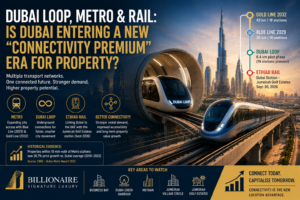
Dubai is simultaneously expanding its Metro network, building out national passenger rail connections and introducing an entirely new underground transport concept through the Dubai Loop.
The result could be a fundamental change in how investors value location.
A property that is 20 minutes from a major employment district today may not have the same investment profile once multiple transport systems connect around it.
This is why Dubai may be entering what could be called a connectivity premium era.
The important point, however, is that investors should not simply buy anything near a future station.
The real opportunity is identifying communities where better connectivity is likely to create more demand than the market has already priced in.
Dubai Is Building a Multi-Layered Transport Network
The most interesting part of Dubai’s current infrastructure story is that these projects are not operating independently.
They are increasingly designed to connect with one another.
Consider the four major pieces now shaping the city’s mobility map:
Dubai Metro
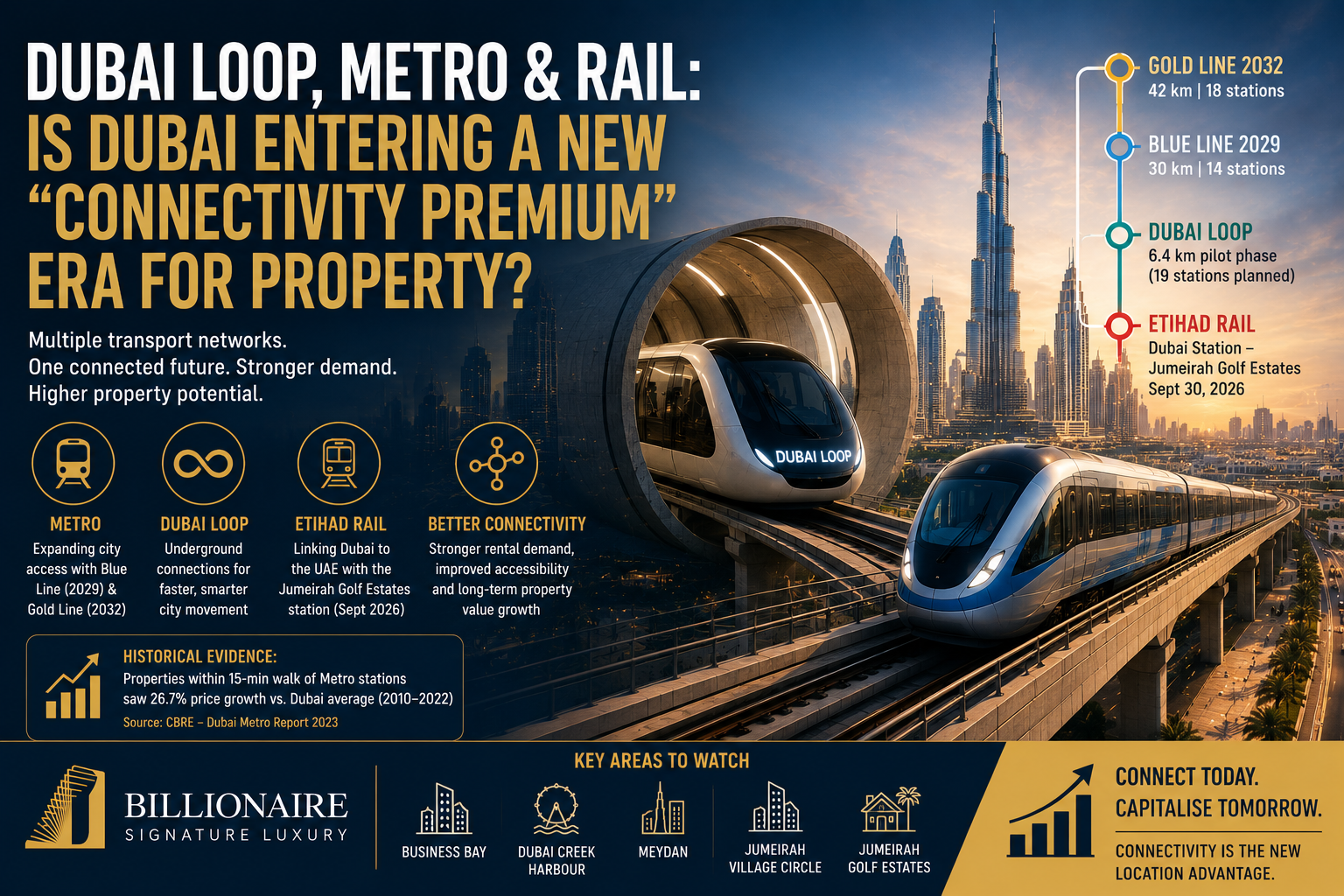
The existing Red and Green lines are being expanded through the Blue Line, scheduled for completion in 2029.
Dubai Metro Gold Line
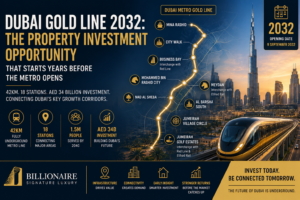
The newly approved Gold Line will add 42 kilometres and 18 stations, with completion scheduled for September 2032.
Etihad Rail
The UAE’s passenger rail network is bringing inter-emirate connectivity into Dubai, with the Dubai station at Jumeirah Golf Estates scheduled to open on September 30, 2026.
Dubai Loop
The new underground passenger tunnel system is being introduced initially between the Financial District and Dubai Mall, with the wider alignment planned to extend toward Business Bay.
This is not simply more public transport.
It is the creation of layers of connectivity.
And that distinction matters for property.
What Exactly Is Dubai Loop?
Dubai Loop is perhaps the most unusual part of the story.
In February 2026, Dubai’s Roads and Transport Authority signed an agreement with The Boring Company to begin implementing the project.
The first phase consists of a 6.4-kilometre pilot route with four stations, linking the Dubai International Financial Centre and Dubai Mall.
The planned wider alignment could extend up to 22.2 kilometres with 19 stations, connecting the Trade Centre and Financial District areas with Business Bay.
The first phase is estimated to cost approximately AED 565 million, with an anticipated delivery period of around one year following completion of design work and required preparations. The full route is estimated at approximately AED 2 billion, with implementation expected to take around three years.
That makes Dubai Loop different from a conventional Metro project.
It is designed around underground passenger tunnels and is intended to support efficient movement in dense urban areas, including first- and last-mile connectivity.
For property investors, the most important part is not the technology.
It is where the network connects.
The proposed wider alignment directly involves some of Dubai’s highest-value commercial and residential districts.
Why Connectivity Can Become a Property Premium
Transport infrastructure changes the effective location of a property.
A building does not physically move.
But the amount of time required to reach employment, retail, entertainment and other parts of the city can change dramatically.
That changes how tenants and buyers evaluate the address.
This effect is supported by Dubai’s own historical data.
CBRE analysed nearly 74,000 residential sales transactions between Q1 2010 and Q4 2022 and found that properties within a 15-minute walk of Dubai Red Line stations recorded average price growth of 26.7%, compared with 24.1% across Dubai overall.
The strongest performance in its analysis came from properties within a 10–15-minute walk, which recorded average price growth of 43.8% over the period studied.
That does not mean a future station guarantees a 43.8% return.
It does demonstrate something much more useful:
Transport accessibility can become economically measurable in property values.
The New Premium Is Not Simply “Near a Metro”
This distinction is critical.
The old property-investment formula was:
Property + Metro station = premium.
The emerging formula is more sophisticated:
Property + multiple transport connections + strong demand + limited competing supply = potential connectivity premium.
A property near one Metro station may benefit.
But a property that eventually connects to:
- Dubai Metro
- Etihad Rail
- major road networks
- Dubai Loop
- airport connectivity
can have a very different strategic position.
This is particularly relevant to communities where transport accessibility has historically been one of the weaker parts of the investment proposition.
Dubai Metro Blue Line Is Already Changing the Equation
The Blue Line is arguably the most immediate Metro-driven property catalyst.
RTA currently lists the project at 30 kilometres and 14 stations, with completion scheduled for 2029. It will connect areas including:
- Dubai Creek Harbour
- Dubai Festival City
- Ras Al Khor
- International City
- Dubai Silicon Oasis
- Academic City
- Mirdif
- Al Warqa
- Dubai International Airport
It will also connect to the existing Red and Green lines.
Construction is already underway.
RTA reported that tunnelling works began in May 2026, with the project involving an investment of more than AED 20.5 billion.
That makes the Blue Line different from a speculative infrastructure announcement.
It is physically being built.
For property investors, this distinction matters.
Dubai Creek Harbour Is a Good Example
Dubai Creek Harbour illustrates why connectivity needs to be considered alongside development quality.
The community is already a major waterfront development.
But the Blue Line will provide a direct Metro connection and integrate the area into the wider Dubai Metro network. RTA identifies Dubai Creek Harbour as a key station location on the Blue Line.
This potentially changes the community’s appeal from:
“A premium waterfront destination that requires road access”
to:
“A premium waterfront destination connected to Dubai’s public transport network.”
That is a meaningful difference for:
- Residents
- Tenants
- Tourists
- Hospitality operators
- End users
- Future buyers
The infrastructure does not create the entire investment case.
It strengthens it.
Business Bay Could Become One of the Most Connected Locations in Dubai
Business Bay deserves special attention because several connectivity stories converge around it.
The existing Metro network already serves the district.
The Dubai Loop’s proposed wider alignment is planned to connect the Trade Centre and Financial District areas with Business Bay.
Business Bay is also immediately adjacent to Downtown Dubai and has become a major residential and commercial market in its own right.
Current market data illustrates its depth.
Bayut’s June 2026 data placed the average apartment sale price in Business Bay at approximately AED 2,413 per square foot, while its broader property index showed around AED 2,498 per square foot.
The important investment question is therefore not whether Business Bay will benefit from connectivity.
It already does.
The question is:
How much additional connectivity premium is still available when much of the advantage is already priced into the market?
That is why buying purely because of the Dubai Loop could be dangerous.
A strong location can already be expensive.
The Dubai Loop May Matter Most for First- and Last-Mile Connectivity
The biggest contribution of Dubai Loop may not be replacing the Metro.
It may be helping people reach the Metro, workplace, retail destination or major transport interchange faster.
RTA specifically describes the Loop as supporting first- and last-mile journeys.
This is important for property because the “walkability” of an area is not determined only by whether a Metro station exists.
It depends on the entire journey.
Imagine a resident living in a tower that is:
- 12 minutes from a Metro station
- 8 minutes from a Loop station
- 10 minutes from a major retail destination
The practical experience of living there can be very different from a property that is technically “near Metro” but poorly connected at street level.
This is where the concept of a connectivity premium becomes more sophisticated.
Etihad Rail Adds Another Dimension
The national rail network takes the connectivity story beyond Dubai itself.
Etihad Rail passenger services launched in phases in 2026. The Dubai station at Jumeirah Golf Estates is scheduled to open on 30 September 2026.
Etihad Rail says its passenger network is designed to connect cities and provide a reliable option for travel between Emirates. Its planned network includes Jumeirah Golf Estates among the strategically selected locations.
Jumeirah Golf Estates is particularly interesting because it is also part of the future Gold Line.
That means the community is moving towards an unusual transport combination:
Metro + national rail + road connectivity.
A footbridge is also planned to connect the Metro and Etihad Rail stations at Jumeirah Golf Estates, according to The National.
That is precisely the type of transport integration investors should be watching.
The Gold Line Takes the Story to 2032
The Gold Line is the long-term piece of the puzzle.
Dubai approved the project in April 2026 with an investment of approximately AED 34 billion.
The line will stretch 42 kilometres, contain 18 stations and become Dubai’s first fully underground Metro line.
It will connect to the existing Red and Green lines and integrate with Etihad Rail.
The official route covers 15 strategic areas and is expected to serve approximately 1.5 million people by 2040. It will also strengthen connectivity to 55 major real estate developments.
This means Dubai’s transport map is no longer simply expanding outward.
It is becoming more interconnected internally.
That could have important consequences for property values.
Which Communities Could Benefit From the Connectivity Premium?
Investors should not create a generic “buy near infrastructure” strategy.
Instead, look for the intersection of four factors.
1. Existing demand
People already want to live there.
2. Current connectivity gap
Transport is one of the area’s weaknesses.
3. Confirmed infrastructure
The improvement is actually funded, approved or under construction.
4. Reasonable entry pricing
The future benefit has not already been fully priced in.
Using that framework, several areas become particularly interesting.
Jumeirah Village Circle
JVC has a large residential population and established rental demand.
Its connectivity story is improving, particularly through the broader Gold Line and surrounding transport infrastructure.
The opportunity here is not simply buying any JVC apartment.
Investors should identify properties where future accessibility can improve tenant demand while current prices remain supported by existing rental fundamentals.
Meydan
Meydan is becoming increasingly important because the Gold Line will integrate with Etihad Rail at Meydan.
This creates a potentially valuable intersection between:
Dubai Metro + national rail + road connectivity.
The area is also undergoing substantial residential and mixed-use development.
That makes Meydan a community worth monitoring over a longer investment horizon.
MBR City
Mohammed Bin Rashid City combines large-scale development with proximity to Dubai’s central districts.
The Gold Line is planned to serve the wider MBR City area, improving its relationship with Business Bay and the rest of the Metro network.
For premium residential investors, improved accessibility could strengthen the area’s appeal to residents who want larger homes and master-planned surroundings without being disconnected from central Dubai.
Dubai Creek Harbour
The Blue Line is the key catalyst here.
The area is already a major waterfront development, but Metro connectivity could broaden its tenant and end-user pool.
The biggest potential benefit is not necessarily a sudden price jump.
It is the creation of a more practical everyday residential location.
That can be more valuable over the long term.
Jumeirah Golf Estates
Few Dubai communities have as interesting a future connectivity combination.
The Etihad Rail station is scheduled to open in September 2026.
The Gold Line is scheduled for 2032.
The Metro and Etihad Rail stations are expected to be physically connected.
That makes Jumeirah Golf Estates one of the clearest examples of the connectivity-premium thesis.
However, there is an important warning.
Experts quoted by The National do not expect an immediate dramatic price increase from the Etihad Rail opening because some of the connectivity benefit is already reflected in market pricing, and many JGE residents remain relatively car-dependent.
This is exactly why investors need to distinguish infrastructure potential from guaranteed appreciation.
Connectivity Is Becoming a Tenant Decision, Not Just an Investor Story
There is another reason this trend matters.
The eventual premium may come from tenants before it comes from investors.
A tenant asks:
How long will it take me to reach work?
Can I get to Downtown without driving?
Can I reach the airport easily?
Can my children get to school?
Can I travel between Emirates without using a car?
The better the answer becomes, the larger the potential tenant pool.
That can support:
- Occupancy
- Rental growth
- Resale demand
- Liquidity
And those fundamentals eventually influence property pricing.
But More Connectivity Does Not Automatically Mean Higher Prices
This is perhaps the most important part of the entire investment thesis.
Infrastructure is an enhancer, not a guarantee.
CBRE’s Metro study provides a useful warning.
Although properties within 15 minutes of Red Line stations outperformed Dubai overall, performance varied significantly by walking-distance category and location. Some properties between five and ten minutes from stations actually underperformed, while high-quality locations such as JBR and Marina performed strongly.
Why?
Because Metro proximity is only one variable.
A property also needs:
- Good building quality
- Strong amenities
- Attractive pricing
- Healthy rental demand
- Good community infrastructure
- Limited oversupply
- Resale liquidity
This means investors should never buy simply because a developer says:
“Future Metro station nearby.”
The “Connectivity Premium” Can Already Be Priced In
This is the biggest risk for investors in 2026.
Infrastructure announcements create excitement.
Excitement creates speculation.
Speculation pushes asking prices higher.
Eventually, investors may be paying today for tomorrow’s connectivity.
If the premium is already fully incorporated into the purchase price, there may be little additional upside left.
The ideal situation is different.
You want:
Strong property fundamentals today + improving connectivity tomorrow + reasonable entry price today.
That combination creates asymmetric potential.
A New Way to Analyse Dubai Property
Instead of evaluating property using only traditional factors, investors can start using a Connectivity Score.
For example:
Current Connectivity
How easy is it to reach major employment and lifestyle areas today?
Future Connectivity
What confirmed projects will improve accessibility?
Interchange Potential
Will the property connect to one transport mode or multiple modes?
Walking Accessibility
Can residents actually walk to the station?
Employment Access
Does the infrastructure connect the property to major employment centres?
Rental Impact
Will tenants realistically value the improvement?
Supply Risk
How many competing properties will exist when the infrastructure opens?
Price Premium
How much of the expected infrastructure benefit is already reflected in today’s price?
This approach is more useful than simply saying:
“This property is near a Metro.”
The 2026–2032 Timeline Matters
The connectivity story is unfolding in stages.
2026
Etihad Rail passenger services expand, with Dubai’s Jumeirah Golf Estates station scheduled for September 30.
2026–2027
Dubai Loop’s first phase moves forward, beginning with the 6.4-kilometre pilot route.
2029
Dubai Metro Blue Line is scheduled for completion.
2032
Dubai Metro Gold Line is scheduled to open.
This gives investors something unusual:
A sequence of infrastructure catalysts rather than one isolated event.
A community could therefore experience several waves of improved connectivity over several years.
What This Means for BSL Group UAE Investors
At BSL Group UAE, the connectivity-premium thesis should not mean recommending infrastructure-linked properties indiscriminately.
The more useful strategy is to identify properties where infrastructure is likely to change the underlying investment fundamentals.
That means asking:
Does the transport project improve accessibility materially?
Is the station genuinely walkable?
How much competing supply will arrive?
Who will rent this property?
Who will buy it from me later?
How much of the future premium is already reflected in today’s price?
Does the property work even if the infrastructure premium takes longer to materialise?
That last question is particularly important.
A good investment should not depend entirely on a future station.
The infrastructure should be the upside catalyst, not the entire investment thesis.
For investors considering off-plan opportunities, BSL’s Dubai off-plan property investment guide covers developer selection, payment structures and future supply.
Our Dubai Gold Line 2032 analysis looks specifically at the long-term property implications of the new Metro corridor.
And our Etihad Rail property investment analysis examines the national rail catalyst.
The Bottom Line
Dubai is moving beyond the idea of a city where property value is determined primarily by proximity to Downtown, the beach or a major highway.
The next phase could be defined by how many transport networks a property can access and how easily residents can move between them.
Dubai Loop is adding a new underground mobility layer.
The Blue Line is expanding the Metro network.
The Gold Line is creating a 42-kilometre future corridor.
Etihad Rail is connecting Dubai with the wider UAE.
And these projects are increasingly being designed to interconnect rather than operate independently.
That creates the possibility of a genuine connectivity premium in Dubai property.
But investors should be selective.
The biggest opportunity is unlikely to be the property with the most infrastructure announcements attached to its sales brochure.
It is the property where:
current fundamentals are strong,
future connectivity is materially better,
supply remains manageable,
and today’s price has not already captured tomorrow’s premium.
Dubai’s next property winners may therefore not simply be the communities that are closest to the city centre.
They may be the communities that become best connected to the entire city.
Frequently Asked Questions
What is the Dubai connectivity premium?
The connectivity premium refers to the potential additional value associated with properties that have superior access to Metro, rail, roads and other transport infrastructure. Dubai’s historical Metro data provides evidence that properties close to stations can outperform wider-market price growth, although the effect varies by location and property quality.
What is Dubai Loop?
Dubai Loop is an underground passenger transport project being implemented by Dubai’s RTA in partnership with The Boring Company. Its first phase covers 6.4 kilometres and four stations between the Financial District and Dubai Mall, with a planned wider alignment of up to 22.2 kilometres and 19 stations connecting the Trade Centre and Financial District areas with Business Bay.
Which Dubai areas could benefit from the new connectivity projects?
Potential beneficiaries include Business Bay, Dubai Creek Harbour, Meydan, Mohammed Bin Rashid City, Jumeirah Village Circle, Al Barsha South and Jumeirah Golf Estates. The effect will depend on exact station proximity, property quality, pricing, demand and competing supply.
When will the Dubai Metro Blue Line open?
The Blue Line is scheduled for completion in 2029. It will span approximately 30 kilometres and include 14 stations serving areas such as Dubai Creek Harbour, Dubai Festival City, International City, Dubai Silicon Oasis, Academic City, Mirdif and Al Warqa.
When will the Dubai Metro Gold Line open?
The Gold Line is scheduled to open on 9 September 2032. It will span 42 kilometres and include 18 stations, connecting with the existing Red and Green lines and integrating with Etihad Rail.
When will Dubai’s Etihad Rail station open?
Etihad Rail’s Dubai station at Jumeirah Golf Estates is scheduled to open on 30 September 2026.
Is buying property near a future Metro station a good investment?
It can be, but proximity alone is not enough. Investors should assess the current price, actual walking distance, rental demand, building quality, competing supply and whether the future connectivity benefit has already been incorporated into the price.
Is connectivity becoming more important than location in Dubai property?
Not exactly. Connectivity is becoming an increasingly important component of location. A property’s location still matters, but the definition of a good location is expanding from simply being close to major destinations to being efficiently connected to multiple parts of Dubai and the UAE.