Dubai has just announced an infrastructure project that could reshape the city’s property map for the next decade.
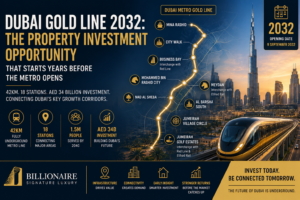
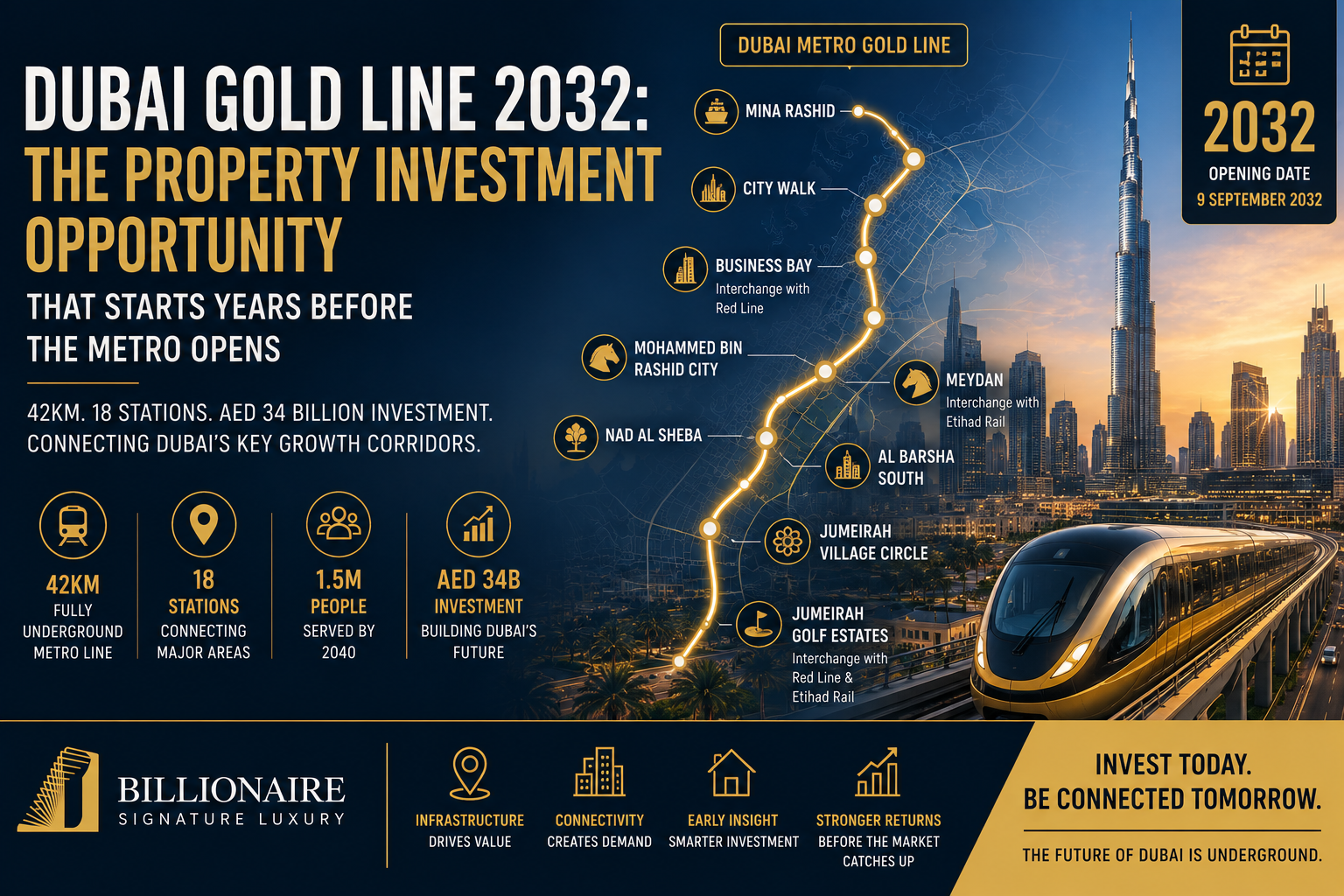
On 22 April 2026, the Dubai Government approved the Dubai Metro Gold Line, a fully underground 42-kilometre metro route with 18 stations and an investment of approximately AED 34 billion. The line is scheduled to open on 9 September 2032.
For most people, 2032 feels far away.
For property investors, that is precisely what makes the project interesting.
The strongest infrastructure-led property opportunities rarely begin on opening day. They begin when the route is announced, communities are identified, developers adjust their plans and buyers start anticipating the improvement in connectivity.
Dubai’s own Metro history provides evidence of this effect. A CBRE study found that properties within a 15-minute walk of Dubai Metro’s Red Line stations recorded average price growth of 26.7% between Q1 2010 and Q4 2022, compared with 24.1% across Dubai overall. Properties within 10–15 minutes recorded even stronger average growth of 43.8%.
The Gold Line is therefore not simply a transport story.
It is potentially a property repricing story that starts years before 2032.
What Is the Dubai Metro Gold Line?
The Gold Line will be Dubai’s first fully underground metro line.
It will stretch approximately 42 kilometres, run at depths of up to 40 metres and contain 18 stations. The Government of Dubai expects the line to serve around 1.5 million people by 2040 and connect more than 55 major development projects currently under construction.
The project will connect with:
- The Green Line at Al Ghubaiba
- The Red Line at Business Bay
- The Red Line at Jumeirah Golf Estates
- Etihad Rail at Meydan
- Etihad Rail at Jumeirah Golf Estates
The planned corridor is particularly interesting for property investors because it crosses both established and emerging parts of Dubai.
The official route identifies areas including Mina Rashid, City Walk, Business Bay, Mohammed Bin Rashid City, Nad Al Sheba, Mohammed bin Rashid Gardens, Meydan, Al Barsha South, Jumeirah Village Circle and Jumeirah Golf Estates.
This creates something more significant than a simple extension of the existing network.
It creates a new connectivity corridor through several communities that have historically been more dependent on road transport.
Why 2032 Is Not Actually Seven Years Away for Property Investors
A common mistake is to think:
“The Gold Line doesn’t open until 2032, so I have plenty of time.”
That is not how infrastructure-driven property markets normally work.
Property markets are forward-looking.
When a major road, railway or metro project is officially announced, buyers begin considering what the infrastructure will mean for future commuting, tenant demand and resale liquidity.
Developers respond to those expectations.
Investors respond to developers.
And eventually, prices begin reflecting the expected benefit.
The Gold Line has already attracted attention from property-market participants. Gulf News reported in June 2026 that JVC, MBR City, Meydan, Al Barsha South, Business Bay and Jumeirah Golf Estates were emerging as areas of interest because of their expected connectivity improvement.
That does not mean prices in every one of these communities will rise by a fixed percentage.
It means the investment thesis has changed.
The Historical Metro Effect Is the Important Part
There is already a significant amount of evidence from Dubai’s existing Metro network.
CBRE’s 2023 Dubai Metro Report analysed residential performance relative to station proximity between Q1 2010 and Q4 2022.
It found that properties within a 15-minute walk of Red Line stations recorded average price growth of 26.7%, compared with 24.1% for Dubai overall.
The strongest performance was recorded in the 10–15-minute walking category, at 43.8%, while properties within 0–5 minutes recorded 35.8%.
The important lesson is not to take these historical percentages and apply them mechanically to the Gold Line.
You cannot assume that buying a property today will produce the same return.
The more useful lesson is this:
Transport accessibility can become a measurable component of property value.
And the effect is strongest when the infrastructure solves a genuine mobility problem.
Which Communities Could Benefit Most?
Not every Gold Line location deserves the same investment attention.
The strongest opportunities are likely to be communities where three conditions overlap:
Existing demand + connectivity gap + future development.
Several areas stand out.
1. Jumeirah Village Circle: From Car-Dependent to Connected
JVC is perhaps one of the most obvious communities to watch.
It already has a large residential population, a deep rental market and relatively accessible property prices compared with Dubai’s prime districts.
Its weakness has historically been connectivity.
The Gold Line could change that.
For tenants, direct Metro access can reduce dependence on private vehicles.
For landlords, that potentially expands the pool of tenants who consider the community practical.
For resale investors, it creates another layer of demand beyond price.
That is important because JVC already has significant residential supply.
The Gold Line does not automatically make every JVC property a good investment.
Instead, investors should look for properties that combine Gold Line accessibility with strong existing rental fundamentals.
The best opportunities may not be the newest or most heavily marketed buildings.
They may be properties that already work as investments and gain additional connectivity later.
2. Mohammed Bin Rashid City: Connectivity Meets Premium Development
Mohammed Bin Rashid City is another important part of the Gold Line story.
The area has been developing into one of Dubai’s major residential and lifestyle corridors, with large-scale projects, villas, apartments and mixed-use development.
The Gold Line could strengthen its connection to Business Bay and the wider Metro network.
That matters particularly for residents who want the lifestyle characteristics of MBR City without sacrificing access to Dubai’s major employment and commercial centres.
For investors, the opportunity is less about buying because a Metro line is coming and more about identifying well-positioned assets before connectivity becomes fully reflected in pricing.
3. Meydan: The Infrastructure Intersection
Meydan is particularly interesting because the Gold Line will integrate with Etihad Rail at Meydan.
That creates a potentially important intersection between Dubai’s urban Metro network and the UAE’s national passenger rail system.
This matters because connectivity is increasingly becoming multi-layered.
A property connected to:
Metro + Etihad Rail + road network
has a different long-term accessibility profile from one that depends entirely on private vehicles.
Meydan is also undergoing significant residential and commercial development.
That combination makes the area worth watching over a multi-year horizon.
4. Al Barsha South: A Connectivity Gap With Potential
Al Barsha South has developed rapidly but has historically been less connected to the Metro network than some of Dubai’s established central districts.
The Gold Line changes that equation.
The Government of Dubai specifically identifies Al Barsha South as one of the strategic locations along the new corridor.
For investors, this is the type of community where infrastructure can have an especially meaningful effect.
The reason is simple:
The infrastructure is solving a real problem.
A Metro station is much more valuable when it materially improves accessibility for residents who previously depended on cars.
5. Business Bay: An Interchange Is More Valuable Than a Simple Station
Business Bay is already one of Dubai’s strongest real estate markets.
So why would the Gold Line matter?
Because it will connect to the existing Red Line at Business Bay.
Interchange locations can be particularly powerful because they connect multiple parts of the city rather than simply providing access to one corridor.
For Business Bay, this could strengthen its role as a central residential and commercial hub.
But there is an important caveat.
Business Bay already commands significant pricing because of its location.
Therefore, investors should not assume that the Gold Line automatically creates huge additional upside.
The infrastructure benefit may already be partially reflected in property pricing.
This is a recurring theme throughout the Gold Line investment story:
The best infrastructure investment is not necessarily the property closest to the station. It is the property where the future connectivity benefit is greatest relative to today’s price.
6. Jumeirah Golf Estates: The National Rail Connection
Jumeirah Golf Estates is perhaps the most strategically interesting endpoint.
The Gold Line will connect with the existing Red Line and integrate with Etihad Rail at Jumeirah Golf Estates.
This creates a particularly unusual combination:
Dubai Metro + Etihad Rail + established residential community.
The location is already significant within Dubai’s residential market.
It is also part of the wider Etihad Rail connectivity story, making it relevant to investors thinking beyond Dubai’s internal transport network.
Our earlier analysis of Etihad Rail and Dubai property investment looks at this wider infrastructure effect.
The Opportunity Is Not “Buy Anything Near the Gold Line”
This is where investors need to be careful.
Infrastructure announcements create excitement.
Excitement creates marketing.
Marketing creates inflated expectations.
And inflated expectations can lead investors to overpay.
The historical evidence from Dubai’s Metro shows that proximity matters, but it does not guarantee superior performance for every property.
CBRE found significant differences even between properties at different walking distances from stations. Some locations significantly outperformed, while others did not.
That tells us something important.
Metro proximity is a factor, not an investment strategy.
You still need to evaluate:
- Purchase price
- Property quality
- Developer reputation
- Service charges
- Rental demand
- Existing occupancy
- Future supply
- Walking distance to the station
- Road access
- Community amenities
- Resale liquidity
The Gold Line should strengthen a good investment.
It should not be used to justify a bad one.
Why Walking Distance Will Matter
One of the biggest mistakes investors can make is assuming that being in the same community as a Metro station means being “Metro-connected.”
It doesn’t.
There is a major difference between:
A five-minute walk
and
A 20-minute drive.
The CBRE data demonstrates that proximity has a measurable relationship with property performance.
For Gold Line investments, BSL would therefore recommend looking at the actual pedestrian relationship between the property and the future station, not simply the community name.
The same principle applies to rental properties.
A tenant is unlikely to pay a premium for “future Metro access” if reaching the station still requires a car.
The Best Time May Be Before the Market Becomes Comfortable
The Gold Line is scheduled to open on 9 September 2032, but the project is already moving through its official development timeline.
The government has directed immediate commencement, with tender issuance planned for 2026 and contract award expected in 2027.
That creates several potential investment phases.
Phase 1: Announcement
This is where the market is now.
Information is new.
Expectations are forming.
Some investors are paying attention while others are ignoring the project because completion is years away.
Phase 2: Construction
As physical construction progresses, uncertainty decreases.
More buyers begin to accept the infrastructure as a genuine future benefit.
This is typically when the investment story becomes easier to explain to the broader market.
Phase 3: Pre-opening
The closer the opening date becomes, the harder it becomes to buy purely on future expectations.
More of the benefit may already be priced into properties.
Phase 4: Operational
Once the Metro is running, the investment thesis changes again.
You can measure:
- Passenger usage
- Rental demand
- Tenant preferences
- Traffic changes
- Actual transaction premiums
- Resale liquidity
The opportunity does not necessarily disappear after opening.
But the early-entry advantage can diminish.
Gold Line vs Blue Line: Why Investors Should Not Confuse the Two
Dubai is currently developing multiple major rail projects.
The Blue Line is scheduled to open in 2029 and will connect areas including Dubai Creek Harbour, Dubai Festival City, International City, Dubai Silicon Oasis, Academic City, Mirdif and Al Warqa.
The Gold Line is a different project.
It is larger at 42 kilometres, has 18 stations, and is scheduled for 2032. It will connect the city’s historic centre with major central and western residential corridors.
For investors, this creates an interesting broader theme:
Dubai is building a property market around connectivity.
The Blue Line is already under construction.
The Gold Line is beginning its journey.
Etihad Rail is expanding national connectivity.
Road infrastructure is also being upgraded.
The result could be a significant reshaping of Dubai’s residential geography over the next decade.
What Could Happen to Rents?
The rental impact could be just as important as capital appreciation.
Historically, Metro access has increased tenant interest.
During the original Dubai Metro rollout, properties close to stations attracted higher demand, and reports at the time documented rental increases in areas around stations.
More recent industry commentary on the Gold Line has suggested that rents in connected communities could potentially rise by 15%–30%, although these are market expectations rather than guaranteed outcomes.
Investors should therefore treat such numbers as scenarios, not forecasts.
A more reliable strategy is to identify properties where rental demand already exists and ask:
Would better connectivity make this property attractive to a larger tenant pool?
If the answer is yes, the Gold Line becomes an additional investment catalyst.
The Three Types of Properties BSL Would Watch
For investors looking at the Gold Line today, three categories stand out.
1. Ready properties with existing rental demand
These provide immediate income while giving the investor exposure to future infrastructure.
This is arguably the lower-risk approach.
You are not betting entirely on 2032.
The property has to work today.
The Gold Line becomes the upside.
2. Near-handover properties
These can offer a middle ground between ready and early-stage off-plan.
You get visibility on the asset while retaining some future infrastructure upside.
3. Early-stage off-plan properties in strategically positioned communities
These provide the greatest exposure to the full infrastructure timeline.
They also carry greater risk.
Investors must evaluate:
- Developer track record
- Construction progress
- Payment plan
- Handover date
- Future competing supply
- Exit strategy
Our Dubai off-plan property investment guide covers these considerations in more detail.
The Biggest Risk: Paying the Gold Line Premium Too Early
The irony of infrastructure investing is that everyone eventually knows about the infrastructure.
The question is whether you paid the right price before everyone knew.
If a developer launches a project specifically marketing “Gold Line connectivity” and prices it significantly above comparable properties, the future Metro benefit may already be incorporated into the price.
That destroys part of the investment advantage.
The strongest opportunity is therefore not:
“Find the property with the biggest Gold Line marketing campaign.”
It is:
“Find the property where the current price still reflects today’s connectivity rather than tomorrow’s.”
That requires comparative analysis.
What This Means for BSL Group UAE Investors
At BSL Group UAE, the Gold Line should be viewed as a long-term investment filter, not a reason to buy indiscriminately.
We would evaluate potential acquisitions through several layers:
1. Current fundamentals
Does the property make sense today?
2. Community demand
Who lives there and who will rent or buy it?
3. Future connectivity
How materially will the Gold Line improve accessibility?
4. Supply
How many competing properties will exist by 2032?
5. Entry price
How much of the future Metro premium is already priced in?
6. Exit
Who is likely to buy the property when you eventually sell?
This approach is particularly important because Dubai’s property market is becoming increasingly fragmented by community, property type and supply.
Our recent analysis of Dubai property prices and the 2026 community investment map explores this broader shift.
The Bottom Line
The Dubai Metro Gold Line does not open until September 2032.
That is exactly why property investors should be paying attention now.
The project will create a 42-kilometre, 18-station underground corridor connecting established districts, emerging residential communities and major development zones. It will also connect with Dubai’s existing Metro network and Etihad Rail.
Dubai’s previous Metro experience shows that transport accessibility can influence property values and rental demand.
But the opportunity is not about predicting that every Gold Line property will rise by 20%, 30% or any other fixed number.
It is about identifying where connectivity is currently undervalued.
The best Gold Line investments may therefore be the properties that:
- Already have genuine demand
- Are reasonably priced today
- Will gain meaningful transport accessibility
- Have limited competing supply
- Are attractive to both tenants and future buyers
In other words:
Don’t wait for the Metro to open.
But don’t buy simply because a Metro line is coming either.
The investment opportunity lies somewhere in between — buying fundamentally strong property before the future connectivity premium becomes fully visible in the market.
Frequently Asked Questions
When will the Dubai Metro Gold Line open?
The Gold Line is scheduled to open on 9 September 2032. The project was approved in April 2026, with immediate commencement directed by the Dubai Government.
Which areas will the Dubai Gold Line serve?
The official route includes areas such as Mina Rashid, City Walk, Business Bay, Mohammed Bin Rashid City, Nad Al Sheba, Mohammed bin Rashid Gardens, Meydan, Al Barsha South, Jumeirah Village Circle and Jumeirah Golf Estates.
Will the Gold Line increase Dubai property prices?
It could support property values in well-positioned communities, particularly where improved connectivity addresses an existing transport gap. Historical Dubai Metro data shows properties near stations have outperformed the wider market in several periods, but the effect is not uniform.
Which Dubai areas could benefit most from the Gold Line?
JVC, Meydan, MBR City, Al Barsha South, Business Bay and Jumeirah Golf Estates are among the communities receiving significant investor attention. However, the best opportunity will depend on the exact property, station proximity, entry price and future supply.
Is it too early to invest in Gold Line properties?
Not necessarily. The project’s opening is years away, but the official route and investment have already been announced. Early investors can potentially benefit from future repricing, although they also take greater uncertainty around construction, pricing and market conditions.
How close should a property be to a Gold Line station?
Actual walking accessibility matters more than simply being in the same community. Historical CBRE research found meaningful differences in performance based on walking distance from existing Dubai Metro stations.
Should I buy off-plan property near the Gold Line?
Off-plan property can provide early exposure to future infrastructure benefits, but it also carries developer, construction, handover and market risks. A ready or near-handover property can provide a more defensive approach because it has current rental or end-user fundamentals.