Dubai’s real estate story has traditionally been told through apartments, villas, branded residences and luxury developments.
But another property market is quietly becoming just as important to the emirate’s economic future:
Industrial and Logistics Real Estate.
Behind every e-commerce order, imported product, pharmaceutical shipment, manufacturing operation and regional distribution network is physical infrastructure.
Warehouses.
Distribution centres.
Fulfilment facilities.
Industrial land.
3PL facilities.
And increasingly, strategically located logistics assets.
In 2026, this segment is attracting growing attention from occupiers, developers and investors.
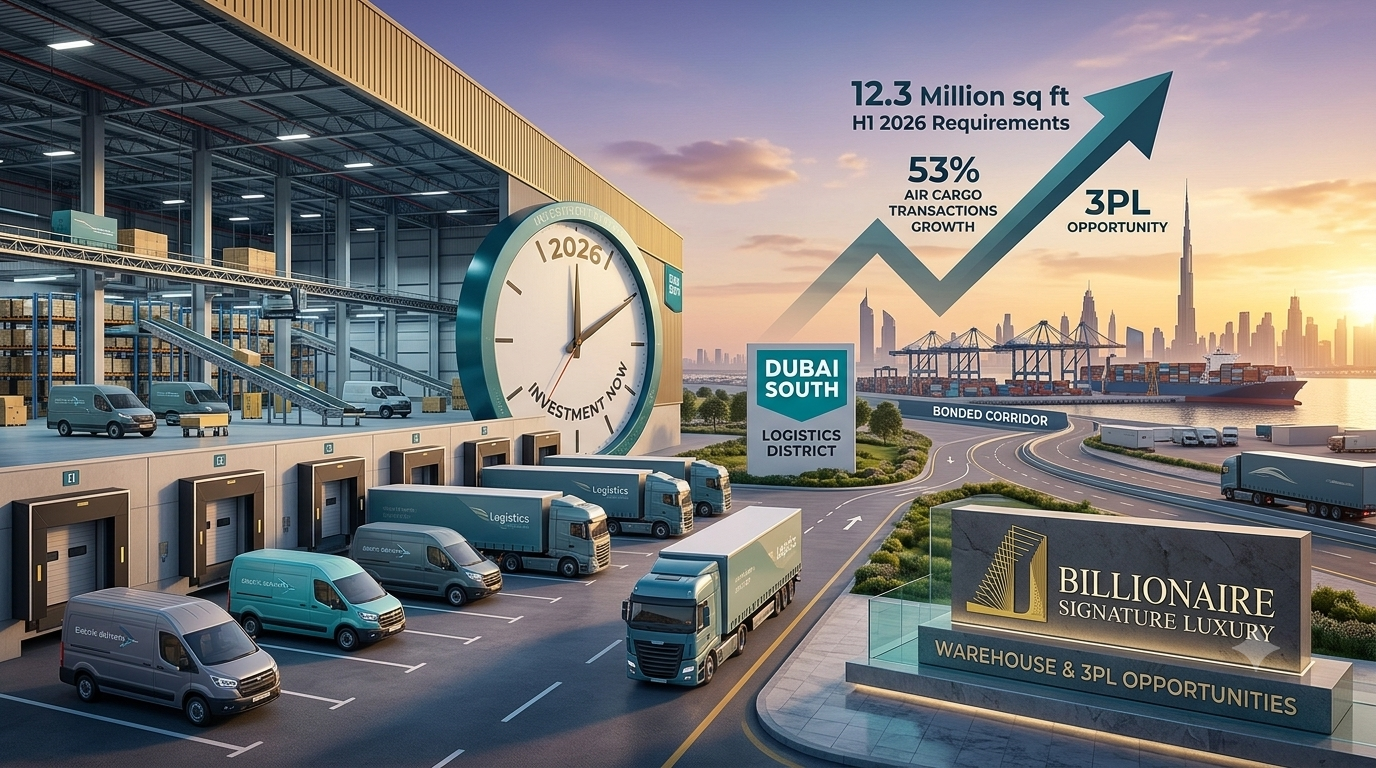
Dubai recorded 12.3 million sq ft of new industrial and logistics requirements during the first half of 2026, compared with 11.5 million sq ft in H1 2025, according to Knight Frank. Manufacturing and industrial occupiers represented 35.1% of Dubai’s requirements, while logistics accounted for another 15.5%.
This is more than a warehouse story.
It is a story about Dubai’s position as a global trade, e-commerce and distribution hub.
And for investors looking beyond conventional residential property, that creates a very different opportunity.
Why Dubai’s Logistics Property Market Matters in 2026
Dubai sits at the intersection of major global trade routes.
It connects businesses across:
- Asia
- Europe
- Africa
- The Middle East
Its ports, airports, free zones, highways and increasingly multimodal infrastructure make the emirate particularly attractive to companies that need to move products quickly.
That economic activity creates demand for physical space.
A retailer needs inventory storage.
An e-commerce company needs fulfilment space.
A manufacturer needs production and distribution facilities.
A pharmaceutical company may need specialised temperature-controlled storage.
A 3PL provider needs warehouses from which it can serve multiple clients.
Therefore, the demand for logistics real estate isn’t based solely on property speculation.
It is connected to real economic activity.
That distinction makes industrial property particularly interesting for investors looking for assets backed by operational demand.
Dubai’s Industrial Demand Is Getting Bigger — and More Selective
The headline 12.3 million sq ft figure is impressive.
But another part of Knight Frank’s H1 2026 research is arguably more interesting.
Demand for facilities exceeding 100,000 sq ft reached 27% of Dubai’s requirements, compared with just 7.8% in H2 2025.
At the same time, occupiers are becoming more selective.
Location matters.
Building quality matters.
Access matters.
Efficiency matters.
Connectivity matters.
This is creating a more sophisticated industrial-property market.
The question is no longer simply:
“Where can I find a warehouse?”
It is:
“Which warehouse or industrial asset gives my business or investment the best combination of location, connectivity, operating efficiency and long-term value?”
That is a much more important question.
The Rise of the 3PL Economy
One of the most important trends behind the logistics-property market is the growth of third-party logistics, or 3PL.
A 3PL provider allows another company to outsource parts of its supply chain.
That might include:
- Warehousing
- Inventory management
- Order fulfilment
- Distribution
- Transportation
- Packaging
- Returns management
- Cross-border logistics
- Value-added services
Instead of building and operating an entire logistics network itself, a business can use a specialised logistics partner.
This model is particularly useful for:
- E-commerce companies
- Retailers
- Manufacturers
- International brands entering the UAE
- SMEs
- Regional distributors
- Businesses expanding into GCC markets
As these businesses grow, their physical requirements grow with them.
That is where 3PL-ready real estate becomes increasingly valuable.
E-Commerce Is Changing What a Warehouse Needs to Do
The modern warehouse is no longer simply a large building filled with boxes.
E-commerce has changed expectations.
Customers increasingly expect:
Fast fulfilment.
Accurate inventory.
Quick delivery.
Easy returns.
Real-time tracking.
That requires logistics infrastructure capable of supporting much faster inventory movement.
Dubai South provides a useful example.
In November 2025, Dubai South inaugurated a 23,000-square-metre logistics facility for INDU Kishore Logistics with storage capacity for approximately 75,000 pallets. The facility was specifically designed to handle e-commerce operations and incorporates data-driven automation.
This illustrates an important change in industrial real estate.
A modern warehouse is increasingly becoming a technology-enabled operating platform.
Dubai’s Air Cargo Growth Adds Another Layer of Demand
The logistics story becomes even more interesting when aviation is considered.
Dubai Customs reported that its Air Cargo Centers Management processed approximately 18.2 million customs transactions during H1 2026, compared with approximately 11.9 million during H1 2025 — an increase of nearly 53%.
Cargo weight also rose by approximately 47%, reaching around 1.3 million tonnes.
Dubai Customs also reported more than 6.2 million postal parcels, highlighting the connection between e-commerce and the emirate’s air-cargo infrastructure.
For logistics investors, this matters because warehousing demand doesn’t exist independently.
It sits within a wider ecosystem:
Airports → customs → warehouses → fulfilment → road networks → customers.
The closer and more efficiently connected these components are, the more strategically valuable the real estate can become.
Why Location Is Everything in Logistics Real Estate
For a residential property, being near a metro station, school or shopping centre may influence demand.
For logistics property, the calculation is different.
Investors and operators may care about:
- Port access
- Airport access
- Highway connectivity
- Free-zone proximity
- Labour availability
- Customer density
- Customs infrastructure
- Truck accessibility
- Loading and unloading efficiency
- Expansion potential
This is why areas such as Dubai South and Jebel Ali are particularly important to watch.
Dubai South’s Logistics District has direct connectivity to Jebel Ali Port through a bonded logistics corridor, alongside access to Al Maktoum International Airport and dedicated e-commerce infrastructure.
Jafza is another major logistics ecosystem.
In the first four months of 2026, DP World reported AED 854 million of investment commitments at Jafza, including investments by third-party logistics providers, manufacturers, healthcare businesses and vehicle-logistics operators. Jafza is home to approximately 12,000 businesses.
That is the kind of ecosystem industrial-property investors should be studying.
Dubai South vs Jebel Ali: What Should Investors Watch?
The two locations serve somewhat different strategic purposes.
Dubai South
Dubai South is closely associated with:
- Aviation
- E-commerce
- Logistics
- Large distribution facilities
- Al Maktoum International Airport
- Multimodal connectivity
- New logistics developments
The area is becoming increasingly important to businesses seeking modern logistics infrastructure.
Jebel Ali
Jebel Ali benefits from its established port and free-zone ecosystem.
Jafza’s scale is particularly important for companies involved in:
- Manufacturing
- Import/export
- Distribution
- Logistics
- Food
- Healthcare
- Automotive
- Industrial activity
The key lesson is that industrial real estate should be analysed through connectivity and economic ecosystems, not simply neighbourhood names.
What Makes a Good Warehouse Investment in Dubai?
Not every warehouse is automatically a good investment.
An attractive industrial asset should be evaluated through several lenses.
1. Location
How efficiently can goods move in and out?
A warehouse located close to major transport infrastructure can have a structural advantage.
2. Building Specification
Modern occupiers may require:
- High ceilings
- Efficient loading bays
- Modern racking potential
- Adequate power
- Temperature control
- Fire and safety systems
- Office space
- Yard space
- Parking
- Automation compatibility
Older buildings can sometimes offer lower acquisition costs, but investors must evaluate the cost of upgrading them.
3. Tenant Demand
Who would actually use the facility?
A property designed around a very narrow tenant profile may carry more leasing risk.
A flexible warehouse capable of serving several industries may offer a broader tenant pool.
4. Lease Quality
For an income-producing asset, the tenant matters enormously.
Investors should examine:
- Lease duration
- Rental escalation
- Tenant credit quality
- Renewal probability
- Vacancy risk
- Operating obligations
- Maintenance responsibilities
A warehouse is not simply a building.
It is an income-producing operating asset.
5. Expansion Potential
Can the site accommodate future expansion?
Can the building be reconfigured?
Can additional storage be added?
Can the property support automation?
Flexibility can become increasingly valuable as logistics businesses evolve.
Why Mid-Sized Warehouses Are Particularly Interesting
One of the most useful findings from Knight Frank’s research is the continued demand for mid-sized facilities.
During H2 2025, warehouses between 10,001 and 50,000 sq ft accounted for 58.1% of recorded requirements in Dubai.
In H1 2026, that segment still accounted for 35.5% of requirements, while facilities between 50,001 and 100,000 sq ft represented 32.2%.
This tells investors something important.
The opportunity isn’t necessarily limited to enormous distribution centres.
There is also substantial demand for flexible, scalable industrial space.
That can be particularly relevant for growing businesses and SMEs.
The New Industrial Investor Is Looking at More Than Rental Yield
Residential property investors often begin with:
“What is the ROI?”
Industrial investors need to go further.
Consider:
Rental yield
What income does the asset generate relative to its value?
Occupancy
How likely is the property to remain occupied?
Tenant quality
Who is paying the rent?
Location
How strategically positioned is the asset?
Replacement cost
How difficult and expensive would it be to build an equivalent facility?
Supply
How much competing stock is entering the market?
Infrastructure
Is connectivity improving?
Adaptability
Can the asset serve changing occupier requirements?
This creates a more sophisticated investment thesis.
Supply Is Increasing — But That Doesn’t Mean Every Warehouse Is Equal
The UAE industrial market is entering a period where additional supply is becoming available.
Knight Frank noted that newly completed stock is giving occupiers greater choice, while rental performance is becoming increasingly differentiated by location and asset quality.
That is actually healthy for the market.
It means investors cannot simply assume:
“Any warehouse in Dubai will perform well.”
Instead, asset quality becomes more important.
A strategically located Grade A warehouse with strong specifications may perform very differently from an older facility in a less connected location.
That differentiation is exactly what creates opportunities for informed investors.
Why 3PL-Ready Assets Could Become Especially Valuable
There is another interesting angle.
A warehouse can be valuable not only because a company wants to occupy it.
It can be valuable because it can support multiple logistics business models.
A 3PL-ready facility can potentially accommodate:
- Inventory storage
- E-commerce fulfilment
- Distribution
- Cross-docking
- Packaging
- Returns
- Value-added services
This flexibility can broaden the potential occupier pool.
Dubai South’s newer logistics developments demonstrate this direction.
Its multi-user facilities launched for SMEs and logistics businesses offer flexible, combinable units with direct access to major transport infrastructure and temperature-controlled environments.
The trend is clear:
Flexibility is becoming a feature of industrial real estate.
The Investment Case Is Also About Dubai’s Economic Diversification
Dubai’s logistics market is supported by more than e-commerce.
The H1 2026 Knight Frank data showed manufacturing and industry as the largest source of new requirements, at 35.1%, followed by logistics at 15.5%.
This diversification matters.
Demand can come from:
- Manufacturing
- Retail
- E-commerce
- Food and beverage
- Healthcare
- Automotive
- Technology
- Trading
- Distribution
- Logistics providers
That makes industrial real estate part of the broader economic infrastructure of Dubai.
Is Warehouse Investment Better Than Residential Property?
There is no universal answer.
Residential property and industrial property serve different investment objectives.
| Factor | Residential Property | Industrial / Logistics Property |
|---|---|---|
| Main demand driver | People | Businesses |
| Tenant profile | Individuals/families | Companies/operators |
| Key location factors | Lifestyle/access | Infrastructure/connectivity |
| Asset management | Often frequent | More operationally specialised |
| Lease structure | Usually shorter | Often longer |
| Main risk | Vacancy / tenant turnover | Tenant concentration / industrial supply |
| Value drivers | Location + demand | Location + infrastructure + functionality |
| Technology requirement | Moderate | Increasingly important |
| Typical investor focus | Yield + appreciation | Income + operational relevance |
The right choice depends on the investor.
But industrial real estate can provide exposure to Dubai’s economic infrastructure, rather than only its residential growth.
What BSL’s Warehouse & 3PL Service Actually Covers
This is where BSL’s new service offering becomes particularly relevant.
BSL describes its Warehouse & 3PL Opportunities vertical as providing access to selected industrial and logistics opportunities focused on warehousing, logistics, storage and third-party logistics assets.
The service covers four principal asset categories:
Warehouse Facilities
Purpose-built storage and distribution facilities for operators and investors.
3PL-Ready Assets
Facilities suitable for third-party logistics, fulfilment and inventory-handling operations.
Industrial Land
Plots positioned for logistics, warehousing, light industrial or development uses.
Leased Industrial Assets
Income-producing industrial properties with existing tenants or operational use cases.
This gives BSL an interesting position in the market.
It isn’t simply about finding a vacant warehouse.
It is about identifying industrial real estate that fits an investment or operational requirement.
How BSL Approaches Warehouse & Logistics Opportunities
BSL’s stated process follows four stages:
Requirement Review → Asset Shortlisting → Commercial Evaluation → Transaction Support.
That structure is important because industrial real estate often requires a different analysis from residential property.
An investor may need to understand:
- Operational suitability
- Tenant profile
- Lease economics
- Location
- Infrastructure
- Development potential
- Commercial viability
BSL positions its Warehouse & 3PL service for private investors, 3PL operators, developers and businesses requiring storage, fulfilment or distribution facilities.
That makes the service relevant to both capital and operations.
Who Should Consider Dubai Warehouse Investment?
Industrial and logistics property isn’t for every investor.
But it may be worth investigating for:
Private Investors
Investors seeking exposure to income-producing commercial real estate.
Family Offices
Long-term capital looking for strategic real assets.
3PL Operators
Companies seeking facilities from which to expand operations.
E-Commerce Businesses
Companies needing fulfilment and distribution infrastructure.
Developers
Groups looking for industrial land or development opportunities.
Manufacturers
Businesses requiring strategically located production and storage facilities.
International Companies Entering the UAE
Businesses needing a regional distribution base.
What Should You Ask Before Buying a Warehouse in Dubai?
Before committing capital, investors should ask:
- Who is the likely tenant?
- What industries are driving demand in this location?
- How accessible is the asset to ports, airports and major roads?
- What is the current occupancy rate?
- What competing supply is under construction?
- How modern is the building?
- Can it support automation?
- What are the service and operating costs?
- What is the current lease structure?
- Could the property be adapted for another tenant?
- What is the realistic exit market?
- Is the investment value driven by the building, the land, the tenant, or all three?
These questions can reveal whether you’re looking at a genuine strategic asset or simply an expensive warehouse.
The Bigger Opportunity: Investing in the Infrastructure Behind Dubai’s Growth
The most interesting thing about industrial real estate is that it is easy to overlook.
People notice a luxury apartment tower.
They don’t necessarily notice the warehouse that makes next-day delivery possible.
They notice the retail store.
They don’t see the distribution facility supplying it.
They notice an online order arriving at their home.
They don’t see the fulfilment centre, inventory system, transport network and logistics operation behind it.
But investors can.
And that is where the opportunity becomes interesting.
Dubai is continuing to invest in the infrastructure that connects air, sea, road, rail, commerce and industry.
The logistics property supporting that infrastructure is therefore becoming increasingly important.
Final Thoughts
Dubai’s next real estate opportunity may not always be residential.
The emirate’s industrial and logistics market is being supported by powerful structural trends:
E-commerce.
Trade.
Manufacturing.
Regional distribution.
Air cargo.
Free-zone expansion.
Supply-chain localisation.
Multimodal connectivity.
And the numbers are already showing the scale of the market.
Dubai recorded 12.3 million sq ft of new industrial and logistics requirements in H1 2026.
Dubai Customs processed 18.2 million air-cargo customs transactions during the same period, up nearly 53% year on year.
Jafza attracted AED 854 million in investment commitments in the first four months of 2026, including from logistics and 3PL businesses.
These are not isolated property statistics.
They are signals of a broader economic ecosystem.
For investors, developers and businesses, the question is therefore becoming:
Where are the real assets supporting Dubai’s next phase of economic growth?
Warehouses, logistics facilities, industrial land and 3PL-ready assets may be one of the answers.
And in a market where location, connectivity and operational relevance increasingly determine value, the right industrial property can be much more than a warehouse.
It can be infrastructure for growth.
Frequently Asked Questions
Is warehouse investment a good opportunity in Dubai in 2026?
Dubai’s industrial and logistics market is showing strong underlying demand. Knight Frank recorded 12.3 million sq ft of new industrial and logistics requirements in H1 2026, although investors should assess individual assets, tenants, locations and future supply carefully.
What is 3PL in logistics?
3PL means third-party logistics. A 3PL provider manages logistics functions for another company, which can include warehousing, inventory management, fulfilment, distribution, transportation and related services.
Which areas of Dubai are important for warehouse investment?
Dubai South and Jebel Ali are particularly important logistics ecosystems because of their connections to airports, ports, free zones and major transport infrastructure. The best location depends on the asset’s intended use and target occupier.
Why is Dubai South important for logistics?
Dubai South’s Logistics District combines access to Al Maktoum International Airport, Jebel Ali Port through a bonded logistics corridor, e-commerce infrastructure and other logistics facilities.
What types of warehouse assets can investors consider?
Options include traditional warehouse facilities, 3PL-ready properties, leased income-producing warehouses and industrial land suitable for logistics or warehouse development.
Are Grade A warehouses in demand in Dubai?
Yes. Cushman & Wakefield Core reported average Grade A occupancy of 95% across the UAE, with Dubai rents rising 18% year on year in its 2025/2026 market update.
Is Dubai’s warehouse market only driven by e-commerce?
No. Manufacturing and industrial occupiers were the largest source of Dubai’s industrial requirements in H1 2026, accounting for 35.1%, while logistics represented another 15.5%.
Can BSL help find a warehouse or 3PL asset in Dubai?
Yes. BSL’s Warehouse & 3PL Opportunities service covers warehouse facilities, 3PL-ready assets, industrial land and leased industrial properties, with support from requirement review through transaction coordination.