
Dubai property investment is often marketed around short-term opportunities: launch prices, payment plans, projected appreciation and rental yields. But for investors who want to make a disciplined decision, a better question is:
Would I still want to own this property five years from now?
That is the idea behind the 5-year property investment Dubai test.
Instead of trying to predict exactly what Dubai property prices will do next month or next year, investors can evaluate whether a property has the fundamentals to remain attractive through different market conditions.
This matters in 2026 because Dubai’s residential market is entering a more mature phase. H1 2026 recorded 80,509 residential sales worth AED 226.5 billion, while buyers became increasingly selective about developer reputation, location, property quality, pricing and long-term investment potential.
At the same time, new supply is increasing. Dubai added around 24,800 homes during H1 2026, according to Cavendish Maxwell data reported by Gulf News, giving buyers and tenants more choice.
That means investors need to think beyond:
“Can this property make money?”
and ask:
“Can this property continue to make sense as the market changes?”
The five-year holding test provides a practical way to answer that.
What Is the 5-Year Holding Test?
The 5-year holding test is a simple investment framework.
Before buying a Dubai property, imagine that you are not allowed to sell it for five years.
Then ask:
- Would I still want to own it?
- Would tenants still want it?
- Will the community still be attractive?
- Will new supply make it less competitive?
- Will the property still have resale demand?
- Can I comfortably hold it through a weaker market?
- Will the rental income justify the ownership costs?
- Does the developer and building have staying power?
- Is there a realistic reason for the property to appreciate?
If the answer to most of these questions is yes, the investment may have a stronger long-term foundation.
If the investment only looks attractive because:
“I can sell it next year for more,”
the strategy is much more dependent on market timing.
Why Five Years?
Five years is not a magical number.
It is a decision-making horizon.
Property is an illiquid asset. Buying and selling involves costs, negotiation and time. A longer holding period gives an investor more opportunity to benefit from:
- Rental income
- Community development
- Infrastructure improvements
- Population growth
- Property appreciation
- Market cycles
- Mortgage amortisation, where applicable
It also reduces the importance of predicting exactly what happens in one particular year.
Dubai’s current market illustrates why this matters.
After several years of exceptional growth, 2026 has become more balanced. Engel & Völkers describes buyers as more measured and selective, while other market forecasts expect growth to moderate rather than continue at the pace seen during the previous cycle.
A five-year investor can therefore approach the market differently from someone trying to flip a property within 12 months.
The First Test: Would You Still Want the Property in 2031?
Start with the simplest question.
Imagine it is 2031.
You own the same property.
Would you still be happy with:
- The location?
- The building?
- The community?
- The unit layout?
- The rental demand?
- The surrounding infrastructure?
- The amount of competing supply?
This forces you to think about durability.
A property that looks exciting because of a launch campaign may not necessarily be attractive five years later.
A property with:
- Strong connectivity
- Established demand
- Good community infrastructure
- Limited direct competition
- Quality construction
- Sustainable rental demand
may have a stronger chance of remaining relevant.
Year 0: The Entry Test
The five-year investment begins before you purchase.
This is where many investors make their biggest mistake.
They focus on:
“Can I afford the booking amount?”
instead of:
“Am I buying this property at a sensible valuation?”
The entry price matters because your future returns depend partly on what you pay today.
Suppose two identical properties eventually rent for AED 100,000 per year.
Investor A
Buys for AED 1.5 million.
Investor B
Buys for AED 1.8 million.
The rental income is identical.
But Investor A begins with:
- Lower capital deployed
- Higher gross yield
- Greater potential margin of safety
This is why negotiation and valuation matter even when the investment horizon is five years.
Test 1: Is the Purchase Price Justified?
Before buying, compare the property with:
- Recent transactions
- Comparable units
- Similar buildings
- New launches nearby
- Rental values
- Price per square foot
- Property condition
Don’t rely exclusively on:
“The developer says this is an early-bird price.”
An early launch isn’t automatically a bargain.
The relevant question is:
What is this property worth compared with realistic alternatives?
Year 1: The Stabilisation Test
The first year after purchase can look very different from the sales presentation.
For a completed investment property, Year 1 is about discovering:
- Actual rental income
- Tenant demand
- Service charges
- Maintenance costs
- Vacancy
- Property management expenses
For an off-plan investment, Year 1 may instead involve:
- Construction progress
- Instalment payments
- Market changes
- Developer communication
- Changes in competing supply
This is why investors should not base a five-year plan solely on projected numbers.
Actual performance matters.
Test 2: Does the Property Produce Real Income?
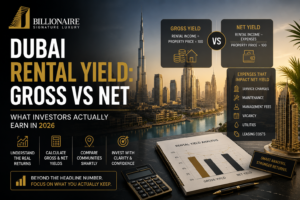
If the property is intended as a rental investment, calculate net rental yield, not just gross yield.
Dubai’s average gross residential rental yield was around 6.6% in June 2026, according to Engel & Völkers, with apartments averaging 6.9%, townhouses 5.1% and villas 4.5%.
But your property may perform very differently.
Calculate:
Gross yield
Annual rent ÷ purchase price × 100
Then deduct realistic costs such as:
- Service charges
- Maintenance
- Vacancy
- Property management
- Leasing costs
- Furnishing and replacement costs where relevant
The result gives you a much more realistic view of the income your property may generate.
Year 2: The Demand Test
By Year 2, you should ask:
Who actually wants this property?
This is more important than simply knowing that the property is located in Dubai.
Your demand may come from:
- Families
- Professionals
- Executives
- International tenants
- Local residents
- Investors
- Short-term visitors
- Corporate occupiers
The broader the sustainable demand base, the less dependent your investment may be on one narrow buyer segment.
Test 3: Would People Still Want to Live Here?
A five-year investment needs a community with durable demand.
Look at:
Connectivity
Are roads and public transport improving?
Employment
Are business districts accessible?
Education
Are schools and nurseries available?
Retail
Are shops and services developing?
Healthcare
Are hospitals and clinics accessible?
Lifestyle
Are parks, restaurants, beaches and leisure facilities nearby?
Community maturity
Does the area feel established or purely speculative?
A property doesn’t become a strong long-term investment simply because a developer builds a beautiful tower.
The surrounding ecosystem matters.
Year 3: The Competition Test
This is one of the most important parts of the five-year holding test.
Imagine you own a one-bedroom apartment.
Now imagine that by Year 3 there are:
3,000 new one-bedroom apartments
within the same competitive area.
Your property hasn’t changed.
But your buyer and tenant now have more choices.
That can affect:
- Rent
- Vacancy
- Resale price
- Negotiating power
- Marketing time
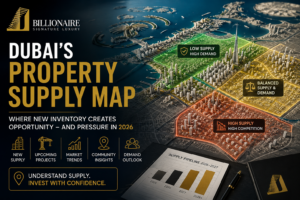
Dubai added around 24,800 homes in H1 2026, highlighting why future supply needs to be part of every long-term investment analysis.
Test 4: What Will Compete With Your Property in Five Years?
Don’t only study today’s supply.
Look at:
- Projects under construction
- Approved developments
- Major planned communities
- Future handovers
- Competing unit types
- Developer pipelines
Ask:
“If I sell this property in 2031, what alternatives will my buyer have?”
This is one of the most useful questions an investor can ask.
Supply Isn’t Automatically Bad
New development can actually improve a community.
It can bring:
- New residents
- Restaurants
- Retail
- Schools
- Roads
- Parks
- Transport
- Employment
- Community facilities
The problem isn’t simply new supply.
The real issue is:
Supply versus demand.
If demand grows alongside new inventory, additional development may be absorbed.
If supply grows much faster than demand, competition may become stronger.
This distinction is particularly important in Dubai’s current market.
Year 4: The Resilience Test
By Year 4, you should ask a more difficult question:
What happens if the market isn’t booming?
This is where a genuine investment strategy separates itself from speculation.
Dubai has experienced exceptional property growth in recent years, but Moody’s has expected a period of moderate cooling following five years of extraordinary growth. It also estimated that roughly 180,000 new units were due between 2026 and 2028, which could temper price gains, particularly in mid-market apartments.
That doesn’t mean Dubai property is necessarily a bad investment.
It means investors should avoid building their entire thesis around perpetual double-digit appreciation.
Test 5: Can You Hold Through a Slow Market?
Ask yourself:
If property prices remain flat for two years, can I still hold?
If rent grows more slowly than expected, can I still hold?
If the property is vacant for several months, can I still hold?
If the market value temporarily falls, can I avoid selling under pressure?
If the handover is delayed, can I continue funding the investment?
If the answer is no, the investment may be too financially aggressive.
The Importance of a Margin of Safety
A five-year investor should not structure a purchase around the most optimistic possible outcome.
Instead, create three scenarios.
Conservative
- Lower rental income
- Higher vacancy
- Minimal capital appreciation
- Higher costs
Base Case
- Reasonable rental income
- Normal occupancy
- Moderate appreciation
- Expected ownership costs
Optimistic
- Strong rental demand
- Low vacancy
- Strong capital growth
- Favourable market conditions
If the investment only works under the optimistic scenario, that’s a warning sign.
Year 5: The Exit Test
The fifth year is where the entire strategy comes together.
You now ask:
“Who will buy this property from me?”
This is the same principle behind the Dubai property liquidity test.
A property can have appreciated significantly on paper.
But if there are few buyers at the price you want, the theoretical gain isn’t the same as an easily realised gain.
Consider:
Property A
Value increased by 30%.
But there are many competing units.
Property B
Value increased by 20%.
But demand is deep and comparable properties sell regularly.
Property B may offer a more practical exit.
That is why capital appreciation and liquidity should be analysed together.
Test 6: Is the Property Easy to Resell?
Ask:
- How many comparable properties transact?
- Who is the likely buyer?
- Is the price point accessible?
- Is the building well regarded?
- Is the community established?
- Are many similar units being launched?
- Does the property have something distinctive?
The goal isn’t necessarily to own the property with the highest appreciation.
It is to own an asset that remains desirable.
The Five-Year Investment Equation
A useful simplified framework is:
Total Five-Year Return
Net rental income over five years
Capital appreciation
−
Acquisition costs
−
Ownership costs
−
Financing costs, where applicable
−
Selling costs
=
Estimated Net Investment Return
This is much more useful than simply saying:
“The property could rise 30%.”
Because a property investment generates returns through multiple channels.
Example: A Five-Year Dubai Investment
Imagine an investor purchases an apartment for:
AED 1,500,000
Assume the property generates an average net rental income of:
AED 75,000 per year
Over five years:
AED 375,000
Now suppose the property appreciates by 20%.
Estimated future value:
AED 1,800,000
Capital gain:
AED 300,000
Simplified combined return before acquisition, financing and selling costs:
AED 675,000
That’s:
AED 375,000 rental income
AED 300,000 capital appreciation
=
AED 675,000
This is only an illustration.
Actual rental income, appreciation and costs can be substantially different.
The purpose is to demonstrate why a five-year investment should be evaluated as a combined income-and-growth strategy.
Why a Five-Year Hold Can Change the Investment Decision
Consider two investors.
Investor A: Short-Term Mindset
Buys because:
“Prices will rise next year.”
Their success depends heavily on market momentum.
Investor B: Five-Year Mindset
Buys because:
- Rental demand is strong
- Purchase price is reasonable
- Community has durable demand
- Supply is manageable
- Developer is credible
- Property has resale appeal
- Investment remains affordable if appreciation slows
Investor B doesn’t need the market to perform perfectly every year.
That’s the advantage of a longer investment thesis.
But Five Years Doesn’t Automatically Make a Bad Property Good
This is important.
A long holding period cannot fix:
- Bad location
- Overpriced property
- Poor construction
- Weak rental demand
- Excessive service charges
- Poor developer execution
- Severe supply competition
- Unsustainable payment obligations
If the investment is fundamentally weak, holding it longer doesn’t magically create value.
The five-year test is therefore not:
“Buy anything and wait.”
It is:
“Buy something that can survive a five-year investment horizon.”
Location: The Five-Year Test
Ask what could change around the property.
Positive changes
- New metro connectivity
- Road improvements
- Schools
- Retail
- Business districts
- Tourism infrastructure
- Parks
- Community amenities
Negative changes
- Excessive competing supply
- Congestion
- Infrastructure delays
- Weak retail development
- Oversupply of similar units
- Poor community management
A five-year investor needs to think about trajectory, not just current conditions.
Developer: The Five-Year Test
For off-plan buyers, the developer can influence the entire investment experience.
Look at:
- Delivery history
- Construction quality
- Handover record
- Building management
- Previous communities
- Customer experience
- Resale reputation
Dubai buyers in 2026 are already becoming more selective about developer reputation and long-term investment potential, according to Engel & Völkers.
That makes developer due diligence particularly relevant for a five-year strategy.
Payment Plan: The Five-Year Test
A payment plan should make the investment manageable.
It should not simply make an expensive property look affordable.
Ask:
What percentage must I pay in Year 1?
What percentage is due at handover?
Do I need a mortgage?
Can I obtain financing if required?
What happens if financing conditions change?
Will I have enough liquidity after making each payment?
A property can have an excellent five-year investment thesis and still be a bad personal investment if the investor cannot comfortably fund the payment schedule.
Rental Yield: The Five-Year Test
Don’t only ask:
“What’s the rental yield today?”
Ask:
“What happens to the rental economics if supply increases?”
Dubai’s rental market remains strong, with more than 271,000 tenancy contracts registered during H1 2026 and average gross residential rental yields of 6.6%.
But rental growth should not automatically be extrapolated indefinitely.
For a five-year model, test:
Year 1
Current market rent.
Year 2
Moderate rental growth.
Year 3
Stable rent.
Year 4
Possible competition from new supply.
Year 5
Realistic market rent.
This is more conservative than simply assuming rent increases every year.
Capital Appreciation: Don’t Use the Last Five Years as Your Next Five-Year Forecast
Dubai has delivered exceptional property growth in recent years.
But the next five years do not have to repeat the previous five years.
One current 2026 analysis describes the market as moving from a rapid growth phase toward a more sustainable pace, with prime and low-supply communities expected to show greater resilience than higher-supply segments.
Another 2026 market outlook from ValuStrat projects continued residential capital growth but expects rental growth to stabilise as supply increases.
The lesson:
Historical performance is evidence.
It is not a guarantee.
A sensible five-year model should use moderate assumptions.
The 5-Year Supply Test
This deserves its own checklist.
Before buying, investigate:
1. Current inventory
How many comparable units already exist?
2. Under-construction inventory
How many are being built?
3. Announced inventory
What additional projects have been announced?
4. Handover timing
When are those units expected to enter the market?
5. Product overlap
Are they studios, apartments, villas or townhouses?
6. Price overlap
Will they compete at your price point?
7. Demand
Who will absorb them?
8. Developer incentives
Could new projects offer payment plans or incentives that make them more attractive?
If you cannot answer these questions, the five-year investment thesis isn’t complete.
The 5-Year Liquidity Test
At the end of the holding period, you need an exit.
Ask:
If I listed this property tomorrow, how many realistic buyers could I reach?
Then consider:
- Property size
- Price
- Location
- Building
- View
- Condition
- Rental income
- Developer
- Community
- Comparable inventory
A property with broad demand can provide more flexibility.
This is why the previous BSL article on Dubai property liquidity fits naturally into this investment framework.
The 5-Year Risk Test
Every investment has risks.
The goal isn’t to eliminate them.
It’s to understand them.
Market risk
Property prices may stagnate or fall.
Supply risk
New developments may increase competition.
Rental risk
Rents may grow slowly or decline.
Developer risk
Off-plan projects may experience delays.
Financing risk
Interest rates or mortgage availability may change.
Liquidity risk
Selling may take longer than expected.
Concentration risk
Too much capital may be tied to one property.
The five-year test asks:
Can I tolerate these risks without being forced to sell at the wrong time?
A Five-Year Stress Test
Before buying, run three hypothetical situations.
Scenario 1: Prices Don’t Increase
The property is worth roughly the same after five years.
Would rental income still make the investment worthwhile?
Scenario 2: Rent Falls 10%
Could you still comfortably cover ownership costs?
Scenario 3: You Need to Sell Early
If you had to exit after two years rather than five, would you face a significant loss after transaction costs?
If the investment remains manageable under these scenarios, your margin of safety is stronger.
What Type of Dubai Property Passes the 5-Year Test?
There is no universal property type that automatically wins.
But a strong candidate often has several characteristics:
Strong location
Accessible to employment, transport and amenities.
Sustainable demand
A clear reason people want to live or invest there.
Sensible entry price
Not dependent on unrealistic future appreciation.
Competitive rental economics
Enough income to justify ownership.
Controlled competition
Not surrounded by unlimited identical inventory.
Strong developer or building reputation
A property people will still trust later.
Resale demand
A sufficiently broad future buyer pool.
Affordable ownership
The investor can comfortably hold it.
What Properties May Fail the Test?
Be cautious if the investment depends heavily on:
- A speculative future price
- An unrealistic rental projection
- A single infrastructure promise
- Aggressive leverage
- A very high advertised yield
- A short-term flipping strategy
- A developer’s unverified appreciation forecast
- Scarcity that isn’t actually scarce
- Extremely high future supply
- A payment plan you can only afford if everything goes perfectly
These characteristics don’t automatically make a property bad.
They simply increase the need for due diligence.
The 5-Year Holding Test: Quick Scorecard
BSL can use this simple framework when screening opportunities.
| Factor | Question | Score |
|---|---|---|
| Entry price | Is the price justified? | /10 |
| Location | Will demand remain strong? | /10 |
| Rental demand | Can the property generate sustainable income? | /10 |
| Supply | Is future competition manageable? | /10 |
| Developer | Is delivery credible? | /10 |
| Property quality | Will the asset remain desirable? | /10 |
| Liquidity | Can it be resold? | /10 |
| Payment plan | Can the investor comfortably fund it? | /10 |
| Capital growth | Is there a credible growth thesis? | /10 |
| Risk | Can the investor survive a weaker market? | /10 |
80–100
Strong five-year candidate
65–79
Worth deeper due diligence
50–64
High caution
Below 50
The investment thesis needs serious reconsideration
This isn’t a formal valuation model.
It is a screening framework.
The actual investment decision should still be based on property-specific financial and legal due diligence.
The Most Important Question
After all the spreadsheets, forecasts and market reports, ask yourself one question:
“If prices stopped rising tomorrow, would I still want to own this property?”
If the answer is:
Yes
because the property still offers:
- Rental income
- Strong location
- Sustainable demand
- Good quality
- Manageable costs
- Future resale potential
then you may have a genuine investment.
If the answer is:
No
because the entire thesis depends on:
“Someone else will pay me more next year,”
you may be speculating rather than investing.
How BSL Group Can Use the 5-Year Holding Test
For investors considering Dubai property, the five-year test can provide a more disciplined framework than simply presenting:
- Project price
- Payment plan
- Rental yield
- Expected appreciation
Instead, evaluate:
Entry
Is the property correctly priced?
Income
What can it realistically generate?
Community
Why will people want to live there?
Supply
What will compete with it?
Developer
Can the project be delivered and maintained properly?
Liquidity
Who will buy it later?
Risk
Can the investor hold through a weaker cycle?
Exit
What is the realistic five-year outcome?
That creates a complete investment thesis.
Final Takeaway: Invest for the Property You Will Own, Not the Property You Are Being Sold
Dubai remains one of the world’s most active real-estate markets, but the investment environment is becoming more selective.
H1 2026 recorded AED 226.5 billion in residential sales across 80,509 transactions, while off-plan accounted for 71.3% of residential sales. At the same time, buyers increasingly focused on quality, location, developer reputation, pricing and long-term value.
That is exactly why the 5-year property investment Dubai test matters.
Don’t ask only:
“What will this property be worth next year?”
Ask:
“Will this property still be desirable, rentable, financeable and sellable five years from now?”
Don’t ask only:
“What is the payment plan?”
Ask:
“Can I comfortably own this property through different market conditions?”
Don’t ask only:
“What’s the projected ROI?”
Ask:
“What is the realistic net return after costs, supply and risk?”
And don’t ask only:
“How much can I make?”
Ask:
“What could go wrong, and could I still hold?”
That is the difference between buying a property and building an investment strategy.
The best five-year property isn’t necessarily the one with the biggest forecast.
It is the one whose investment case still makes sense when the forecast is wrong.
Frequently Asked Questions
What is the 5-year holding test for Dubai property?
The 5-year holding test is a long-term investment framework that evaluates whether a Dubai property is likely to remain financially attractive, rentable and resalable over approximately five years. It considers price, rental income, supply, location, developer quality, liquidity, costs and risk.
Is five years a good holding period for Dubai property?
Five years can provide a useful investment horizon because it gives an investor more time to collect rental income and potentially benefit from capital appreciation while reducing dependence on short-term market timing. However, the appropriate holding period depends on the property, financing structure and investor’s objectives.
Is Dubai property still a good five-year investment in 2026?
Dubai’s market remains active, but investors should be selective. H1 2026 recorded AED 226.5 billion in residential sales, while buyers became more focused on long-term value, location, quality and developer reputation.
Should I buy Dubai property for capital appreciation or rental income?
Ideally, evaluate both. Rental income can provide recurring returns while capital appreciation can contribute to the overall investment return. The appropriate balance depends on your investment objectives and risk tolerance.
How much can Dubai property appreciate over five years?
There is no reliable single forecast for every Dubai property. Performance can vary significantly by community, property type, supply, demand and purchase price. Investors should use conservative scenarios rather than assuming that recent years of exceptional appreciation will automatically repeat.
Is Dubai property likely to fall over the next five years?
No one can reliably predict five-year property prices. Current 2026 research points toward a more balanced market, with additional supply likely to moderate growth in some segments while lower-supply and prime communities may remain more resilient.
What should I check before buying a Dubai property for five years?
Check the purchase price, rental potential, service charges, future supply, developer delivery record, location, infrastructure, payment plan, financing requirements, resale liquidity and likely buyer demand.
Does future supply matter if I plan to hold for five years?
Yes. Supply entering the market during your holding period can affect rental competition, resale values and buyer choice. Dubai added around 24,800 homes during H1 2026, making future inventory an important part of long-term property analysis.
Should I choose a property with the highest rental yield?
Not necessarily. A high gross yield can be offset by service charges, maintenance, vacancy, management costs, weaker liquidity or excessive future supply. Net yield and total investment return are more useful measures.
What makes a Dubai property suitable for long-term investment?
Strong and sustainable demand, sensible pricing, good location, quality construction, manageable ownership costs, reasonable rental economics, controlled competing supply and strong resale potential can all support a long-term investment thesis.