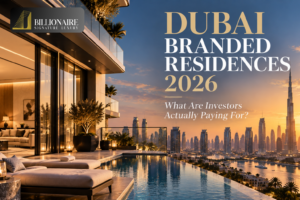
Luxury real estate in Dubai is no longer defined only by the address, view or size of the property.
A new factor is becoming increasingly important: the brand behind the residence.
From hospitality groups and fashion houses to automotive and lifestyle brands, branded residences have become one of the fastest-evolving segments of Dubai’s luxury property market.
But there is a more important question for investors:
When a branded residence costs significantly more than a comparable property, what are you actually paying for?
In H1 2026, Dubai’s branded-residence market reached 183 developments and 64,744 residential units. Average achieved pricing was AED 3,662 per sq ft, representing a reported 56% premium over comparable non-branded residences.
That premium makes the segment interesting.
It also makes proper evaluation essential.
What Is a Branded Residence?
A branded residence is a residential property developed in association with a recognised luxury, hospitality, fashion, automotive or lifestyle brand.
The brand may influence:
- Interior design
- Architecture
- Amenities
- Concierge services
- Resident experiences
- Property management
- Hospitality services
- Marketing and positioning
The concept effectively combines real estate ownership with a managed lifestyle experience.
Dubai has become particularly important in this market.
Knight Frank’s latest 2026 Global Branded Residence Survey identifies Dubai as the world’s leading city market for branded residences, while the global market continues expanding beyond traditional city locations into resort and lifestyle destinations.
Why Are Buyers Paying a Premium?
The obvious answer is the brand.
But that is only part of the equation.
A strong brand can provide something that conventional residential developments may struggle to replicate: a clearly defined identity.
Consider two otherwise similar luxury apartments.
One offers a high-end specification.
The other offers the same, but with an internationally recognised hospitality or lifestyle brand, dedicated services and an established operating concept.
The second property may appeal to buyers who value:
- Service consistency
- Brand recognition
- Concierge access
- Design identity
- Hospitality-style management
- Privacy
- Convenience
- International resale appeal
The premium therefore isn’t necessarily for a logo on the building.
It can represent an entire operating and lifestyle proposition.
Dubai’s Branded Residence Market Is Getting Bigger—and More Selective
The growth of the sector is substantial.
Dubai added 5,184 branded residential units during H1 2026, increasing total inventory by 8.7% in just six months. Yet transaction volume fell 21% year-on-year to 4,648 transactions.
That combination is important.
More supply is entering the market while buyers are becoming more selective.
It means investors cannot necessarily assume that every branded residence will benefit equally from the broader growth of the category.
The brand matters. But the asset still matters more.
Five Things to Evaluate Before Paying the Brand Premium
1. The Brand’s Actual Value
Not every international name creates the same value.
Investors should examine the brand’s:
- Global recognition
- Target customer
- Hospitality or residential track record
- Service standards
- Existing properties
- Long-term commitment to the project
A famous name alone does not automatically justify a substantial price premium.
2. Location
Branding cannot completely overcome a weak location.
A branded residence should still be evaluated according to its proximity to:
- Business districts
- Waterfronts
- Major attractions
- Airports
- Retail
- Restaurants
- Leisure destinations
- Transport infrastructure
The underlying location remains one of the most important determinants of long-term property demand.
3. The Service Model
This is where branded residences can become genuinely different.
Does the project actually provide hotel-style services?
Are concierge services included?
Is housekeeping available?
Who manages the building?
What are the service charges?
What happens after the initial launch period?
These details can materially affect both the ownership experience and the economics of the property.
4. The Premium Over Comparable Properties
This may be the most important calculation.
Instead of asking:
“Is this branded residence expensive?”
compare it with similar non-branded properties in the same location.
Calculate the price-per-square-foot difference.
Then ask what the additional capital is buying.
If the premium is substantial, investors should examine whether the services, scarcity, rental potential, resale market and brand strength provide sufficient justification.
5. Future Supply
Competition matters.
Dubai’s branded-residence pipeline continues to expand, and the global sector is becoming increasingly diverse, with fashion, automotive and lifestyle brands entering a market historically dominated by hotel operators.
An investor should therefore ask:
How many comparable branded projects could exist when I eventually want to sell?
Scarcity can support value.
Oversupply can weaken differentiation.
Branded Does Not Automatically Mean Better Investment
This distinction is important.
A branded residence can offer a superior ownership experience without necessarily being the strongest investment at every price.
Investment performance depends on several variables:
Entry price + location + demand + operating costs + rental economics + brand strength + future supply + exit liquidity
A buyer paying a large premium at launch needs to understand what could support that premium several years later.
This is particularly relevant now because Dubai’s branded-residence market has moved beyond the early stage of the trend.
There are simply more projects competing for luxury buyers.
The Off-Plan Question
Off-plan properties remain a major part of Dubai’s branded-residence market.
In H1 2026, under-construction properties represented 82% of branded-residence transaction volume and 78% of transaction value.
That creates both opportunity and risk.
Buying early can provide access to:
- Launch pricing
- Payment plans
- Early unit selection
- Future development upside
But investors also take on:
- Delivery risk
- Construction timelines
- Changing market conditions
- Future competing supply
- Uncertainty around the eventual resale environment
BSL’s 5-Year Property Investment Guide provides another useful framework for thinking about an investment beyond the initial purchase and launch cycle.
What Makes a Branded Residence More Defensible?
The strongest projects are likely to have several elements working together.
A strong location
The address should have independent demand.
A credible brand
The brand should have genuine recognition and relevance to the target buyer.
Distinctive design
The project should offer something difficult to replicate.
Strong operations
Services and property management need to match the positioning.
Controlled supply
Scarcity can become increasingly valuable as more branded projects enter the market.
Sensible pricing
Even a highly desirable brand can be overpriced.
This is where valuation becomes particularly important.
BSL’s Private Office Advisory approach focuses on evaluating high-value assets through factors including asset quality, location strength, market positioning and long-term value potential. Its advisory scope covers premium residences, hospitality assets, development opportunities and private transactions.
The Next Phase of Dubai’s Luxury Property Market
The branded-residence trend is becoming part of a broader transformation in luxury real estate.
Luxury buyers are increasingly purchasing services, identity, privacy, wellness and experiences, rather than simply square footage.
Knight Frank’s 2026 research highlights this shift, noting the growing influence of hospitality-led services, wellness and lifestyle-oriented placemaking within luxury residential development.
But as the market grows, differentiation becomes harder.
The next phase may therefore be less about how many branded residences Dubai can launch and more about which projects can maintain their positioning after the launch excitement disappears.
What Should Investors Ask Before Buying?
Before committing to a branded residence in Dubai, ask:
- What is the premium over comparable non-branded properties?
- What exactly does the brand provide?
- Who operates and manages the property?
- What are the annual service charges?
- How much comparable supply is coming?
- What is the property’s rental profile?
- How liquid is the resale market?
- What happens if the brand changes or exits?
- What is the expected holding period?
- Who is the likely buyer when you eventually sell?
These questions turn a luxury purchase into an investment analysis.
Final Thoughts
Dubai’s branded-residence market has reached significant scale.
With 64,744 units across 183 developments by June 2026 and an average reported 56% premium over comparable non-branded properties, the category is clearly no longer a niche segment.
But scale also changes the investment question.
The opportunity is no longer simply finding a property with a famous name attached to it.
It is understanding whether the brand, location, services, scarcity and pricing work together to create lasting value.
For investors considering premium residential assets, that distinction can be more important than the brand name itself.
FAQs
What are branded residences in Dubai?
Branded residences are luxury homes associated with recognised hospitality, fashion, automotive or lifestyle brands, often combining residential ownership with enhanced services and amenities.
Are branded residences more expensive in Dubai?
They generally command a premium over comparable non-branded properties. H1 2026 data from Morgan’s reported an average 56% premium, although the premium varies between individual projects.
Why are branded residences popular in Dubai?
They combine luxury real estate with recognised branding, hospitality-style services, design, amenities and lifestyle positioning, making them attractive to some local and international buyers.
Is every branded residence a good investment?
No single property category guarantees investment performance. Investors should examine location, entry price, brand strength, service charges, rental economics, future supply and resale liquidity for the specific project.
Are Dubai branded residences mainly off-plan?
Off-plan and under-construction properties represent a substantial portion of the market. In H1 2026, they accounted for 82% of branded-residence transaction volume and 78% of sales value.