While much of the conversation about Dubai property in 2026 has focused on broader market moderation, one segment has been operating in a different reality entirely. The ultra-luxury market, covering homes above $10 million, has spent the first half of 2026 breaking records that have never been broken before. Understanding why is not just an exercise in headline reading. It tells you something fundamental about where global capital is going and why Dubai has become its primary residential destination.
The Numbers That Defined H1 2026
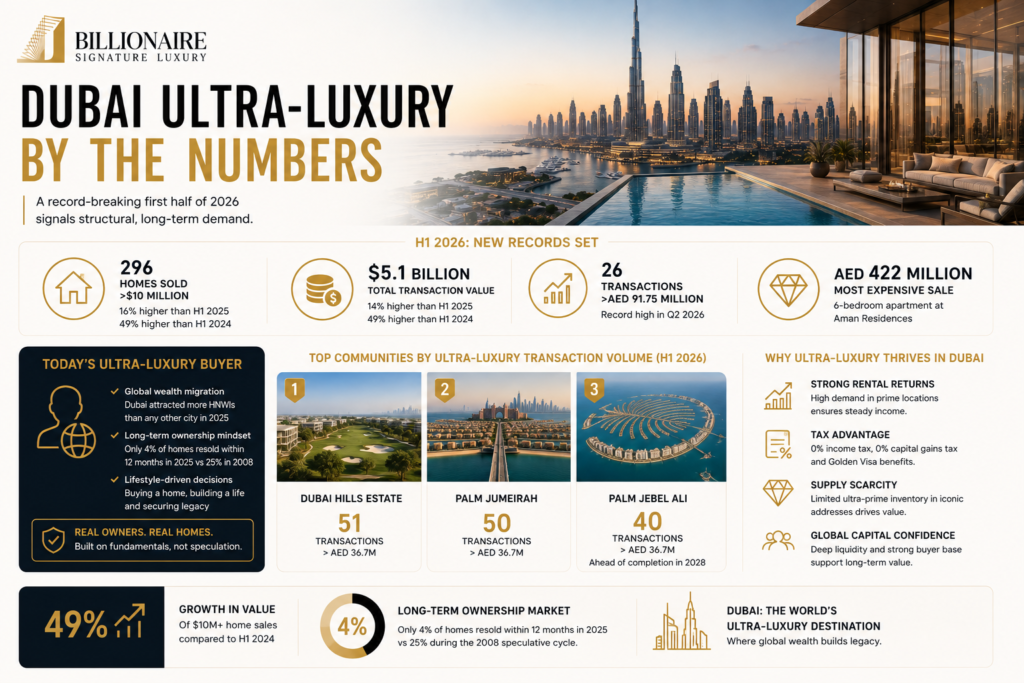
Dubai recorded a new record for luxury home sales during the first half of 2026, with 296 residential properties selling for more than $10 million, generating $5.1 billion in transaction value despite ongoing regional geopolitical uncertainty, according to Knight Frank. Economy Middle East
The value of homes sold above $10 million increased 14 per cent compared with the first half of 2025, while the number of transactions was 16 per cent higher than a year earlier and 49 per cent above the first half of 2024. Economy Middle East
The 49% uplift against H1 2024 is the figure that puts the growth trajectory in proper context. In two years, the value flowing through Dubai’s ultra-luxury segment has essentially doubled. That is not a cyclical rally. That is a structural repricing of what Dubai’s finest residential assets are worth to the global wealth community.
Q2 alone included a record 26 residential transactions above AED 91.75 million, the highest quarterly count at that price point on record. The most expensive single transaction across the entire first half of 2026 was a six-bedroom apartment that changed hands for AED 422 million. 4FRONT REALTY
A AED 422 million apartment. That is not a figure that emerges from a market experiencing uncertainty. It is a figure that emerges from a market where the world’s wealthiest buyers have made a considered decision that Dubai is where they want to place significant capital.
What Is Actually Driving This Demand
The ultra-luxury segment in Dubai is driven by a buyer profile that is fundamentally different from the mid-market investor. Understanding who is buying and why gives you a more accurate picture of whether this demand is sustainable or speculative.
The primary driver is wealth migration. Dubai attracted more high-net-worth and ultra-high-net-worth individuals in 2025 than any other city in the world. These individuals are not buying property speculatively. They are establishing primary or secondary residences in a city that has become their lifestyle base, their business hub, and their tax-efficient home. When a wealth migrant buys a AED 50 million villa, they are not flipping it in six months. They are living in it or holding it long-term as a family asset.
One figure released this week defines the structural character of today’s Dubai luxury buyer more clearly than any other. Only 4 percent of homes sold in Dubai last year were resold within 12 months of purchase. During the 2008 property cycle, that figure stood at 25 percent. 4FRONT REALTY
That single statistic explains everything about why the current luxury market behaves so differently from previous cycles. In 2008, Dubai’s market was characterised by rampant speculation: buyers acquiring assets with no intention of holding them, creating a fragile chain of transactions that collapsed quickly when sentiment turned. Today’s ultra-luxury buyer is holding. The market is not being built on flipped contracts. It is being built on genuine, long-term ownership.
Dubai Hills Estate: The New Ultra-Luxury Leader
Dubai Hills Estate led all communities for luxury volume with 51 transactions above the AED 36.7 million threshold, with Palm Jumeirah following closely at 50, and Palm Jebel Ali recording 40 luxury transactions ahead of its scheduled completion in 2028. Edwards and Towers
Dubai Hills Estate’s emergence as the top luxury community by transaction volume is a notable shift. For years, Palm Jumeirah was the unambiguous leader for UHNW residential transactions. The fact that Dubai Hills Estate has overtaken it reflects the appeal of master-planned, golf-course communities with generous plot sizes, contemporary design standards, and green-space integration that a new generation of wealthy buyers prioritises.
This does not signal weakness in Palm Jumeirah. Its 50 transactions in the same period, in a community where the island is built out and supply is permanently constrained, represents extraordinary demand intensity relative to available stock. It signals instead that Dubai’s ultra-luxury residential supply is expanding across multiple compelling addresses, deepening the market rather than diluting it.
Palm Jebel Ali: The Early-Mover Opportunity
The 40 ultra-luxury transactions in Palm Jebel Ali during H1 2026, from a development that does not complete until 2028, deserves specific attention from investors thinking about positioning ahead of the market.
Buyers are committing at the ultra-luxury level to an asset they will not receive for two years. They are doing this because they believe, based on how Palm Jumeirah matured, that Palm Jebel Ali will establish itself as one of the world’s premier waterfront addresses upon completion. The larger plot sizes, greater privacy, and more contemporary architectural standards compared to the original Palm Jumeirah make a compelling case for this view.
For investors who can operate on a two to three year horizon, the entry pricing in Palm Jebel Ali today represents access to a future ultra-luxury address before full market pricing reflects its likely status upon completion.
Why Ultra-Luxury Is the Most Resilient Segment
A consistently high demand for rental units, particularly in prime locations, assures property owners of steady returns, making luxury real estate an even more attractive long-term investment. This strong rental yield potential, combined with Dubai’s tax-efficient environment, reinforces its position as a preferred destination for real estate capital. Khaleej Times
At the ultra-luxury level, the combination of zero capital gains tax at exit, zero income tax on rental earnings, and a Golden Visa that comes with purchases above AED 2 million creates a total value proposition that no other global residential market currently matches. Add to that the structural supply scarcity in Palm Jumeirah, Emirates Hills, and similar communities, and the case for continued ultra-luxury price strength in Dubai is well-grounded in fundamentals rather than sentiment.
The market’s ability to absorb such high-value transactions indicates a deep and liquid pool of capital specifically targeting Dubai’s top-tier residential offerings. Khaleej Times
This liquidity matters. A market that can absorb 296 individual transactions above $10 million in six months is not a thin market dependent on a handful of exceptional buyers. It is a deep market with a significant, globally sourced buyer base. That depth provides price support and exit liquidity that investors in ultra-prime Dubai assets can rely on.
What This Means for BSL Group UAE Clients
At BSL Group UAE, our luxury and ultra-luxury clients are positioned in exactly the communities where these transactions are concentrated. We source acquisition opportunities, structure joint venture development projects, and provide the interior design and property management services that maximise both rental returns and resale premiums in this segment.
If you want to access Dubai’s ultra-luxury market with the knowledge, network, and execution capability that produces results at this level, start the conversation with our team at bslgroupuae.com/contact.
Frequently Asked Questions
How did Dubai’s ultra-luxury property market perform in H1 2026?
Dubai set a new H1 record with 296 home sales above $10 million, generating $5.1 billion in transaction value. This was 16% higher by volume and 14% higher by value than H1 2025, and 49% above H1 2024 in value terms.
Which community led Dubai’s ultra-luxury market in H1 2026?
Dubai Hills Estate led with 51 transactions above AED 36.7 million, followed by Palm Jumeirah with 50 and Palm Jebel Ali with 40.
What was the most expensive property sold in Dubai in H1 2026?
A six-bedroom apartment at Aman Residences in Jumeirah Second sold for AED 422 million ($114.9 million), the most expensive single residential transaction in H1 2026.
Is Dubai ultra-luxury real estate speculative or fundamentals-driven?
Fundamentals-driven. Only 4% of Dubai homes sold last year were resold within 12 months, compared to 25% during the 2008 speculative cycle. Today’s ultra-luxury buyers are holding assets long-term, not flipping them.
What makes Palm Jebel Ali attractive for ultra-luxury investors in 2026?
Palm Jebel Ali recorded 40 ultra-luxury transactions in H1 2026 despite not completing until 2028. Larger plots, greater privacy, and contemporary design standards position it as a future premier address at entry pricing that does not yet reflect its likely completed value.