

Dubai’s real estate market is approaching an important phase. After several years of strong investment activity, rising property values and expanding development, the next stage may be shaped less by broad market momentum and more by location, asset quality, pricing and the timing of new supply.
For investors considering Dubai property in 2027, the key question is not simply whether prices will rise or fall. It is which properties are likely to remain attractive as buyers gain more options, new developments reach completion and investment decisions become increasingly selective.
The latest available research points to a substantial residential handover pipeline extending through 2027. Peak Trust Research, analysing Dubai Land Department project-register data as of 4 October 2026, identified 104,339 homes scheduled for completion in 2027. These are planned completions, not guaranteed handovers, but they highlight why supply deserves close attention.
This Dubai property market outlook for 2027 examines the forces that could influence prices, rents and investment opportunities, along with practical considerations for investors seeking long-term value.
1. Dubai’s property market may become more selective in 2027
The market’s next phase could reward careful asset selection over decisions based primarily on recent price appreciation.
In September 2026, Gulf News reported that Emaar founder Mohamed Alabbar expected the arrival of additional housing supply to bring greater balance to Dubai’s property market in 2027. His comments reinforce the importance of monitoring new inventory and demand at the community level.
A more balanced market does not automatically mean falling prices across every segment. Instead, performance may diverge between properties with strong underlying demand and those competing with a large volume of similar homes.
Three factors deserve particular attention:
- Supply concentration: How many comparable properties are expected to enter a particular community?
- End-user demand: Is demand supported by residents, families and businesses, or primarily by investors seeking short-term appreciation?
- Asset differentiation: Does the property offer something distinctive in terms of location, design, views, privacy, amenities or access?
For investors, this means that citywide forecasts should be treated as context rather than as a substitute for property-level due diligence.
2. Property prices in Dubai: What could happen in 2027?
Predicting a single percentage change for the entire Dubai market would create a misleading picture. Apartment prices, villas, prime waterfront residences and properties in supply-heavy communities can follow different trajectories.
ValuStrat’s 2026 outlook projected continued residential capital-value growth while anticipating moderation compared with earlier highs. Meanwhile, analysts cited by The National in January 2026 expected increased supply to place pressure on price growth. These are forecasts for 2026, not confirmed outcomes for 2027, but they illustrate the transition toward a more measured market environment.
For 2027, investors should evaluate three broad scenarios.
Scenario A: Gradual growth in well-positioned assets
Properties in established communities with limited competing supply, strong amenities and consistent end-user demand could remain comparatively resilient.
Prime residences, distinctive villas and properties with scarce characteristics may benefit from buyers who prioritise quality and long-term ownership over short-term price movements. However, scarcity alone does not justify an inflated purchase price.
Scenario B: Greater negotiation in supply-heavy locations
Communities receiving a large number of comparable apartment handovers may experience stronger competition between sellers and landlords.
Possible consequences include longer selling periods, greater incentives from developers, pressure on achievable rents and increased negotiation between buyers and sellers.
The effect will depend on actual handovers, occupancy, absorption and the quality of the incoming properties.
Scenario C: Different outcomes across property types
Apartments, townhouses, standalone villas and luxury residences serve different buyer groups.
A property category with limited new supply may perform differently from a segment with numerous similar launches. Investors should therefore compare assets within the same location, price band and property type rather than relying exclusively on Dubai-wide averages.
The investment implication: In 2027, the purchase price, comparable transactions, expected rental income and realistic exit value may matter more than a broad prediction about the direction of the market.
3. The 2027 housing supply pipeline: What investors should monitor
New housing supply is one of the most important variables in the Dubai property market outlook for 2027.
According to Peak Trust Research’s analysis of the Dubai Land Department project register, 104,339 homes were scheduled for completion in 2027 as of 4 October 2026. Of these, 98,780 were apartments and 5,559 were villas. The research also reported that many projects listed for 2027 had limited recorded construction progress at the time of analysis, so scheduled completion dates should not be interpreted as certain delivery dates. For investors, the headline number is only the starting point.
The more useful questions are:
- Which communities have the highest concentration of upcoming handovers?
- How many comparable units are already available for sale or rent?
- Are construction milestones progressing as expected?
- Does the area’s population and employment base support additional housing?
- Is the property differentiated enough to compete with newer inventory?
A community receiving many new apartments may still perform well if demand absorbs the additional supply. Conversely, even a smaller number of handovers can affect a location where existing inventory is already difficult to lease.
Investors considering off-plan property should also distinguish between a developer’s announced completion date, the project’s actual construction progress and the expected timing of possession.
4. Rental yields in 2027: Look beyond headline returns
Rental income will remain a key consideration for investors who want their properties to generate recurring cash flow.
However, a high advertised rental yield does not automatically translate into a strong investment. Returns depend on the purchase price, achievable rent, vacancy periods, maintenance, service charges, property management and financing costs.
Before purchasing an income-generating property, investors should calculate:
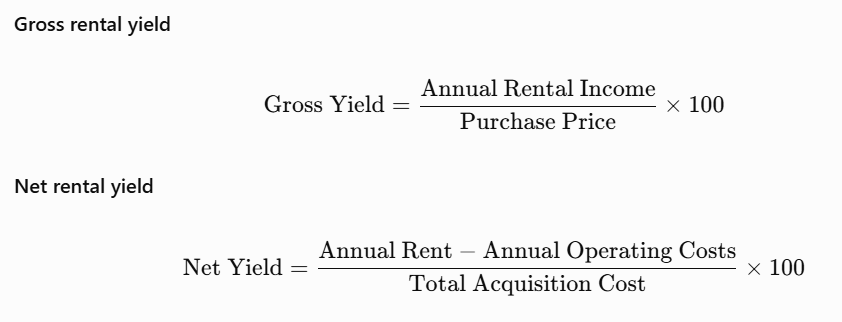
For example, consider a hypothetical property purchased for AED 2 million with annual rent of AED 120,000.
- Gross rental yield: 6%
- Assumed annual operating costs: AED 20,000
- Net yield before financing and tax considerations: 5%, using the purchase price as the denominator and excluding additional acquisition costs
This example is illustrative, not a forecast of achievable Dubai rents or yields in 2027.
Investors should also stress-test their calculations against lower rents, longer vacancy periods and unexpected maintenance expenses.
For a more detailed assessment, use the BSL Group ROI & Yield Calculator to examine projected income, estimated exit value and potential returns. All calculator outputs should be treated as estimates rather than guaranteed results.
5. Which Dubai property segments could offer opportunities in 2027?
The strongest opportunities will depend on the investor’s objectives, available capital, risk tolerance and intended holding period. The following segments merit investigation rather than being treated as guaranteed outperformers.
Luxury villas and distinctive residential assets
Investors seeking privacy, larger plots and distinctive architecture may consider established villa communities and carefully selected bespoke developments.
The key is to evaluate land scarcity, property condition, community quality, comparable sales and the depth of the eventual buyer pool. A premium property can still underperform if its purchase price exceeds what the market can support.
For investors considering a bespoke residential project, BSL Group’s Villa Developments service offers a relevant starting point for exploring development strategy and execution support.
Established communities with proven end-user demand
Locations with established infrastructure, schools, transport access, retail facilities and employment connections may appeal to residents who intend to occupy their homes.
The presence of these features does not eliminate investment risk, but it gives investors concrete factors to assess beyond speculative appreciation.
Selected off-plan developments
Off-plan properties may offer staged payment structures and access to new inventory. However, investors need to consider developer execution, contractual obligations, construction progress, handover timing and the volume of competing units scheduled for completion.
Before committing, compare the total purchase cost with similar completed properties. Also assess whether the expected rent and resale value remain reasonable if market growth slows.
Commercial and logistics real estate
Investors with a longer-term horizon may also examine warehouses, logistics facilities and other commercial assets. These investments require a different assessment from residential property, including tenant quality, lease terms, location, operating expenses and asset adaptability.
Explore BSL Group’s Warehouse & 3PL opportunities for a starting point on logistics-related real estate opportunities.
6. Off-plan versus ready property: Which approach makes sense in 2027?
Neither off-plan nor ready property is universally superior. The right choice depends on the investor’s cash flow, risk tolerance and intended use of the asset.
| Consideration | Off-plan property | Ready property |
|---|---|---|
| Rental income | Usually begins after handover and leasing | May begin sooner if the property is rentable |
| Main risks | Construction delays, delivery and future competing supply | Existing condition, maintenance and current market pricing |
| Due diligence | Developer, contract, escrow arrangements and construction progress | Title, condition, service charges, tenancy and comparable sales |
| Investment focus | Future value and delivery risk | Current value, immediate usability and achievable income |
| Key question | Will the completed property remain competitively priced? | Does the current income or use justify the purchase price? |
Investors should compare the total cost of each option, including payment timing, financing, fees, potential rental income and the cost of waiting for possession.
A ready property may offer greater visibility into its current condition and rental potential. An off-plan property may offer different payment terms or product features, but these benefits need to be weighed against delivery and market risks.
7. How interest rates, population growth and economic activity could influence the market
Dubai real estate does not operate in isolation. Financing conditions, employment, business expansion, population growth and international investment flows can influence demand.
Lower borrowing costs, if they occur, could improve affordability for some buyers. Higher financing costs may constrain purchasing power and reduce the returns available to leveraged investors.
Population and employment growth can support housing demand, but the effect is not uniform. Buyers and tenants need homes at different price points, in different locations and with different property configurations.
Dubai’s first-quarter 2026 real estate figures showed AED 252 billion in transaction value, up 31% year on year, according to the Dubai Land Department. That is a historical indicator of market activity, not a guarantee that the same growth rate will continue into 2027.
For investors, the practical approach is to test multiple assumptions rather than build a financial plan around one optimistic scenario.
Consider whether the investment remains viable if:
- The property’s value stays flat for several years.
- Rent grows more slowly than expected.
- The property remains vacant for longer than planned.
- Interest rates or other financing costs rise.
- The resale process takes longer than anticipated.
A property that remains financially manageable under conservative assumptions may be more suitable for long-term ownership than one that depends on rapid appreciation.
8. A practical due-diligence checklist for Dubai property investors in 2027
Before making an investment, review the property as a financial asset—not simply as a desirable location or attractive development.
Investor due-diligence checklist
- Compare the asking price with recent transactions for similar properties
- Review upcoming handovers and competing listings in the community
- Verify title, ownership and relevant project documentation
- For off-plan purchases, assess the developer, contract and construction progress
- Estimate realistic rent, vacancy and annual operating costs
- Calculate net yield and test conservative financial scenarios
- Assess resale demand and likely exit costs
- Check financing obligations and maintain a sufficient cash reserve
The purpose of due diligence is not to eliminate every risk. It is to understand the risks before committing capital and ensure that the expected return is proportionate to them.
9. How BSL Group UAE can support investment decisions
As Dubai’s market becomes more differentiated, investors may benefit from a structured approach to asset selection, financial assessment and long-term planning.
BSL Group UAE focuses on real assets, private capital and long-term value. Its services span private office advisory, property management, private funding, villa developments and warehouse and logistics opportunities.
For investors assessing potential acquisitions, development opportunities or existing holdings, a disciplined process should include:
- Defining investment objectives and the intended holding period.
- Assessing the asset’s location, condition and competitive position.
- Reviewing projected rental income and ownership costs.
- Evaluating financing requirements and downside scenarios.
- Establishing a realistic exit strategy.
Learn more about BSL Group’s Private Office Advisory or explore its broader real estate and investment services.
The objective is to evaluate opportunities against the investor’s own requirements rather than assume that every property or market segment will deliver the same outcome.
10. Final outlook: What should investors expect from Dubai real estate in 2027?
Dubai’s property market enters 2027 with a substantial scheduled residential supply pipeline and a greater need for asset-level analysis. The additional housing could improve choice for buyers and tenants, while creating stronger competition for properties that lack a clear advantage.
This does not mean that all prices will fall or that all prime assets will appreciate. The outcome will depend on the interaction between new supply, demand, affordability, financing conditions and individual property characteristics.
For investors, four priorities stand out:
- Prioritise fundamentals: Evaluate location, demand, asset quality and comparable transactions.
- Calculate net returns: Account for vacancies, operating costs, financing and acquisition expenses.
- Monitor supply locally: Understand the specific community and property segment rather than relying on citywide totals.
- Plan for different outcomes: Make sure the investment remains manageable if appreciation or rental growth disappoints.
The most effective approach to the Dubai property market in 2027 is likely to be selective, data-led and aligned with a clearly defined investment horizon.
For investors seeking long-term value, the goal is not simply to buy into Dubai’s property market. It is to identify an asset whose price, income potential, risk profile and exit prospects make sense together.
Frequently asked questions
1. Will Dubai property prices rise in 2027?
There is no reliable basis to guarantee a single direction for all Dubai properties. Performance may vary by community, property type, pricing and incoming supply. Investors should evaluate comparable transactions and local demand before making a decision.
2. Will Dubai property prices fall because of new supply in 2027?
Additional supply may increase competition in locations receiving large numbers of comparable homes. However, the effect depends on actual completions, demand and how quickly new inventory is absorbed. A supply increase does not automatically cause citywide price declines.
3. Is 2027 a good time to invest in Dubai real estate?
It may offer opportunities for investors who have sufficient capital, a suitable holding period and a clear investment strategy. Whether a particular purchase is attractive depends on its price, expected income, costs and risks—not simply the year of purchase.
4. Is off-plan property a good investment in Dubai in 2027?
Off-plan property can suit investors who understand construction and delivery risks and can wait for possession. Before investing, review the developer’s track record, contractual terms, construction progress, total cost and competing supply.
5. What should investors look for in a Dubai investment property?
Important factors include location, comparable market prices, tenant demand, net rental yield, operating expenses, building or developer quality, upcoming supply and resale prospects.
6. How can investors calculate rental yield in Dubai?
Gross yield is annual rental income divided by purchase price. Net yield deducts relevant operating costs before comparing the income with the investment cost. Investors should also consider vacancy, financing and acquisition expenses to understand the overall financial position.
7. Which Dubai property segments should investors research for 2027?
Investors may compare established residential communities, distinctive villas, selected off-plan projects and commercial or logistics assets. The appropriate segment depends on available capital, investment objectives, risk tolerance and holding period.