
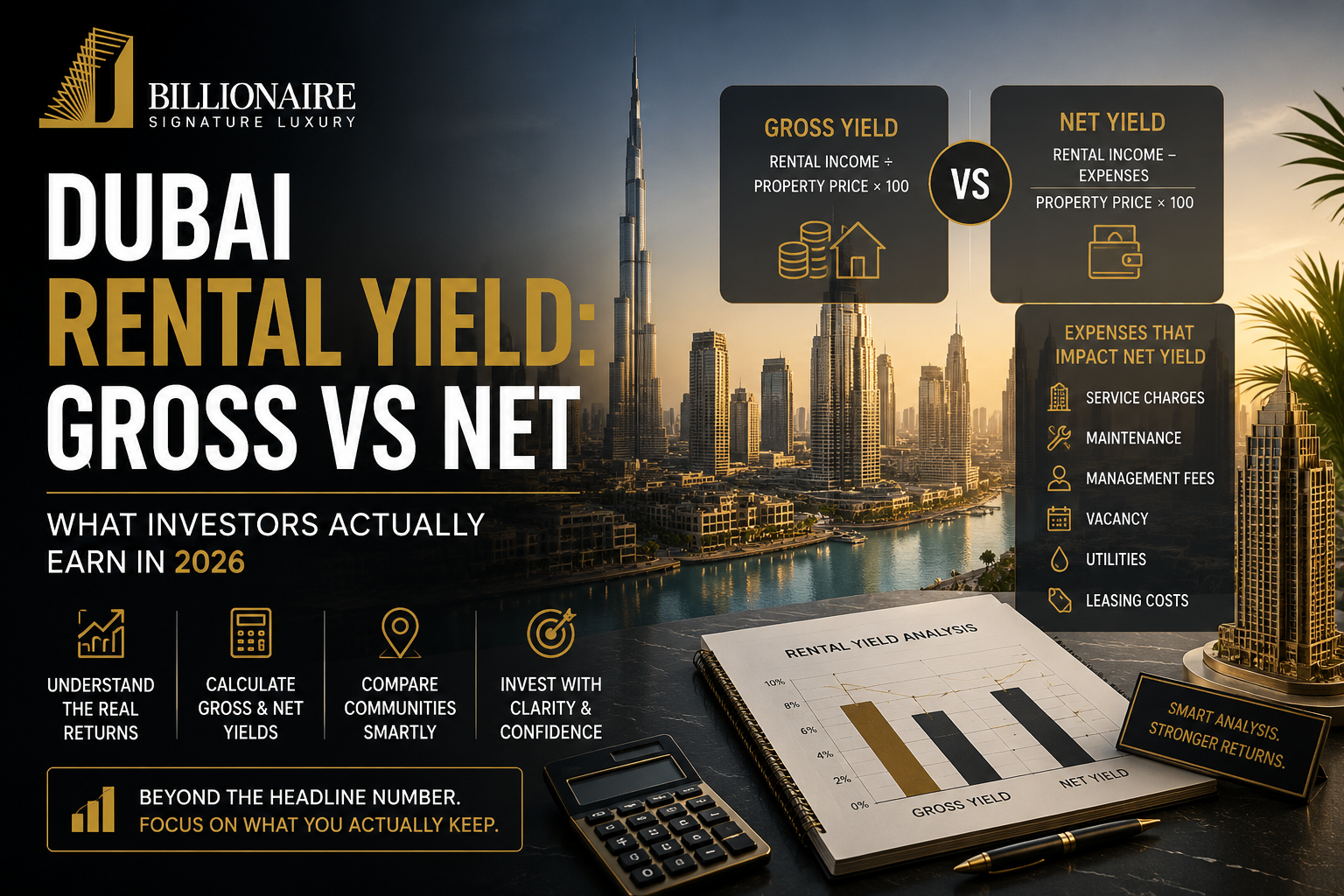
When investors compare Dubai property opportunities, one number often dominates the conversation:
Rental yield.
A property advertised with a 7%, 8% or even 9% rental yield can immediately look attractive.
But there is a problem.
That number is usually gross rental yield.
It does not necessarily represent the amount of money an investor actually keeps after service charges, maintenance, vacancy, management and other operating expenses.
This is why understanding the difference between gross vs net rental yield is essential for anyone considering Dubai property in 2026.
Dubai’s rental market remains highly active. Engel & Völkers reported more than 271,000 tenancy contracts in H1 2026, with average gross residential rental yields of 6.6%. Apartments averaged around 6.9%, while villas averaged approximately 4.5%.
But the headline yield is only the starting point.
The real investment question is:
How much rental income actually remains after the costs of owning and operating the property?
What Is Rental Yield?
Rental yield measures the annual rental income generated by a property relative to its value or purchase cost.
The basic formula is:
Gross Rental Yield = Annual Rent ÷ Property Purchase Price × 100
For example:
- Property price: AED 1,000,000
- Annual rent: AED 70,000
Gross rental yield = 7%
At first glance, that looks straightforward.
But the investor does not necessarily receive AED 70,000 as spendable rental profit.
There may be:
- Service charges
- Maintenance
- Property management fees
- Vacancy
- Repairs
- Leasing costs
- Utilities in some rental arrangements
- Furnishing replacement
- Insurance or other property-related expenses
After these costs, the actual return can be considerably lower.
That is why serious property investors should calculate net rental yield, not just gross yield.
Dubai Rental Yield in 2026: What Does the Market Average?
There is no single rental yield that applies to every Dubai property.
Yield varies according to:
- Community
- Property type
- Unit size
- Purchase price
- Building quality
- Rental demand
- Service charges
- Age of the property
- Furnishing
- Rental strategy
Engel & Völkers reported an average gross residential rental yield of 6.6% in June 2026, with apartments at approximately 6.9% and villas at approximately 4.5%.
Other datasets produce different averages because methodologies differ.
For example, a DLD- and Ejari-based dataset updated in August 2026 calculates citywide gross apartment yield at 6.2% and villa yield at 4.9%, using median registered rents and sale prices.
The difference is important.
It demonstrates why investors should not blindly use a single “Dubai average.”
The property-specific calculation matters more than the city-wide headline.
Gross vs Net Rental Yield: The Difference
Let’s simplify the two concepts.
Gross Rental Yield
Gross yield looks at:
Annual rent ÷ purchase price
It ignores most operating expenses.
Net Rental Yield
Net yield looks at:
Annual rental income − operating expenses ÷ total investment
It gives a much more realistic picture of what the property generates.
For investors, net yield is usually the more useful number.
A Simple Dubai Rental Yield Example
Imagine you buy an apartment for:
AED 1,500,000
You rent it for:
AED 105,000 per year
Your gross yield is:
AED 105,000 ÷ AED 1,500,000 × 100 = 7%
Looks good.
Now assume annual costs are:
| Cost | Annual Amount |
|---|---|
| Service charges | AED 15,000 |
| Maintenance allowance | AED 4,000 |
| Management | AED 5,250 |
| Vacancy allowance | AED 5,250 |
| Other operating costs | AED 2,500 |
| Total | AED 32,000 |
Your estimated net rental income becomes:
AED 105,000 − AED 32,000 = AED 73,000
Net yield:
AED 73,000 ÷ AED 1,500,000 × 100 = 4.87%
The property didn’t suddenly become a bad investment.
But the investor’s actual income picture is very different from the headline 7% gross yield.
That’s the distinction this article is about.
Why Gross Yield Can Be Misleading
Suppose an agent tells you:
“This property gives you 8% ROI.”
Your first question should be:
“Is that gross or net?”
If it is gross, ask:
“What assumptions are being used?”
You should then calculate:
- Actual purchase price
- Actual achievable rent
- Service charges
- Expected vacancy
- Management
- Maintenance
- Other recurring costs
Only then can you compare the property properly.
A higher gross yield does not automatically mean a better investment.
Service Charges: The Cost Investors Often Underestimate
Service charges are particularly important for apartment investors.
They can cover items such as:
- Building maintenance
- Common areas
- Security
- Elevators
- Landscaping
- Swimming pools
- Gyms
- Shared facilities
- Building management
The exact amount depends on the property and building.
Two apartments with identical purchase prices and identical rents can therefore produce different net yields if their service charges are different.
Example
Apartment A:
- Price: AED 1 million
- Rent: AED 70,000
- Service charges: AED 8,000
Apartment B:
- Price: AED 1 million
- Rent: AED 70,000
- Service charges: AED 18,000
Both advertise:
7% gross yield
But Apartment A has a stronger income position after service charges.
This is why investors should investigate the specific building, not just the area.
Vacancy Can Destroy a “High-Yield” Calculation
A gross yield calculation often assumes:
The property is rented for 12 months.
Real life may be different.
Imagine:
- Annual potential rent: AED 90,000
- Monthly rent: AED 7,500
If the property remains vacant for one month:
Actual rent = AED 82,500
The investor has already lost AED 7,500 before considering any other costs.
That’s why serious investors should include a vacancy allowance when calculating net yield.
Even if the property has historically remained occupied, assuming 100% occupancy forever is an aggressive investment assumption.
Rental Yield Depends on Purchase Price
One of the most important points in Dubai property investment is that yield is partly a function of what you pay.
Imagine a property generates:
AED 80,000 annual rent.
If you buy it for:
AED 1 million → 8% gross yield
If you buy it for:
AED 1.2 million → 6.67% gross yield
If you buy it for:
AED 1.4 million → 5.71% gross yield
The property didn’t change.
The rental income didn’t change.
Your purchase price changed.
This is why negotiating the acquisition price can materially affect investment returns.
Why Some Cheaper Dubai Areas Offer Higher Yields
Lower-priced properties can sometimes produce higher rental yields because rent doesn’t always fall proportionally with purchase prices.
This is visible in current Dubai market data.
Bayut’s H1 2026 sales-market analysis reported apartment ROI of:
- 9.06% in Discovery Gardens
- 7.69% in Al Furjan
- 6.48% in Al Barari
- 6.41% in Sobha Hartland
depending on the market segment.
These figures shouldn’t be interpreted as guaranteed future returns.
They illustrate an important principle:
Yield is highly location- and property-specific.
An investor should therefore compare properties on their actual numbers rather than assuming that the most expensive communities produce the best rental returns.
High Yield Does Not Always Mean High Quality
This is another trap.
Suppose Property A generates:
9% gross yield
while Property B generates:
6% gross yield.
It is tempting to immediately choose Property A.
But consider:
Property A
- Higher service charges
- Older building
- More maintenance
- Higher vacancy
- Weaker resale demand
- Large future supply pipeline
Property B
- Lower service charges
- Stronger tenant demand
- Better building quality
- Better location
- Stronger resale market
- More stable occupancy
The lower-yielding property could potentially produce the better risk-adjusted investment.
Yield should therefore never be considered in isolation.
Gross Yield vs Net Yield: What Should Investors Include?
A practical net-yield calculation should consider the following.
1. Annual Rental Income
Start with the rent you realistically expect to collect.
Don’t automatically use the highest asking rent you see online.
Look at comparable achieved rents and current market conditions.
Dubai Land Department provides a Rental Index that allows users to check average rental values based on factors including area, property type and number of rooms.
2. Vacancy
Estimate realistic downtime.
Even one vacant month can materially affect a smaller property’s annual return.
3. Service Charges
Check the actual service charge for the building.
Don’t use a generic community estimate if building-specific data is available.
4. Maintenance
Budget for:
- Repairs
- Appliances
- Plumbing
- Air conditioning
- Painting
- Fixtures
- Wear and tear
Not every year will produce the same maintenance expense.
That is why a reasonable annual allowance can be more useful than assuming maintenance is always zero.
5. Property Management
If you live outside the UAE or don’t want to manage tenants yourself, professional management can reduce your net return.
But it may also save you:
- Time
- Administrative effort
- Tenant-management problems
- Maintenance coordination
The question isn’t simply whether management costs money.
It is whether the service creates enough value to justify the cost.
6. Leasing Costs
Depending on the arrangement, you may have costs associated with finding and onboarding tenants.
These should be considered when calculating the longer-term investment return.
7. Furnishing
Furnished properties can sometimes attract different tenant segments and potentially different rents.
But furniture has:
- Initial cost
- Replacement cost
- Wear and tear
- Maintenance requirements
Therefore, the additional rent should be compared with the additional investment.
A Better Formula for Net Rental Yield
A simple practical formula is:
Net Rental Yield = (Annual Rent − Annual Operating Costs) ÷ Total Investment × 100
Where operating costs can include:
Service charges + maintenance + management + vacancy + leasing costs + other recurring property expenses
And “total investment” should ideally reflect more than just the advertised property price when you’re assessing your overall capital deployment.
For a complete investment return analysis, also consider transaction and acquisition costs separately.
Gross Yield Is Not the Same as ROI
These terms are often used interchangeably.
They shouldn’t be.
Gross rental yield
Measures rental income relative to property value or purchase price.
Net rental yield
Measures rental income after operating expenses.
Cash-on-cash return
Looks at the cash return relative to the investor’s actual cash invested, particularly relevant when financing is used.
Total ROI
Can include:
- Rental income
- Capital appreciation
- Transaction costs
- Financing costs
- Exit costs
So a property producing a 6% net rental yield could potentially outperform a 7% property if it has significantly stronger capital appreciation.
Rental Yield vs Capital Appreciation
This is where property investment becomes more interesting.
There are essentially two major return engines:
Income
What the property produces through rent.
Capital growth
How the property’s value changes over time.
A property could have:
High rental yield + low capital growth
or:
Lower rental yield + stronger capital growth
or potentially:
Moderate yield + moderate capital growth
There is no universal winner.
The right combination depends on the investor’s objectives.
Should You Choose the Highest Rental Yield?
Not necessarily.
Suppose:
Property A
Gross yield: 8.5%
Net yield: 5.8%
Property B
Gross yield: 7.0%
Net yield: 5.9%
Property B actually produces a slightly higher estimated net yield.
Now imagine Property B also has:
- Better location
- Lower supply risk
- Better tenant demand
- Stronger resale liquidity
It may be the more attractive investment despite the lower headline yield.
This is why investors should compare net return + risk + liquidity + growth potential.
Dubai Apartment vs Villa Rental Yield
Current market data shows a significant difference between apartment and villa yields.
Engel & Völkers reported average gross yields of approximately:
Apartments: 6.9%
Villas: 4.5%
in H1 2026.
Another H1 2026 analysis from Reliant Surveyors reported apartment gross yields around 6.93% and villa yields around 4.48%, showing a similar gap.
Why?
Because villas typically have:
- Higher purchase prices
- Larger floor areas
- Higher capital values
- Different tenant profiles
Apartment investors often prioritise income yield.
Villa investors may place greater emphasis on:
- Family demand
- Lifestyle
- Scarcity
- Capital appreciation
- Long-term occupancy
Again, neither is automatically superior.
Smaller Apartments Can Produce Higher Gross Yields
Current DLD/Ejari-based data illustrates how unit size can affect yield.
A recent dataset calculated citywide gross apartment yields of approximately:
- 7.9% for studios
- 7.3% for approximately 1-bedroom units
- 6.3% for approximately 2-bedroom units
- 5.5% for approximately 3-bedroom units
- 4.4% for approximately 4-bedroom units
These figures are based on registered rents and sale prices and are presented as gross yields, before service charges, vacancy and other costs.
This creates a common pattern:
Smaller unit → lower purchase price → potentially higher yield
But it doesn’t mean every studio is a better investment.
The investor still needs to consider:
- Tenant turnover
- Vacancy
- Building quality
- Service charges
- Supply
- Resale demand
- Furnishing
- Location
Long-Term vs Short-Term Rental Yield
Another important distinction is the rental strategy.
Long-Term Rental
Usually involves:
- Annual tenancy
- More predictable occupancy
- Lower operational complexity
- Lower turnover
- More stable income
Short-Term Rental
Can potentially generate higher gross income in the right location.
But it can also involve:
- Higher management costs
- Cleaning
- Utilities
- Furnishing
- Maintenance
- Platform costs
- Greater occupancy variability
- Regulatory requirements
Property Finder notes that short-term rentals can advertise higher gross returns in areas such as Dubai Marina, Downtown Dubai, Palm Jumeirah and Business Bay, but net returns are reduced by management, utilities, cleaning, maintenance, vacancy and permit-related costs.
So comparing:
8% short-term gross
with:
6.5% long-term gross
without calculating the actual operating expenses is meaningless.
The Importance of Building-Level Analysis
Two buildings in the same neighbourhood can have completely different investment economics.
Consider:
Building A
- AED 1.2 million purchase
- AED 90,000 rent
- AED 20,000 service charges
Building B
- AED 1.2 million purchase
- AED 85,000 rent
- AED 8,000 service charges
Building A:
7.5% gross yield
Building B:
7.08% gross yield
At first glance, Building A wins.
But after service charges:
Building A:
AED 70,000 before other costs
Building B:
AED 77,000 before other costs
The lower gross-yield property can produce the better income position.
This is why building-level due diligence matters.
Dubai’s Rental Market Still Has Strong Underlying Demand
The gross-vs-net conversation shouldn’t be interpreted as a negative view of Dubai’s rental market.
Dubai’s rental sector remains highly active.
Dubai Land Department reported that registered tenancy contracts in 2025 increased 6% in volume and 17% in value year on year, reaching 1.38 million contracts worth AED 126.4 billion. New tenancy contracts exceeded 513,000.
DLD also reported 118,385 new tenancy contracts and 135,607 renewals during Q1 2026, while the value of rental contracts reached AED 32.2 billion.
So the fundamental question isn’t:
“Is there rental demand?”
There clearly is substantial activity.
The investor’s question should be:
“How much of that demand will my specific property capture, at what rent, and at what cost?”
Future Supply Can Compress Rental Yields
This connects directly to BSL’s previous article about Dubai’s property supply map.
Imagine you buy an apartment because it generates:
AED 100,000 annual rent.
Then several thousand similar apartments enter the market.
Landlords may have to compete more aggressively.
Potential outcomes include:
- Slower rental growth
- Higher vacancy
- Tenant incentives
- More competition
- Greater furnishing expectations
Your property value may still increase.
But your rental yield could change.
This is why a strong rental investment analysis needs to examine future supply, not just current rent.
Yield Compression Is Already Visible
Rental yields have not remained static.
Reliant Surveyors’ H1 2026 data shows apartment gross yields declining from 7.59% in H1 2024 to 6.93% in H1 2026, while villa yields declined from 5.42% to 4.48% over the same period.
This illustrates an important market dynamic:
If property values rise faster than rents, yield compresses.
For example:
Property price:
AED 1 million → AED 1.2 million
Annual rent:
AED 70,000 → AED 75,000
The property appreciated substantially.
But the gross yield moved from:
7% → 6.25%
That’s not necessarily bad.
The investor may have gained capital appreciation.
But it demonstrates why today’s yield shouldn’t be projected indefinitely.
The 2026 Investor Should Track Three Numbers
Instead of looking at one yield figure, track:
1. Gross Yield
What the property appears to generate before operating costs.
2. Net Yield
What remains after realistic recurring costs.
3. Total Return
Rental income + capital appreciation − relevant costs.
This gives a much more complete investment picture.
The BSL Rental Yield Test
Before considering a Dubai investment, investors can run this simple test.
Step 1 — Purchase Price
What are you actually paying?
Step 2 — Realistic Rent
What rent can the property realistically achieve?
Step 3 — Gross Yield
Calculate:
Rent ÷ purchase price × 100
Step 4 — Operating Costs
Deduct:
- Service charges
- Vacancy
- Maintenance
- Management
- Leasing
- Other recurring costs
Step 5 — Net Yield
Calculate the remaining annual income against your investment.
Step 6 — Supply
What competing properties are coming?
Step 7 — Resale
How liquid will the property be?
Step 8 — Capital Growth
What could drive future appreciation?
This produces a much more sophisticated investment decision than simply asking:
“What’s the ROI?”
A Worked Example: From 8% Gross to Realistic Net
Let’s assume:
Purchase price: AED 1,250,000
Annual rent: AED 100,000
Gross yield
AED 100,000 ÷ AED 1,250,000 × 100
= 8%
Now assume:
- Service charges: AED 12,000
- Maintenance: AED 4,000
- Management: AED 5,000
- Vacancy allowance: AED 5,000
- Other costs: AED 2,000
Total:
AED 28,000
Net rental income:
AED 72,000
Net yield:
AED 72,000 ÷ AED 1,250,000 × 100
= 5.76%
The investor should therefore evaluate the property as approximately:
8% gross
versus
5.76% net before financing and certain acquisition/exit costs.
That is a much more useful number.
What If You Finance the Property?
Financing introduces another layer.
Suppose you purchase using a mortgage.
Your rental income may be healthy, but you now have:
- Interest cost
- Mortgage payments
- Bank fees
- Equity contribution
The return on the property and return on your cash invested can therefore be different.
This is where investors need to distinguish:
Property yield
from:
Equity return.
A leveraged investment can produce a different cash-on-cash return than an all-cash purchase.
For this reason, financing should be modelled separately rather than simply deducted from the gross rental yield calculation.
Should Investors Focus on Gross Yield or Net Yield?
For initial screening:
Gross yield is useful.
It allows investors to quickly compare a large number of properties.
For final investment decisions:
Net yield is more important.
Once you have shortlisted a property, calculate the realistic income after recurring operating costs.
For a complete investment decision:
Look at:
Net yield + capital growth + liquidity + supply risk + total ownership costs.
That’s the complete picture.
Questions to Ask Before Buying a High-Yield Dubai Property
Before accepting an advertised yield, ask:
- Is the yield gross or net?
- What rent is the calculation based on?
- Is that rent actually achievable today?
- What are the building’s service charges?
- How much vacancy has been assumed?
- What maintenance allowance has been included?
- Is property management included?
- Is the property furnished?
- How much does furnishing cost?
- How many comparable units are available?
- How much new supply is coming?
- What is the expected resale market?
- Is the yield based on the current purchase price or an older transaction?
- Are transaction costs included?
- What happens if rent falls 5–10%?
If the seller cannot explain the yield calculation clearly, that’s a reason to investigate further.
Final Takeaway: Don’t Buy the Yield. Buy the Economics.
A Dubai property advertised at:
8% yield
can sound better than one advertised at:
6.5% yield.
But that comparison is incomplete.
The 8% property may have:
- Higher service charges
- Higher vacancy
- More maintenance
- Weaker rental demand
- Greater future supply
- Lower resale liquidity
Meanwhile, the 6.5% property may have:
- Stronger tenant demand
- Lower operating costs
- Better location
- Better building quality
- Greater scarcity
- Stronger capital appreciation potential
The right investment isn’t necessarily the property with the highest gross rental yield.
It is the property with the strongest combination of:
Net income + capital growth + liquidity + manageable risk.
Dubai’s rental market remains fundamentally active in 2026, with strong tenancy volumes and average gross yields around the mid-6% range according to major market reports.
But as property prices, rents and supply continue to evolve, investors need to move beyond headline numbers.
Gross yield tells you what the property appears to earn.
Net yield tells you what the property actually produces.
And that difference can determine whether a Dubai property is merely attractive on paper or genuinely attractive as an investment.
Frequently Asked Questions
What is a good rental yield in Dubai in 2026?
There is no single yield that qualifies as “good” for every property. Dubai’s average gross residential rental yield was around 6.6% in H1 2026 according to Engel & Völkers, but yields vary considerably by location, property type and building. A good investment should be evaluated on net yield, capital growth, liquidity and risk rather than gross yield alone.
What is the difference between gross and net rental yield?
Gross rental yield compares annual rent with the property’s purchase price before operating expenses. Net rental yield deducts costs such as service charges, maintenance, management and vacancy before calculating the return.
Is 7% rental yield good in Dubai?
A 7% gross yield can be attractive, but it doesn’t tell you the actual return. You should calculate the property’s net yield after service charges, vacancy, maintenance and management costs before comparing it with other investments.
What is the average rental yield in Dubai?
Major 2026 market reports place Dubai’s average gross residential rental yield around the mid-6% range. Engel & Völkers reported 6.6% overall in H1 2026, while apartments averaged 6.9% and villas 4.5%.
Do apartments or villas have higher rental yields in Dubai?
Apartments generally produce higher gross rental yields than villas. H1 2026 data from Engel & Völkers showed approximately 6.9% for apartments compared with 4.5% for villas.
Which Dubai areas have the highest rental yields?
Yield varies significantly by property type and market segment. Bayut’s H1 2026 data reported apartment ROI of 9.06% in Discovery Gardens and 7.69% in Al Furjan among the segments it analysed. These figures should be treated as market-specific indicators rather than guaranteed returns.
Does service charge affect rental yield?
Yes. Service charges reduce the rental income remaining for the owner and can therefore materially reduce net yield. Two properties with identical rents and purchase prices can have very different net returns because of different service-charge levels.
How do I calculate net rental yield in Dubai?
Subtract realistic annual operating costs from annual rental income, then divide the resulting net rental income by the investment amount and multiply by 100.
Net Yield = (Annual Rent − Operating Costs) ÷ Investment × 100
Does vacancy affect rental yield?
Yes. If a property remains vacant for part of the year, actual rental income falls. Investors should therefore include a realistic vacancy allowance when calculating net yield rather than assuming the property is occupied for every month.
Is rental yield more important than capital appreciation?
Neither is automatically more important. Rental yield measures income, while capital appreciation measures growth in the property’s value. A strong investment strategy considers both.
Can a high-yield property be a bad investment?
Yes. A high gross yield may be caused by a low purchase price, but the property could have high service charges, weak tenant demand, substantial future supply or poor resale liquidity. Yield should always be considered alongside risk and future demand.
How can I check rental values in Dubai?
Dubai Land Department provides an official Rental Index that allows users to check rental information based on property type, area, rooms and other property details.