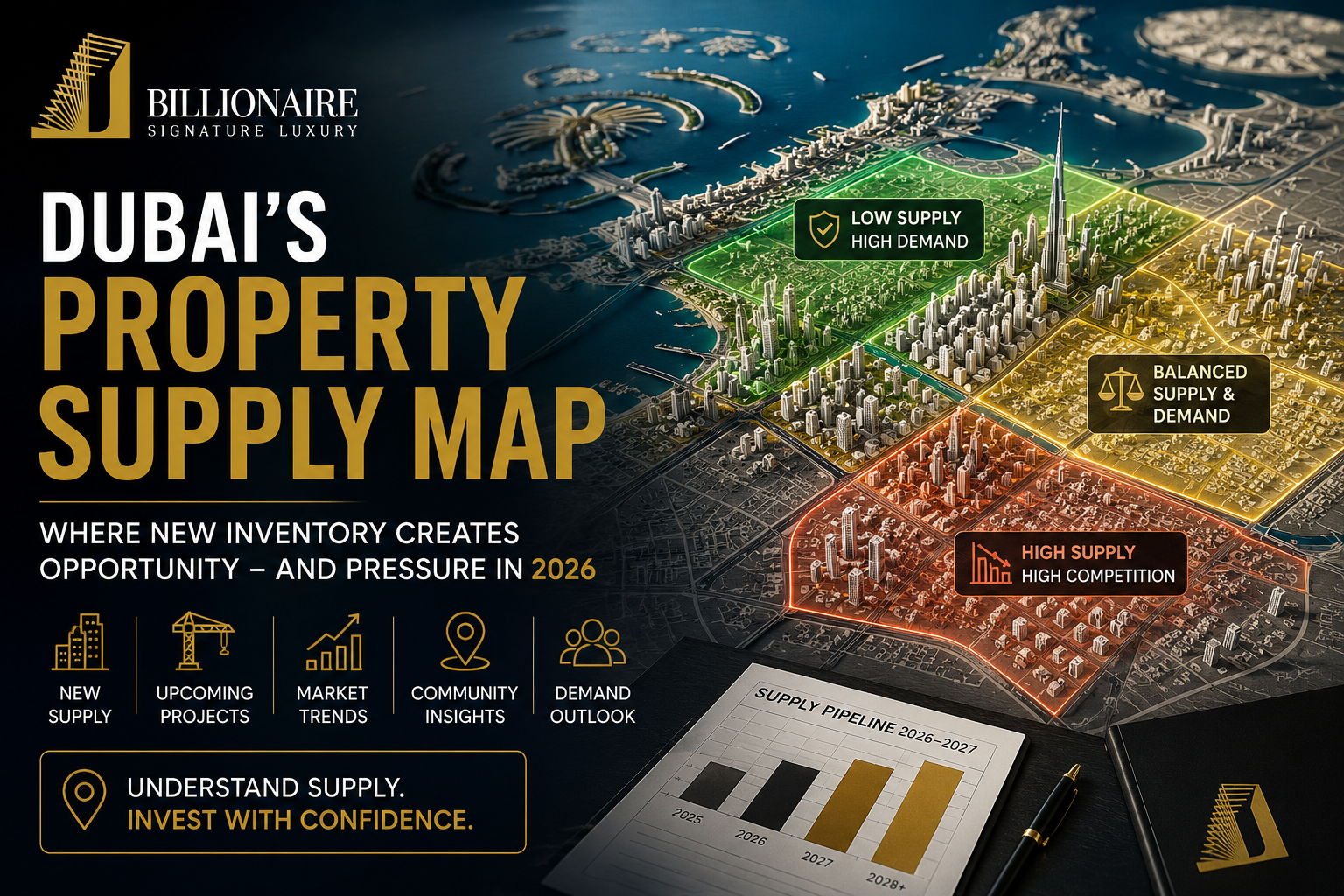
Dubai’s property market is no longer moving as one single market.
In 2026, Dubai property supply is becoming increasingly important at the community level. Two neighbourhoods can experience completely different conditions at the same time: one may be protected by limited land and strong end-user demand, while another may be dealing with a large pipeline of new apartments, multiple launches and growing buyer choice.
That changes the way investors should analyse Dubai real estate.
Instead of asking:
“Is Dubai property oversupplied?”
the better question is:
“Where is new supply coming, what type of property is being delivered, and will demand be strong enough to absorb it?”
That distinction matters because Dubai continues to attract residents, investors and businesses, while developers are simultaneously delivering a substantial pipeline of new homes.
In H1 2026, more than 24,500 residential units were completed in Dubai, according to data reported from the Dubai Land Department, representing approximately 36% year-on-year growth in completed residential supply.
At the same time, market forecasts show a much larger pipeline of scheduled and announced units extending into the coming years. One H1 2026 market review estimates approximately 110,000 scheduled units for 2026 and 138,000 for 2027, although scheduled supply should not be confused with guaranteed completions.
The implication is clear:
Investors need to stop looking only at today’s inventory.
They need to look at tomorrow’s inventory too.
What Does “Property Supply” Actually Mean?
When investors hear the word supply, they often think about completed homes sitting empty.
That’s only one part of the picture.
Dubai’s property supply can be divided into several stages:
Existing supply
Properties already completed and available in the market.
Under-construction supply
Projects currently being built and expected to reach completion.
Announced supply
Projects that have been announced but may still be some distance from completion.
Future pipeline
Projects that form part of longer-term development plans.
These categories matter because they create different levels of competitive pressure.
A completed apartment can compete with another completed apartment today.
An off-plan project may compete with dozens of future projects that won’t reach the market for several years.
Therefore, investors should not simply count every announced unit as if it were immediately available.
The more useful exercise is to understand when the supply is likely to become relevant to your investment.
Why Dubai’s Supply Map Matters More Than the Dubai Average
Dubai-wide statistics are useful for understanding the direction of the market.
But they can hide major differences between communities.
Property Finder’s 2026 analysis makes this point particularly clearly: Dubai is increasingly behaving as a collection of community-level markets, with local supply, demand and development pipelines influencing pricing rather than one uniform city-wide cycle.
Consider two hypothetical communities.
Community A
- Limited new land
- Strong end-user demand
- Few comparable launches
- Established infrastructure
- High-quality existing stock
Community B
- Large apartment pipeline
- Multiple new launches
- Many investor-owned units
- Several projects approaching handover
- Buyers have numerous alternatives
Even if both communities are in Dubai, they should not be analysed in the same way.
This is why a city-wide statement such as:
“Dubai property prices are going up”
isn’t enough for an investment decision.
You need the community supply map.
Dubai’s 2026 Supply Wave: What the Numbers Tell Us
The current data presents an important distinction between completed supply and future pipeline.
According to The National’s reporting on Dubai Land Department data, residential supply exceeded 24,500 units in H1 2026, with completed projects rising nearly 39% year on year.
Meanwhile, fäm Properties estimated that 96,585 homes were scheduled for handover during 2026, with 82.9% already sold.
These figures aren’t contradictory.
They describe different things.
One measures homes that have been completed.
The other measures homes scheduled for handover during the year.
This distinction is extremely important for investors because:
scheduled supply ≠ completed supply ≠ available-for-sale supply.
A large percentage of future homes may already have buyers.
That means the real question isn’t simply:
“How many units are being built?”
It’s:
“How many comparable units will compete for the same buyer or tenant when my property reaches the market?”
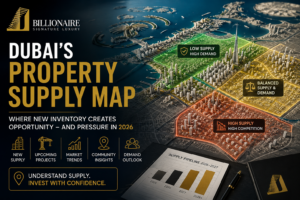
The Dubai Property Supply Map: A Better Way to Analyse Communities
Instead of looking at Dubai as one market, divide your analysis into five categories.
1. Low-Supply / Scarcity Markets
These are communities where:
- Land availability is limited
- New development is constrained
- Existing properties are difficult to replicate
- Demand is strong
- New competing inventory is relatively limited
Scarcity can provide a degree of protection because future buyers have fewer alternatives.
Property Finder’s 2026 analysis identifies communities such as Palm Jumeirah and Dubai Hills Estate as examples where scarcity is helping support pricing resilience.
But scarcity alone isn’t enough.
The property still needs demand.
2. High-Supply Apartment Markets
These communities have significant numbers of:
- New launches
- Under-construction apartments
- Investor-owned units
- Upcoming handovers
- Competing rental stock
This is where investors need to be particularly careful.
Property Finder currently identifies Jumeirah Village Circle, Business Bay and Dubai South, among others, as communities more sensitive to high supply and buyer choice.
That doesn’t mean:
“Don’t buy there.”
It means:
“Don’t buy there without analysing the competition.”
A high-supply market can still produce excellent investments.
But the property needs to stand out through:
- Price
- Location
- Layout
- Developer
- Amenities
- Rental yield
- View
- Handover timing
- Payment structure
- Resale potential
3. Controlled-Supply Communities
Some communities sit between scarcity and oversupply.
New projects may still be launched, but development is more controlled or staged.
This can create a healthier balance between:
new inventory + existing demand.
Property Finder’s 2026 analysis highlights communities such as Mudon, Tilal Al Ghaf, Arabian Ranches and Jumeirah Golf Estates as examples of areas closer to controlled-supply conditions.
For family-oriented markets, this distinction can be especially important because demand may come from end-users rather than purely from investors.
4. High-Demand Growth Markets
Supply isn’t automatically negative.
If population and household formation are growing quickly enough, new homes may be absorbed.
A market can add thousands of units while remaining healthy if:
new demand ≥ new supply.
One H1 2026 market review projects Dubai’s population rising from roughly 3.7 million in 2023 toward 5 million by 2030, alongside substantial future residential delivery.
This is why looking only at construction numbers can be misleading.
Dubai is not building homes into a vacuum.
The emirate is simultaneously attracting:
- New residents
- Businesses
- Entrepreneurs
- Professionals
- Investors
- International families
The real question is whether new demand can absorb new inventory at the community level.
5. Handover-Heavy Markets
This is perhaps the most important category for 2026.
A community may look balanced today.
Then several large projects can reach completion within the same six-to-twelve-month period.
Suddenly:
- More apartments become available
- Investors begin marketing units
- Rental competition increases
- Tenants get more choices
- Buyers negotiate harder
- Resale listings increase
This is known as handover pressure.
Reidin’s April 2026 market overview identified significant completed and upcoming supply activity across locations including Damac Lagoons, Jumeirah Village Circle, Business Bay, Dubai Studio City, Arjan and Dubailand Residence Complex.
For investors, the timing matters.
A community can be attractive in 2026 but experience temporary competition when several projects hand over simultaneously.
Jumeirah Village Circle: The Classic Supply-Sensitive Market
Jumeirah Village Circle, or JVC, is one of the clearest examples of why investors need to analyse supply at the community level.
Property Finder’s current 2026 analysis identifies JVC as having one of Dubai’s largest project pipelines, while its demand index has weakened year on year.
That creates a very different investment environment from a scarcity-led community.
The investor has to ask:
- How many similar apartments are coming?
- What are developers charging for new launches?
- What are existing apartments selling for?
- How many units are being handed over?
- What rental incentives are developers offering?
- How differentiated is the unit?
- What will the resale competition look like?
JVC can still offer opportunities.
But the investment thesis should be:
“I have identified the right property within a competitive market.”
Not:
“JVC is growing, therefore everything in JVC will rise.”
Business Bay: Demand, Location and Supply in One Market
Business Bay is another useful case study.
It remains one of Dubai’s most established urban districts, but it also has substantial new residential development.
Property Finder identifies Business Bay as increasingly sensitive to new supply and buyer choice, with several projects contributing to the competitive environment.
This creates an interesting situation.
Business Bay has genuine advantages:
- Central location
- Downtown proximity
- Metro connectivity
- Office demand
- Restaurants
- Hotels
- Lifestyle amenities
- Strong rental market
But investors cannot ignore the volume of new residential stock.
The right question isn’t:
“Is Business Bay a good area?”
It is:
“Which Business Bay property can outperform the surrounding competing supply?”
That is a much harder question.
And it is the question worth answering.
Dubai Hills Estate: Why Scarcity Can Matter
Dubai Hills Estate demonstrates the opposite side of the supply equation.
Property Finder currently describes Dubai Hills Estate as a scarcity-led market with pricing resilience, supported by limited land availability and strong end-user demand.
That doesn’t mean prices can never soften.
It means the competitive environment is different.
When buyers have fewer comparable properties to choose from, sellers may have greater pricing power.
This is particularly relevant for:
- Villas
- Townhouses
- Family homes
- Premium apartments
The investment thesis can therefore shift from:
“How many units are coming?”
to:
“How difficult will it be to reproduce this property’s characteristics elsewhere?”
Palm Jumeirah: The Scarcity Premium
Palm Jumeirah is another example of scarcity.
The supply of genuinely comparable waterfront property is naturally limited.
A new apartment project elsewhere in Dubai doesn’t necessarily compete directly with a specific Palm Jumeirah villa.
That creates a form of replacement scarcity.
For investors, this is an important concept.
Replacement scarcity means:
How difficult would it be for another developer to create an equivalent property?
If the answer is:
“Very difficult.”
the asset may have a stronger long-term competitive position.
If the answer is:
“There are 10 similar projects launching nearby.”
the investor needs to be much more careful.
Why New Supply Isn’t Always Bad
This is where property analysis often becomes too simplistic.
You will frequently hear:
“Too much supply is bad.”
Not necessarily.
New supply can actually improve a community.
New projects can bring:
- Retail
- Schools
- Restaurants
- Parks
- Roads
- Public transport
- Healthcare
- Community facilities
- Employment
- Population growth
A new development can increase the attractiveness of the entire area.
The problem occurs when supply grows faster than demand for a particular product.
Therefore:
Healthy supply
New inventory is absorbed by new demand.
Risky supply
Inventory accumulates faster than demand.
That is the distinction investors need to monitor.
The Most Important Number Isn’t Units. It’s Absorption.
Suppose Community A receives:
10,000 new apartments.
That sounds alarming.
But suppose:
- Population is growing rapidly
- Rental demand is strong
- Occupancy is high
- Most units are already sold
- Infrastructure is improving
The supply may be absorbed successfully.
Now consider Community B:
3,000 new apartments.
Sounds manageable.
But if demand is weak and 5,000 existing units are already competing for tenants and buyers, those 3,000 units could create much greater pressure.
So investors should focus on:
Absorption rate.
In simple terms:
How quickly is new supply being taken up by buyers or tenants?
fäm Properties’ August 2026 analysis provides a useful example of this distinction: it estimated that 82.9% of the homes scheduled for 2026 handover had already been sold, including a reported 95% absorption rate for villas.
Again, sold does not necessarily mean occupied.
But it demonstrates why raw supply numbers alone can be misleading.
A New Way to Read Dubai’s Property Supply
Instead of asking:
“How many homes are being built?”
ask these six questions:
1. How many?
What is the size of the pipeline?
2. What type?
Are they:
- Studios?
- One-bedroom apartments?
- Luxury apartments?
- Villas?
- Townhouses?
3. Where?
Are they concentrated in one community?
4. When?
Will they complete in:
- 6 months?
- 12 months?
- 3 years?
5. Who will buy them?
Investors?
Families?
International buyers?
End-users?
6. Who will compete with them?
Existing owners?
Developers?
Other investors?
This gives you a much clearer picture.
The 5-Minute Dubai Supply Map
Before buying a property, investors can create a simple supply map around the project.
0–1 km
Direct competition
Look for identical or highly comparable properties.
1–3 km
Local competition
Look at other buildings and developments targeting the same buyer.
3–5 km
Submarket competition
Analyse the wider community.
Ask what alternatives a buyer could choose instead of your property.
Step 1: Count the Competing Units
Start with:
Existing units + under-construction units + scheduled units.
Don’t automatically treat every announced project as guaranteed supply.
Separate:
- Completed
- Under construction
- Scheduled
- Announced
This makes the analysis much more realistic.
Step 2: Identify the Product Type
A community might have a large supply pipeline, but that doesn’t necessarily mean your property is directly exposed.
For example:
10,000 new studios
do not necessarily compete directly with:
500 villas.
So always analyse supply by:
property type + price bracket + buyer profile.
Step 3: Look at Handover Timing
Timing is critical.
If 5,000 comparable units are scheduled to complete over five years, the market may absorb them gradually.
If 5,000 units arrive within six months, the impact could be very different.
That’s why handover clustering matters.
Step 4: Compare Prices
Look at:
New launch price
versus
resale price
versus
rental value
If a developer is offering a brand-new unit at almost the same price as an older resale property, the resale seller may face pressure.
The older property needs another advantage.
Maybe:
- Better location
- Immediate occupancy
- Larger layout
- Better view
- Established building
- Lower total cost
Without differentiation, the newer property may win.
Step 5: Measure Demand
Supply without demand is a risk.
Look at:
- Buyer enquiries
- Transaction volumes
- Rental transactions
- Occupancy
- Population growth
- New businesses
- Infrastructure
- Search behaviour
Property Finder’s 2026 Demand Index is an example of why demand velocity can be useful alongside pricing data. Its analysis found stronger demand growth in several family-oriented villa communities, while some apartment-heavy markets experienced demand fatigue.
Step 6: Ask What Happens at Handover
This is the question many investors skip.
Imagine your property is handed over in 2028.
Ask:
What else will be handed over at the same time?
If the answer is:
“Three competing towers with thousands of similar units,”
you need to factor that into your investment decision today.
Supply Risk Does Not Mean “Don’t Buy”
This is a critical point for investors.
A high-supply market can actually create opportunities.
For example, buyers may gain:
- Better negotiation power
- More choice
- Better payment plans
- Developer incentives
- Discounts on resale units
- More attractive rental deals
The key is knowing who has the negotiating power.
Low supply + high demand
Seller advantage.
High supply + high demand
Competitive but potentially healthy.
High supply + weak demand
Buyer advantage.
Low supply + weak demand
Scarcity alone may not save the investment.
This simple matrix is much more useful than calling an entire community “good” or “bad.”
The Supply Risk Score Every Investor Should Consider
BSL Group can use a simple framework when evaluating projects:
🟢 Low Supply Risk
- Limited competing inventory
- Strong demand
- Established infrastructure
- Few comparable launches
- Strong end-user market
🟡 Moderate Supply Risk
- New projects coming
- Demand remains healthy
- Multiple property types
- Reasonable absorption
🔴 High Supply Risk
- Large comparable pipeline
- Multiple handovers
- Weakening demand
- High investor concentration
- Heavy developer incentives
- Many competing resale units
This isn’t a formal market index.
It’s an investment-screening framework.
And that’s exactly how investors should treat supply data.
Why Developers’ Delivery Record Matters
Supply analysis shouldn’t stop with the number of projects.
You also need to understand who is delivering them.
A pipeline full of announced projects isn’t equivalent to a pipeline dominated by projects already under active construction.
Ask:
- Is construction progressing?
- What is the developer’s delivery history?
- Are previous projects on time?
- How quickly does the developer sell inventory?
- Are there recurring delays?
- What percentage of announced projects actually reach completion?
This is especially important when building a long-term investment thesis.
How Supply Can Affect Rental Investors
Supply affects owners even if they never intend to sell.
Imagine you’re renting out a one-bedroom apartment.
Five similar buildings launch nearby.
Suddenly tenants have more choices.
Landlords may have to compete through:
- Lower rents
- Better furnishings
- Flexible payment terms
- Better maintenance
- Incentives
- Upgrades
This is why rental investors should analyse future rental supply, not just today’s rent.
A 7% gross yield today doesn’t guarantee the same rental economics after thousands of comparable units enter the market.
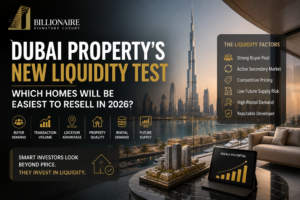
Supply and Resale Liquidity Are Connected
This is particularly important for investors.
More supply means more future choices for buyers.
If your apartment is one of:
5,000 similar units
your future buyer has leverage.
If your property is one of:
200 genuinely comparable units
your position may be stronger.
That is why Dubai property supply and Dubai property liquidity should be analysed together.
Supply affects competition.
Competition affects pricing.
Pricing affects resale.
And resale affects investment returns.
The Dubai Supply Map Is More Useful Than a “Best Areas” List
Generic articles often ask:
“What are the best areas to buy property in Dubai?”
But there is no universal answer.
The better question is:
“Which community has the right balance of demand, supply, pricing and future competition for my investment objective?”
An investor seeking rental income may prefer one type of community.
A family buyer may prefer another.
A luxury investor may prioritise scarcity.
An off-plan investor may prioritise early entry and development trajectory.
The supply map helps answer these questions.
What Investors Should Watch Through 2026 and Beyond
Dubai’s supply story shouldn’t be analysed once and forgotten.
Investors should continue watching:
New project launches
Are developers adding more competing inventory?
Construction progress
Are scheduled units actually moving toward completion?
Handover clusters
Are multiple projects completing simultaneously?
Rental absorption
Are tenants absorbing new inventory?
Resale transactions
Are completed units actually changing hands?
Price incentives
Are developers increasingly using payment plans or incentives?
Population growth
Is underlying demand expanding?
Infrastructure
Is the surrounding community becoming more attractive?
These indicators tell you whether supply is becoming a risk, opportunity or neutral factor.
The Real Question: Who Will Absorb the New Supply?
Ultimately, this is what matters.
Dubai’s population is growing.
Its economy continues to attract international capital and residents.
The city continues to develop new communities and infrastructure.
So new supply isn’t inherently a problem.
The real investment question is:
Who will absorb it?
If the answer is:
new residents + growing families + businesses + investors + end-users
then new supply can support a healthy expanding market.
If the answer is:
existing investors selling to other investors
then the situation becomes much more competitive.
That distinction can determine whether a new project becomes an investment opportunity or simply another unit in a crowded pipeline.
How BSL Group Should Evaluate Supply Before Recommending a Property
For investors, the supply analysis should form part of the investment decision before looking at projected appreciation.
A useful sequence is:
1. Community
Where is the property?
↓
2. Existing stock
What already exists?
↓
3. Future pipeline
What is coming?
↓
4. Product overlap
How much of that future supply directly competes with this property?
↓
5. Demand
Who will absorb it?
↓
6. Timing
When does the competition arrive?
↓
7. Exit
Who will buy the property later?
This approach is much more useful than simply saying:
“Dubai’s property market is growing.”
Growth at the city level doesn’t guarantee growth for every individual project.
Final Takeaway: Don’t Fear Supply. Understand It.
The Dubai property market isn’t simply a story of too much supply or not enough supply.
It is becoming a story of where supply is located, what is being delivered, when it arrives and whether demand can absorb it.
More than 24,500 residential units were completed during H1 2026, while the broader pipeline remains substantially larger.
But the market data also shows that many scheduled homes are already sold, demonstrating why the headline number of future units does not tell the whole story.
Some communities are benefiting from scarcity.
Some are dealing with heavy new inventory.
Some are seeing strong family-driven demand.
Others are becoming increasingly comparison-driven.
And some may experience temporary pressure when multiple projects reach handover simultaneously.
For investors, the lesson is simple:
Don’t ask whether Dubai has too much property.
Ask:
Where is the supply, what competes with my property, when will it arrive, and who will absorb it?
That is the Dubai property supply map that matters.
And in 2026, understanding that map could be the difference between buying into a growing community and buying into a crowded pipeline.
Frequently Asked Questions
Is Dubai property oversupplied in 2026?
There is no single answer for the entire emirate. Supply conditions vary significantly by community and property type. Some areas have substantial pipelines of new apartments, while scarcity-led communities have much more constrained supply. Property Finder’s 2026 analysis specifically highlights differences between communities based on local supply, demand and development pipelines.
How much new property is coming to Dubai in 2026?
The exact figure depends on whether the source is measuring completed, scheduled or announced supply. Dubai recorded more than 24,500 completed residential units in H1 2026, while other market analyses estimate a much larger number of homes scheduled for handover across the full year.
Which Dubai areas have the highest property supply?
Jumeirah Village Circle, Business Bay, Dubai South and several other apartment-heavy communities currently have significant pipelines. However, the amount of supply should always be compared with demand and the size of the existing market.
Is high property supply bad for investors?
Not necessarily. High supply can give buyers more choice and negotiation power, but it can also create opportunities if demand is strong and the property is well positioned. The important metric is the relationship between new supply and absorption.
What is supply absorption in real estate?
Supply absorption refers to how quickly newly available properties are taken up by buyers or tenants. High absorption can indicate that demand is strong enough to accommodate new inventory.
Will new Dubai property supply reduce prices?
It can create price pressure in individual communities if supply grows faster than demand. However, new supply does not automatically reduce prices across Dubai because different communities have different levels of demand, scarcity and product mix.
Should I avoid buying in a high-supply Dubai community?
No. A high-supply community can still contain excellent investment opportunities. Investors should compare the specific property against competing projects, rental demand, pricing, handover timing and future resale competition.
Why are handover dates important?
When several projects are completed around the same time, many new units can enter the market simultaneously. This can increase competition for buyers and tenants and potentially affect rents, resale prices and marketing periods.
How can I check future property supply in Dubai?
Investors can examine Dubai Land Department data, developer announcements, project construction progress and community-level market reports. DLD’s real-estate data ecosystem includes information on transactions, projects, units, buildings, developers and other market categories.
Is off-plan property more exposed to supply risk?
It can be, particularly when several competing projects are scheduled to complete around the same time. Off-plan investors should analyse what competing inventory will exist when their own property reaches completion rather than relying only on today’s market conditions.
Which is better: a low-supply or high-supply community?
Neither is automatically better. Low-supply communities may benefit from scarcity, while high-supply communities can offer greater choice and potentially more attractive entry opportunities. The best choice depends on demand, pricing, product quality and the investor’s objectives.