
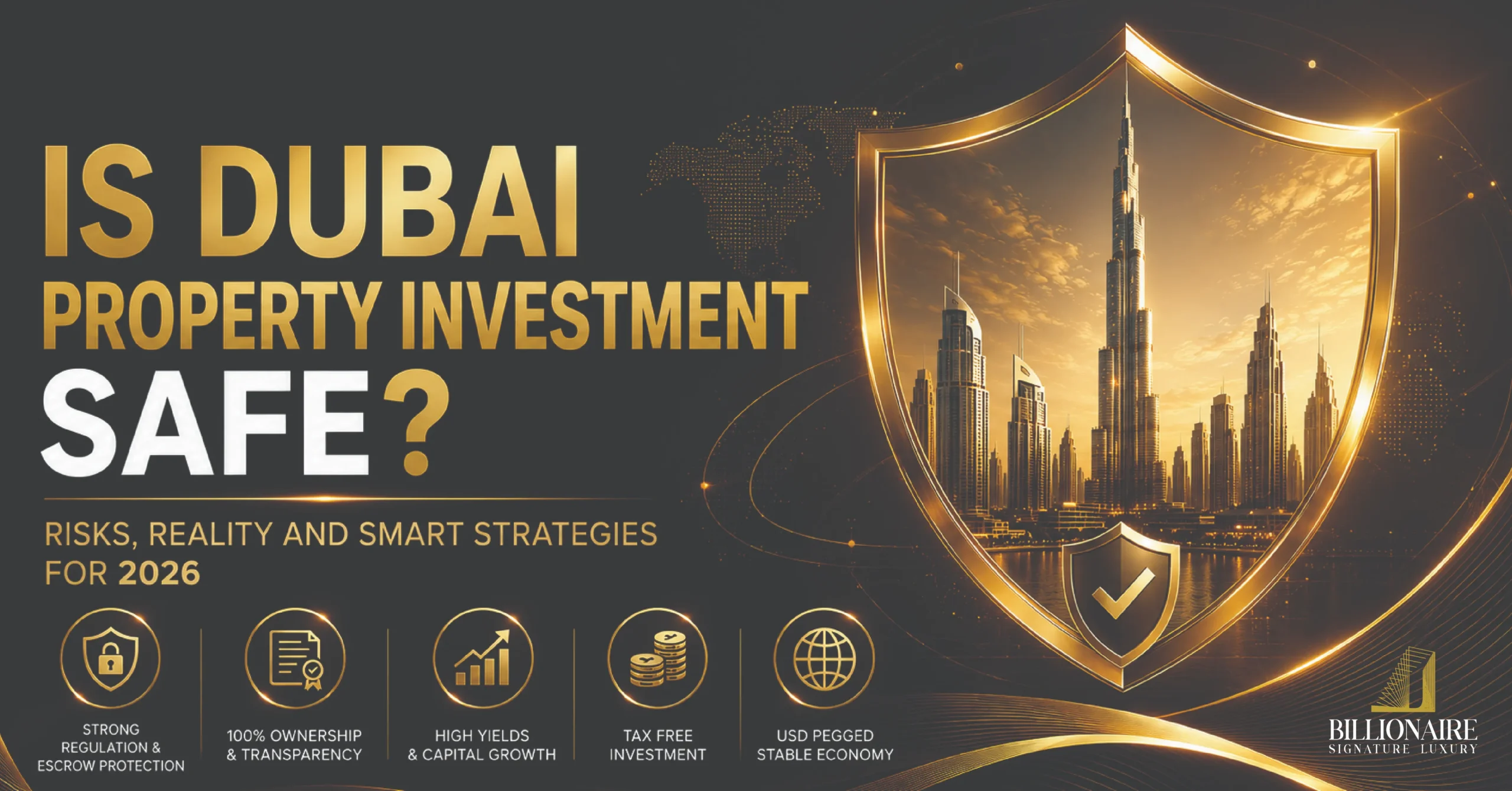
Before any investor puts significant capital into a foreign market, one question has to come first: is it safe?
When it comes to Dubai, the honest answer is yes. Dubai property investment is safe. But the more complete answer is that it is safe when approached with the right strategy, the right partners, and the right understanding of where the real risks lie.
This guide gives you both the full picture and the practical tools to navigate it intelligently.
Why Dubai Has Earned Its Reputation as a Safe Investment Market
Dubai did not become one of the world’s most popular real estate investment destinations through luck or marketing. It earned that position by building a regulatory ecosystem that genuinely protects investor interests.
The real estate sector is overseen by the Real Estate Regulatory Authority, which licenses all developers, agents, and projects. Off-plan transactions are protected by a mandatory escrow account system: your payment goes into a regulated account, and funds are released to the developer only when verified construction milestones are met. This means your money cannot be misused, even if a developer faces financial difficulty.
All property transactions are registered with the Dubai Land Department, which maintains digital ownership records. This transparency means title disputes are rare, and when they do occur, the legal resolution process is clear and enforceable.
Dubai also has among the lowest crime rates of any major global city, a politically stable government, and an economy that has consistently demonstrated resilience through global uncertainty. These are not soft advantages. They translate directly into reduced investment risk.
The Risks That Are Real and How to Manage Them
Every investment market carries risk. Dubai is no exception. But the key difference between Dubai and many other markets is that the risks here are largely predictable and manageable with the right approach.
The most common risk is developer quality. Not all developers deliver with the same execution quality, the same adherence to timelines, or the same commitment to the product they sold. Investors who enter off-plan projects with developers who lack a strong track record face the real possibility of delays, quality shortfalls, or in extreme cases, projects that stall. The solution is straightforward: work exclusively with established developers who have a history of delivering on time and to specification.
The second common risk is location selection. Dubai is a collection of micro-markets, each with different demand dynamics. A property in the wrong location can sit vacant for extended periods, deliver yield well below market average, and appreciate slowly regardless of what the overall Dubai market is doing. The solution here is discipline: choose based on demand data, not marketing narrative.
The third risk is overpaying at entry. Real estate returns are largely determined at the point of purchase. Enter at a price that is above genuine market value, and even a good property in a good location will underperform. Proper market analysis and professional guidance before purchase prevents this.
Market Timing Risk Is Different From What Most People Think
Many investors worry about buying at the top of a cycle. This is a legitimate concern in any market. In Dubai, the way to manage this risk is not to wait indefinitely for a perfect moment that never arrives, but to focus on income-generating assets that deliver returns regardless of short-term price movements.
A property that yields 7% per year returns your full capital in approximately 14 years through income alone, entirely independent of what happens to its market value. For long-term investors focused on income, market timing is significantly less critical than property selection and yield quality.
What Makes Dubai Safer Than Most Comparable Markets
Compared to many markets where international investors deploy capital, Dubai offers several structural safety advantages.
There is no annual property tax, which means your running costs are predictable and contained. There is no capital gains tax, so your exit return is not diminished by government levies. The currency is pegged to the USD, eliminating currency risk for dollar-denominated investors. And the legal system governing property transactions is clear, enforceable, and built around protecting investor interests.
Smart Strategies That Reduce Risk Further
The investors who consistently perform well in Dubai are not the ones who took the least risk. They are the ones who managed risk most intelligently.
They think in portfolios rather than individual properties, spreading their exposure across locations, property types, and investment timelines. They focus on data over emotion, evaluating rental demand, vacancy rates, and comparative transaction values before committing capital. They diversify between income-generating assets that provide financial stability and appreciation-focused assets that provide long-term wealth growth. And they work with experienced partners who know the market from inside.
Why BSL Group UAE Is Central to Safe Investing
At BSL Group UAE, we have been guiding investors through Dubai’s property market since 2012. Our approach is built on verified projects, data-backed recommendations, and honest advice that prioritises your long-term returns over short-term transaction volume.
We help clients avoid the developer quality risks, the location mistakes, and the pricing errors that create underperformance. And we manage portfolios actively so that assets continue to perform after purchase.
Dubai is one of the safest real estate markets in the world for international investors. With the right strategy and the right partner, it is also one of the most profitable.