
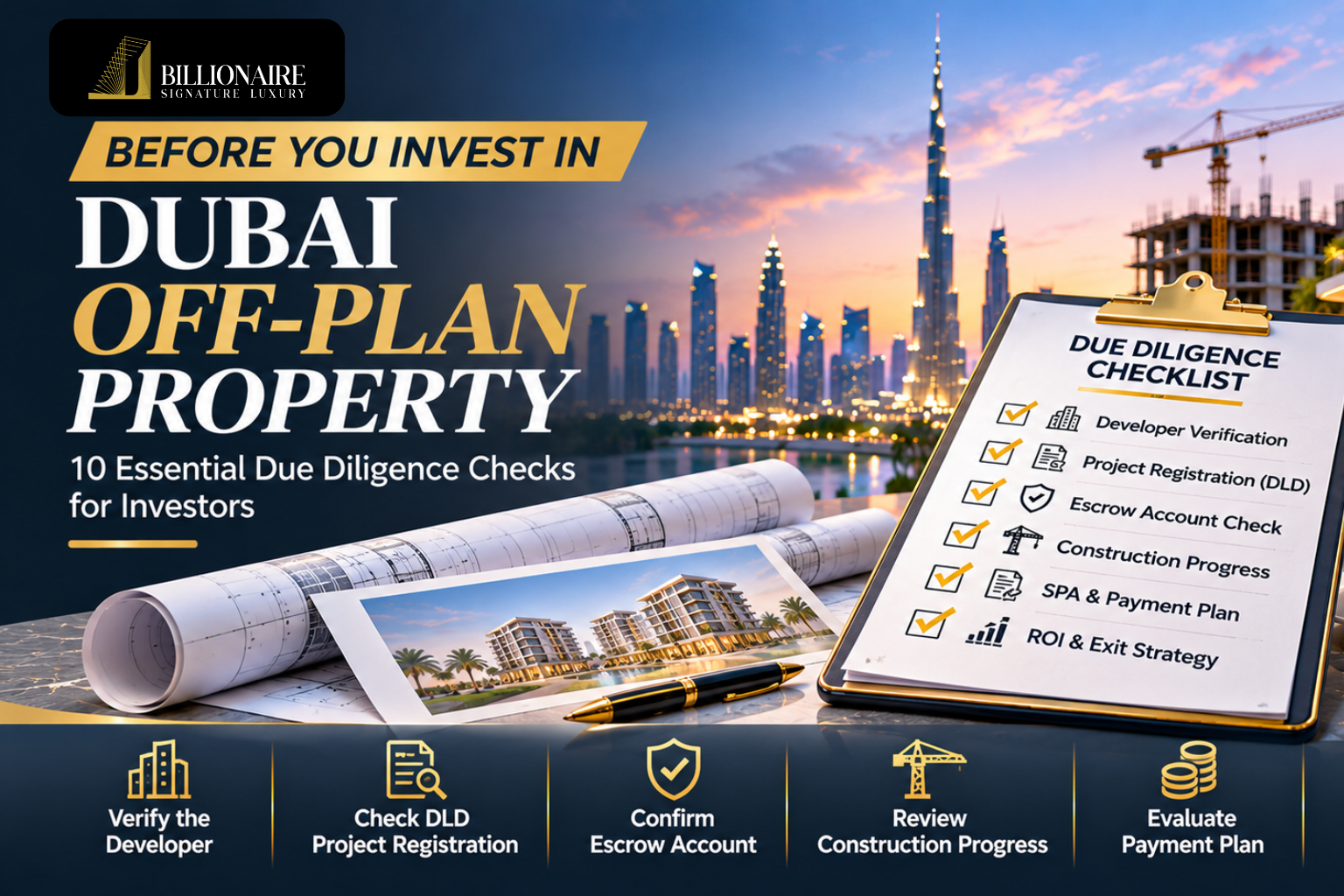
Dubai’s off-plan property market offers investors access to new residential and commercial developments, flexible payment plans and opportunities to participate in projects before completion.
However, an attractive launch price, impressive marketing campaign or convenient payment schedule does not automatically make a property a sound investment.
Before committing capital, investors need to understand the developer, project registration, escrow arrangements, construction progress, contractual obligations and potential exit opportunities.
Dubai off-plan property due diligence is therefore an essential part of evaluating any property acquisition. It helps investors identify potential risks, verify important information and make decisions based on the underlying fundamentals rather than promotional claims.
Here are ten important checks to complete before investing.
1. Verify the Developer’s Registration and Track Record
The developer is one of the most important factors in an off-plan investment.
A project may have an attractive location and design, but its successful delivery depends on the developer’s financial capacity, execution capabilities and project management.
Investors should evaluate:
- Whether the developer is appropriately licensed and registered.
- The developer’s previous completed projects.
- Construction quality and delivery history.
- Any publicly documented project delays or disputes.
- The developer’s experience with similar developments.
- Its financial and operational capabilities.
Dubai Law No. 8 of 2007 requires developers conducting regulated off-plan development activity to be registered and licensed under the applicable framework.
Investors should independently verify the developer’s credentials rather than relying exclusively on sales representatives or marketing materials.
2. Confirm That the Project Is Registered with Dubai Land Department
A project should be independently verified before an investor makes a financial commitment.
Dubai Land Department (DLD) provides services that allow users to check real estate project information and development status.
Investors should verify:
- The project’s official name and registration details.
- The developer associated with the project.
- The development’s location and plot details.
- The project’s registration status.
- Available construction progress information.
The project name used in marketing material should match the official project records.
Official resource: Dubai Land Department – Real Estate Project Status
A project appearing in promotional material is not a substitute for independent verification through official records.
3. Verify the Project’s Escrow Account
One of the most important protections in Dubai’s off-plan property framework is the project escrow account.
Under Dubai Law No. 8 of 2007, developers covered by the law must use a dedicated escrow account for relevant off-plan development projects.
The account is opened in the name of the real estate development project. Buyer payments and qualifying project financing are deposited into it.
The law also provides that:
- Each project must have its own escrow account where a developer undertakes multiple projects.
- The account is dedicated to the development of the relevant project.
- The account is managed by an approved escrow agent.
- Payments are subject to the applicable legal and regulatory controls.
Investors should verify the account details directly through the developer’s official documentation and relevant approved channels.
Never transfer an off-plan purchase payment to an unrelated personal or corporate bank account simply because a sales representative requests it.
Official reference: Dubai Law No. 8 of 2007 – Escrow Accounts for Real Estate Development
4. Examine Actual Construction Progress
A payment plan may extend across several years, but investors should understand what is happening on the construction site.
Construction progress can influence delivery expectations, financing requirements and the property’s future marketability.
Investors should examine:
- The project’s latest reported completion percentage.
- Whether construction is progressing against the announced schedule.
- The status of major construction milestones.
- Whether the project has experienced significant delays.
- Whether the latest available information is supported by official project records.
Dubai Land Department provides a project-status service that can display available completion information based on the relevant project details and approved technical reporting.
Do not rely solely on photographs or construction updates shared by a broker. Where possible, compare marketing updates with independently verifiable information.
5. Read the Sale and Purchase Agreement Carefully
The Sale and Purchase Agreement (SPA) is one of the most important documents in an off-plan acquisition.
Investors should review the contract before signing and understand the obligations it creates.
Important areas include:
Unit specifications: Verify the unit number, floor, area, layout, parking allocation and agreed specifications.
Payment schedule: Confirm instalment amounts, due dates and payment conditions.
Completion and handover: Understand the contractual completion date and provisions dealing with delays.
Default provisions: Review the consequences of late payments or failure to fulfil contractual obligations.
Cancellation and termination: Understand the circumstances in which the contract may be terminated and the applicable consequences.
Assignment and resale: Check whether the investor can transfer the contractual interest before handover and what conditions apply.
Additional charges: Review registration, service-related and other contractual costs.
An investor should obtain independent legal advice where contractual terms are unclear or commercially significant.
6. Evaluate the Payment Plan Beyond the Initial Deposit
Flexible payment plans can make off-plan properties appear financially attractive.
However, a low initial payment does not necessarily mean that the investment requires little capital.
Investors should calculate the complete financial commitment.
Consider:
- Initial booking amount.
- Instalments during construction.
- Milestone-linked payments.
- Any payment due at handover.
- Post-handover instalments, where applicable.
- Registration and administrative expenses.
- Potential financing costs.
- Expected service charges after completion.
For example, consider a hypothetical property priced at AED 2 million.
| Payment stage | Percentage | Amount |
|---|---|---|
| Booking | 10% | AED 200,000 |
| During construction | 50% | AED 1,000,000 |
| On handover | 40% | AED 800,000 |
| Total | 100% | AED 2,000,000 |
This example is illustrative only.
The investor should assess whether sufficient liquidity will be available at every payment milestone, rather than evaluating affordability based on the booking amount alone.
7. Assess the Location and Future Supply
A property’s investment potential is closely connected to its location.
A development may look attractive on paper, but its long-term performance depends on the surrounding infrastructure, employment centres, transport access and competing supply.
Investors should examine:
- Proximity to business districts and employment hubs.
- Road connectivity and public transport access.
- Schools, healthcare and retail infrastructure.
- Existing residential and commercial communities.
- Planned infrastructure developments.
- Competing projects scheduled for delivery.
- The likely tenant and buyer profile.
Future supply is particularly important.
If a large number of comparable units are scheduled for completion around the same period, investors may face greater competition when renting or selling their property.
A location should therefore be evaluated using both current demand and expected future supply.
8. Calculate the Investment Economics Realistically
Projected appreciation and rental returns should be supported by market evidence.
Investors should avoid relying exclusively on developer projections or estimated future selling prices.
A basic acquisition assessment should include the following:
Gross rental yield
Gross Rental Yield = (Annual Rental Income ÷ Purchase Price) × 100
For example, assume a property costs AED 2 million and the expected annual rent is AED 120,000.
Gross rental yield:
(AED 120,000 ÷ AED 2,000,000) × 100 = 6%
However, this does not represent the investor’s actual net return.
Net rental income
Investors should account for:
- Service charges.
- Property management expenses.
- Maintenance.
- Vacancy periods.
- Insurance and other relevant costs.
- Financing expenses, where applicable.
Acquisition and exit costs
The investment model should also include applicable registration charges, transaction expenses, brokerage costs and potential resale-related expenses.
A property that appears attractive based on gross rental yield may deliver a materially different outcome after all expenses are considered.
9. Understand the Exit Strategy Before Buying
Investors should consider how they intend to realise value from the property.
There are several possible approaches:
Sell before handover: An off-plan contractual interest may be assigned before completion, subject to applicable law, the developer’s requirements and contractual conditions.
Sell after completion: The investor may sell the completed property through the secondary market.
Hold for rental income: The property may be retained as a long-term income-producing asset.
Hold for capital appreciation: The investor may retain the property in anticipation of future market growth.
Each strategy has different liquidity requirements, costs and risks.
Before purchasing, investors should understand the relevant resale restrictions, payment obligations, potential buyer demand and expected transaction costs.
An investment should not depend entirely on the assumption that another buyer will always be available at a higher price.
10. Review the Risks and Prepare for Delays
Even properly registered developments can experience commercial and operational challenges.
Investors should evaluate potential risks, including:
- Construction delays.
- Changes in market conditions.
- Lower-than-expected rental demand.
- Increased competing supply.
- Changes in financing costs.
- Additional contractual or administrative expenses.
- Reduced resale liquidity.
- Developer or contractor performance issues.
A prudent investment assessment should consider both the expected scenario and a downside scenario.
For example, calculate whether the investor can continue meeting payment obligations if handover is delayed or if the expected rental income is lower than projected.
Financial flexibility is an important part of property investment risk management.
A Practical Dubai Off-Plan Property Due Diligence Checklist
Before making a booking payment, investors can use this checklist to organise their review.
- Verify the developer’s registration and licensing.
- Check the project’s registration with Dubai Land Department.
- Confirm the official project and escrow account details.
- Review available construction progress information.
- Examine the Sale and Purchase Agreement.
- Understand the complete payment schedule.
- Evaluate location fundamentals and competing supply.
- Calculate realistic rental yield and acquisition costs.
- Review assignment, resale and exit conditions.
- Obtain independent legal and financial advice where necessary.
Completing these checks does not eliminate investment risk. It helps ensure that the decision is based on verified information and a clearer understanding of the transaction.
How BSL Group Approaches Real Estate Investment Opportunities
At BSL Group, real estate opportunities are considered within a broader investment and private-capital perspective.
The objective is to understand the commercial fundamentals of an opportunity before evaluating its suitability within an investor’s wider strategy.
For off-plan and other property investments, this involves examining relevant considerations such as:
- Asset fundamentals and location.
- Project and developer information.
- Capital requirements and payment structures.
- Potential income and appreciation drivers.
- Investment risks and liquidity.
- Funding and transaction requirements.
Through its private office advisory and funding-related services, BSL supports discussions around real assets, investment considerations and private capital requirements.
Explore BSL Group’s Private Office Advisory and Private Funding services to learn more.
Frequently Asked Questions
How can I verify an off-plan property project in Dubai?
Use Dubai Land Department’s official project-status service to check available project information, registration details and construction progress. Also verify the developer’s credentials and the project’s contractual documentation.
What is an escrow account in Dubai real estate?
An escrow account is a dedicated bank account established for a real estate development project. Under Dubai Law No. 8 of 2007, relevant buyer payments and qualifying project financing are deposited into the account and managed under the applicable legal framework.
Can I pay an off-plan property booking amount into the developer’s normal bank account?
Investors should follow the official payment instructions and verify the designated project escrow account or applicable authorised payment arrangement before transferring funds. Do not rely on informal payment instructions.
What should I check in a Dubai off-plan SPA?
Review the unit specifications, payment schedule, completion provisions, default clauses, termination conditions, assignment restrictions and additional charges. Independent legal review is advisable.
How do I check the construction progress of a Dubai project?
Dubai Land Department provides a project-status service that allows users to search using relevant project information and review available completion and status details.
Is buying off-plan property in Dubai risky?
Like any property investment, off-plan acquisitions involve risks. These may include construction delays, market fluctuations, payment obligations, oversupply and resale restrictions. Proper due diligence can help investors understand these risks before committing capital.
Should I invest in off-plan property based only on the payment plan?
No. A payment plan is only one part of the investment decision. Investors should also assess the developer, location, project fundamentals, total acquisition costs, expected returns and exit strategy.
Make Informed Property Investment Decisions
Off-plan property investment should begin with research, not a booking form.
Understanding the developer, verifying the project, examining escrow arrangements and reviewing the financial structure can help investors make more informed decisions.
In a market with a wide range of developments and investment opportunities, disciplined due diligence remains one of the most important parts of protecting capital.
BSL Group – Real Assets. Private Capital. Long Term Value.
Connect with BSL Group to discuss real estate investment and private capital opportunities.