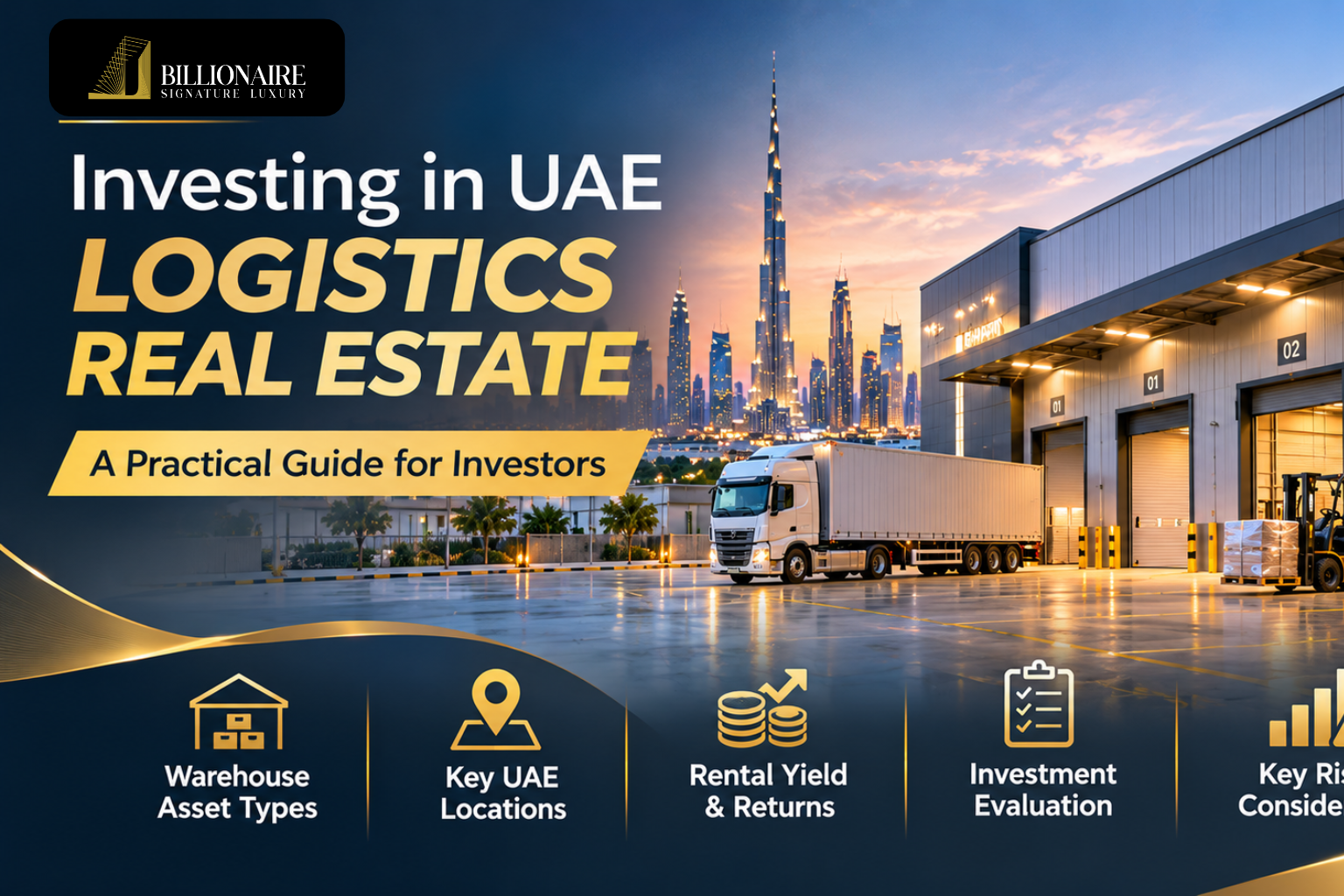
Real estate investment is often associated with residential apartments, luxury villas and branded residences. However, another segment is attracting increasing attention from institutional investors and private capital: industrial and logistics real estate.
Warehouses, distribution centres and industrial facilities play an essential role in the UAE’s expanding trade, manufacturing and e-commerce ecosystem. As businesses require reliable storage, distribution and operational infrastructure, well-positioned industrial assets can offer investors exposure to a different segment of the property market.
For investors exploring logistics real estate investment in the UAE, the opportunity goes beyond purchasing a warehouse. It involves evaluating the location, tenant profile, lease structure, operational specifications and long-term income potential of the asset.
Why Is UAE Logistics Real Estate Attracting Investor Attention?
The UAE’s position as a regional trade and distribution hub supports demand for industrial and logistics infrastructure.
Dubai and Abu Dhabi connect businesses to international markets through their ports, airports, free zones, road networks and growing industrial ecosystems.
Several developments are shaping the sector.
1. Expansion of Manufacturing and Industrial Activity
Manufacturing businesses require suitable facilities for production, storage and distribution.
Dubai recorded 12.3 million sq ft of new industrial and logistics requirements during the first half of 2026. Manufacturing and industry accounted for 35.1% of these requirements, making them the largest source of demand during the period.
This highlights the importance of industrial infrastructure beyond conventional warehouse requirements.
2. Growth of E-Commerce and Distribution Networks
E-commerce businesses depend on strategically located distribution facilities to manage inventory, fulfil orders and maintain delivery timelines.
As businesses expand their distribution networks, demand can emerge for facilities with efficient loading areas, adequate storage capacity and access to major transport corridors.
3. Supply Chain Diversification
Businesses are increasingly evaluating supply-chain resilience, alternative trade routes and regional distribution strategies.
The UAE’s ports, logistics infrastructure and connectivity provide an important foundation for these operations.
4. Demand for Modern Industrial Facilities
Not every warehouse is equally attractive to occupiers.
Modern facilities with suitable layouts, specifications, utilities and transport access can appeal to businesses seeking operational efficiency.
JLL’s Q3 2026 UAE industrial market review reported that Dubai’s industrial rents increased by 5.9% year-on-year, while demand remained concentrated around modern, well-located facilities.
Types of Logistics and Industrial Assets Investors Can Consider
The industrial real estate market includes several asset categories. Each serves a different operational purpose and carries distinct investment considerations.
1. Conventional Warehouses
Conventional warehouses provide storage space for businesses handling inventory, equipment, raw materials and finished products.
Their investment attractiveness depends on location, building condition, access, usable floor area and tenant demand.
2. Grade A Warehouses
Grade A facilities generally offer modern specifications, efficient layouts, appropriate infrastructure and better operational functionality.
They may attract established logistics operators, manufacturers and larger corporate occupiers.
However, investors should verify the actual building specifications rather than relying exclusively on the Grade A label.
3. Distribution and Fulfilment Centres
These facilities support inventory management, order processing and product distribution.
Their value is closely connected to transport accessibility, proximity to consumer markets and the operational requirements of tenants.
4. Industrial and Manufacturing Facilities
Industrial properties accommodate production, assembly, processing and related activities.
Investors must pay particular attention to permitted usage, power capacity, building specifications and environmental requirements.
5. Build-to-Suit Industrial Properties
A build-to-suit facility is developed or configured around the requirements of a particular occupier.
This approach may provide greater alignment between the building and the tenant’s operational needs.
However, the investor must carefully assess construction costs, development timelines, tenant commitments and the consequences of tenant withdrawal.
Key UAE Locations for Logistics and Industrial Real Estate
Location influences tenant demand, operating costs, rental potential and the long-term competitiveness of an industrial property.
Some established UAE industrial and logistics locations include:
Dubai South
Dubai South benefits from its strategic relationship with Al Maktoum International Airport and the wider logistics ecosystem.
Its position makes it relevant to aviation-linked logistics, distribution and industrial operations.
Jebel Ali and JAFZA
The Jebel Ali ecosystem benefits from its proximity to Jebel Ali Port and the established Jebel Ali Free Zone.
It is relevant to businesses involved in international trade, manufacturing, warehousing and distribution.
Dubai Industrial City
Dubai Industrial City supports manufacturing and industrial operations through its dedicated industrial ecosystem.
Its relevance extends to businesses requiring production facilities and associated logistics infrastructure.
Dubai Investments Park
Dubai Investments Park combines industrial, commercial and logistics activities.
Its established infrastructure and connectivity make it an important location for businesses seeking operational facilities in Dubai.
KEZAD, Abu Dhabi
Khalifa Economic Zones Abu Dhabi offers an industrial and logistics ecosystem connected to Khalifa Port and wider transport infrastructure.
It is relevant to manufacturing, logistics, distribution and industrial investment requirements.
The right location depends on the intended tenant, permitted activity, transport requirements and asset economics. Investors should not assume that every industrial location offers the same rental prospects.
How to Evaluate a Warehouse Before Investing
A warehouse may appear attractive because of its size, asking price or location. However, a disciplined acquisition assessment should examine several factors.
1. Tenant Quality and Lease Security
An income-producing warehouse is only as reliable as its underlying tenancy.
Investors should evaluate:
- Tenant financial strength and operating history.
- Remaining lease duration.
- Contractual rental escalation provisions.
- Payment history and outstanding obligations.
- Renewal conditions and break clauses.
- Tenant concentration and vacancy exposure.
A long lease with a financially sound tenant may provide greater income visibility than an asset dependent on frequent tenant replacement.
2. Location and Transport Connectivity
Industrial occupiers often prioritise operational efficiency.
An asset should be evaluated based on its proximity to ports, airports, highways, industrial clusters and distribution networks.
Accessibility for heavy vehicles, loading requirements and transport restrictions should also be considered.
3. Building Specifications and Operational Capacity
The building must meet the requirements of its intended occupier.
Important considerations include:
- Clear internal height.
- Floor loading capacity.
- Loading bays and vehicle access.
- Fire safety and civil defence compliance.
- Electrical and power capacity.
- Ventilation and cooling requirements.
- Storage and handling capabilities.
- Condition of the roof and structural components.
An asset that requires significant upgrades may involve additional capital expenditure before it becomes commercially competitive.
4. Ownership, Approvals and Permitted Use
Investors should verify the property’s ownership documentation, title status, permitted activities and applicable regulatory requirements.
The legal structure of the acquisition should also be examined, particularly where the property is located within a designated free zone or industrial jurisdiction.
Independent legal and technical due diligence is essential before completing the transaction.
5. Operating Expenses and Maintenance
Gross rental income does not represent the investor’s actual return.
Costs may include maintenance, insurance, management, service charges, property-related expenses and periods of vacancy.
The property’s age, construction quality and maintenance history can influence future expenditure.
6. Exit Liquidity and Resale Potential
An industrial asset should be evaluated not only for its rental income but also for its potential resale market.
Investors should consider:
- Demand from other industrial occupiers.
- Interest from institutional and private investors.
- Tenant quality and lease expiry.
- Asset condition and future capital expenditure.
- Location-specific transaction activity.
A property that generates income but has limited resale demand may create challenges when the investor wants to exit.
Understanding Rental Yield and Net Operating Income
Rental yield is one of the most common measures used to evaluate an income-producing property.
However, investors should distinguish between gross rental yield and net operating income.
Gross rental yield:
Gross Rental Yield = (Annual Rental Income ÷ Property Purchase Price) × 100
For example, consider a warehouse purchased for AED 10 million with annual rental income of AED 800,000.
Gross rental yield:
(AED 800,000 ÷ AED 10,000,000) × 100 = 8%
However, the investor must also account for operating expenses.
Assume annual operating expenses are AED 150,000.
Net Operating Income (NOI):
AED 800,000 − AED 150,000 = AED 650,000
Net yield on the purchase price:
(AED 650,000 ÷ AED 10,000,000) × 100 = 6.5%
These figures are illustrative, not current market averages or a representation of expected returns.
A complete investment assessment should also consider acquisition costs, financing expenses, capital expenditure, taxes where applicable and the investor’s intended holding period.
Risks Associated with Logistics Real Estate Investment
Industrial property can offer exposure to long-term business demand, but it is not without risks.
Tenant Concentration
A single-tenant warehouse may depend heavily on one occupier. If that tenant leaves or defaults, the property could experience a significant income interruption.
Changing Industrial Requirements
Businesses may require different specifications as technology, storage methods and operating models evolve.
Older facilities may need upgrades to remain competitive.
Location-Specific Oversupply
New industrial developments can increase competition in particular locations.
Investors should evaluate existing and planned supply rather than relying on broad UAE market statistics.
Capital Expenditure
Roof repairs, fire safety upgrades, structural improvements and utility enhancements can affect investment returns.
A detailed technical inspection can help identify potential costs before acquisition.
Financing and Interest Rate Exposure
Borrowing can increase investment returns when property income supports the financing cost. However, it also increases financial risk.
Investors should stress-test their financial models against higher borrowing costs, lower occupancy and delayed rental payments.
Why Institutional and Private Capital Matters in Industrial Real Estate
Industrial and logistics assets can require significant acquisition capital, specialised due diligence and an understanding of operational property requirements.
For investors evaluating larger transactions, the funding structure can be as important as the asset itself.
Private capital may be considered for selected acquisition opportunities, portfolio transactions and development requirements, subject to the asset, financial structure and investor objectives.
A structured approach should consider:
- The commercial fundamentals of the asset.
- Tenant quality and income visibility.
- Acquisition valuation and capital requirements.
- Financing costs and leverage.
- Potential development or repositioning requirements.
- Long-term ownership and exit strategy.
The objective is not simply to acquire a property. It is to acquire an asset with a defensible commercial rationale and a clearly understood risk profile.
How BSL Group Approaches Real Asset Opportunities
BSL Group’s approach to real assets and private capital focuses on understanding the commercial purpose behind each opportunity.
Industrial and logistics properties can form part of a broader real estate investment strategy when supported by suitable location fundamentals, asset quality, tenant demand and financial structuring.
BSL’s areas of focus include private funding, investment advisory and real estate-related opportunities.
For investors evaluating an industrial acquisition, development requirement or asset-backed funding structure, the starting point should be a detailed review of the transaction and its underlying economics.
Explore BSL Group’s Private Funding solutions or learn more about its Private Office Advisory services.
Frequently Asked Questions
Is logistics real estate a good investment in the UAE?
Logistics real estate may offer exposure to industrial expansion, trade and distribution demand. However, investment suitability depends on the asset, location, tenant quality, acquisition valuation and expected operating costs.
What types of warehouses can investors acquire in Dubai?
Investors may evaluate conventional warehouses, Grade A facilities, distribution centres, manufacturing properties and build-to-suit industrial assets, subject to ownership rules and permitted-use requirements.
Which locations are important for industrial property investment in the UAE?
Dubai South, Jebel Ali, JAFZA, Dubai Industrial City, Dubai Investments Park and KEZAD are among the established industrial and logistics locations investors may evaluate.
How is warehouse rental yield calculated?
Gross rental yield is calculated by dividing annual rental income by the property’s purchase price and multiplying the result by 100. Net yield accounts for relevant operating expenses.
What makes a warehouse attractive to institutional investors?
Factors can include a strong tenant covenant, long-term lease, modern building specifications, strategic location, reliable income and potential resale liquidity.
Is a single-tenant warehouse riskier than a multi-tenant facility?
A single-tenant facility may have greater exposure to one tenant’s financial position and lease renewal decision. A multi-tenant facility can diversify rental income but may involve greater leasing and management complexity.
Invest in Real Assets with a Long-Term Perspective
The UAE’s industrial and logistics sector is becoming an increasingly important part of its wider real estate ecosystem.
For investors, the opportunity lies in identifying assets that serve genuine business requirements, generate sustainable income and remain commercially relevant over time.
A disciplined assessment of location, tenant quality, building specifications, operating expenses and exit potential can help distinguish a compelling investment from an expensive acquisition.
BSL Group – Real Assets. Private Capital. Long Term Value.
Connect with BSL Group to discuss real estate investment and private capital opportunities.