Every rising property market eventually attracts the same debate. One voice says prices are growing and now is the time to invest. The other voice says prices have grown too much and a correction is coming. Dubai in 2026 sits squarely in the middle of that argument, and working out which voice is right requires looking at the actual data rather than the loudest opinions.
What Is Actually Happening to Dubai Property Prices
Prices are rising. That is not in question. The average price per square foot across Dubai reached AED 1,759 in Q1 2026, up 12.5% year on year. In prime areas and the luxury segment, appreciation has been even more pronounced, with some ultra-prime locations on Palm Jumeirah seeing value increases of 30% or more over two years.
But the more important question is not whether prices are rising. It is why they are rising, and whether the reasons behind that growth are sustainable or fragile.
The Bubble Argument and Why the Data Does Not Support It
A property bubble is typically characterised by prices that have detached from underlying economic fundamentals. Demand is driven by speculation rather than genuine need. Buyers are purchasing assets not to use or rent them, but because they expect to sell them to the next buyer at a higher price.
Dubai’s current market does not fit that profile.
Demand is increasingly driven by end users: people who are moving to Dubai, living in their properties, or holding them as genuine long-term investments generating rental income. The UAE’s growing population, now above 4 million in Dubai alone and growing, creates structural housing demand that is not speculative. The occupancy rates across Dubai’s established rental communities are high, meaning the properties that exist are being used, not held empty waiting for a buyer.
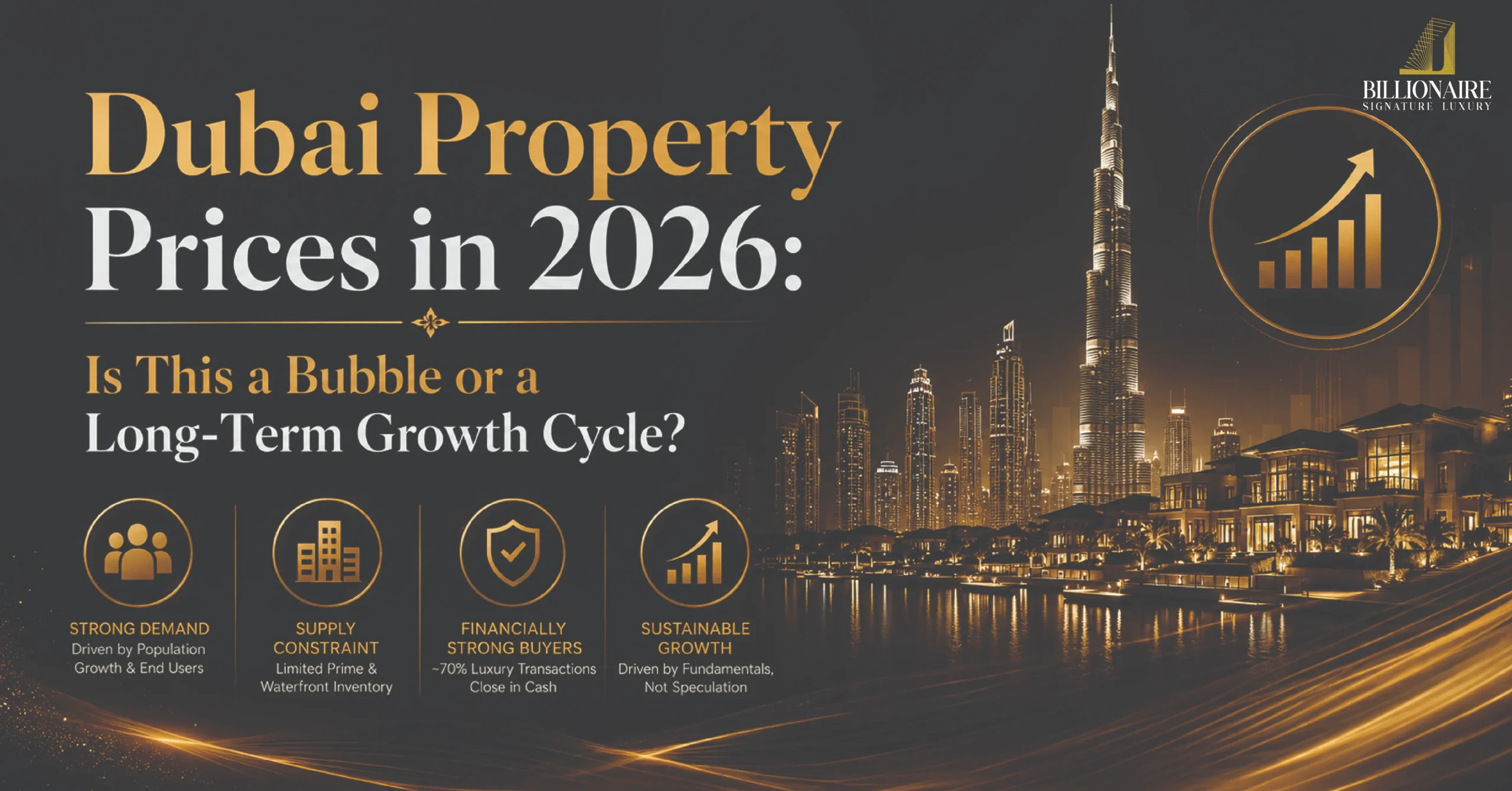
Additionally, the composition of today’s Dubai buyer is fundamentally different from 2008. That cycle was characterised by high leverage, aggressive speculative buying, and a significant proportion of buyers who could not afford the properties they were purchasing. Today, approximately 70% of luxury transactions close in cash. That is a market driven by genuine wealth, not borrowed confidence.
Why This Looks More Like Structural Growth Than a Speculative Cycle
Three factors distinguish a sustainable growth market from a bubble: demand driven by real need, supply that is constrained relative to that demand, and buyers who have the financial capacity to hold their assets through short-term volatility.
Dubai’s current market has all three in the luxury and prime segments. The population is growing. Infrastructure is expanding, creating genuine new demand in areas that were previously underdeveloped. The supply of quality housing in truly prime locations, particularly villas and waterfront properties, is structurally limited by the finite nature of the best locations.
That said, not every segment shares the same fundamental strength. Some mid-market apartment segments have seen supply increase more rapidly, and in areas where new delivery is outpacing demand growth, price appreciation is more modest and rental yields are under mild pressure. This differentiation is important for investors to understand.
Where Growth Is Most Defensible
The segments where price growth is most likely to be sustained are those where supply is most constrained: luxury villas in built-out communities, waterfront properties where new competing supply cannot easily be added, and branded residences that carry unique positioning within their markets.
In these segments, the supply-demand dynamic supports continued appreciation even if broader market conditions soften. Buyers at this level are less sensitive to price movements and more focused on asset quality and long-term positioning.
Mid-market apartments in high-demand communities with strong rental yields represent a different but also defensible growth thesis: even if price appreciation moderates, the income return remains strong and provides a floor on investment performance.
The Honest Risk Assessment
No market grows indefinitely without interruption. Dubai has experienced cyclical corrections before, notably in 2008 and again in 2015. Any investor who presents Dubai as risk-free is not giving you the full picture.
The risk of a meaningful price correction increases if global economic conditions deteriorate significantly, reducing the flow of international capital that is currently supporting demand. It also increases in oversupplied segments where developer pipelines have moved ahead of genuine demand.
The investors who will be most insulated from any future correction are those who have entered at defensible prices in supply-constrained premium locations, generating strong rental income that provides return even without price appreciation.
Conclusion: Growth, Not Hype
The data does not support the bubble narrative for Dubai’s luxury and prime real estate segments in 2026. What it does support is a market in a maturing growth cycle, driven by genuine demand, constrained supply, and capital that is choosing Dubai deliberately rather than speculatively.
For investors with a three to seven year horizon, the opportunity in Dubai’s current market is real. The risk of missing this phase by waiting for a correction that the fundamentals do not support is at least as significant as the risk of a short-term price softening.
BSL Group UAE is ready to help you navigate this market with the clarity and data that lead to sound decisions.