Most people say they are investing in Dubai for capital growth. But if you look closely at how serious investors actually build wealth in this market, the foundation is almost always the same: consistent, reliable rental income.
Not hypothetical appreciation five years from now. Not speculative gains on a project that is still a hole in the ground. Income that comes in every month, covers costs, and compounds over time into real financial independence.
Dubai is one of the best rental income markets in the world. Understanding why, and knowing where to position yourself, is what separates investors who build genuine cash flow from those who wait for appreciation that may or may not arrive on schedule.
Why Dubai Works So Well for Rental Income
Dubai is a city built on movement. People arrive for career opportunities, for business, for lifestyle. The majority of the resident population rents rather than owns. The expat community is large, mobile, and continuously refreshed as contracts end and new professionals arrive.
This creates a tenant base that is structurally active. Vacancy periods in well-located, well-managed properties are short. Demand is not cyclical in the way that purely domestic markets can be, because it is driven partly by global economic forces that consistently bring skilled workers and executives to Dubai regardless of what is happening locally.
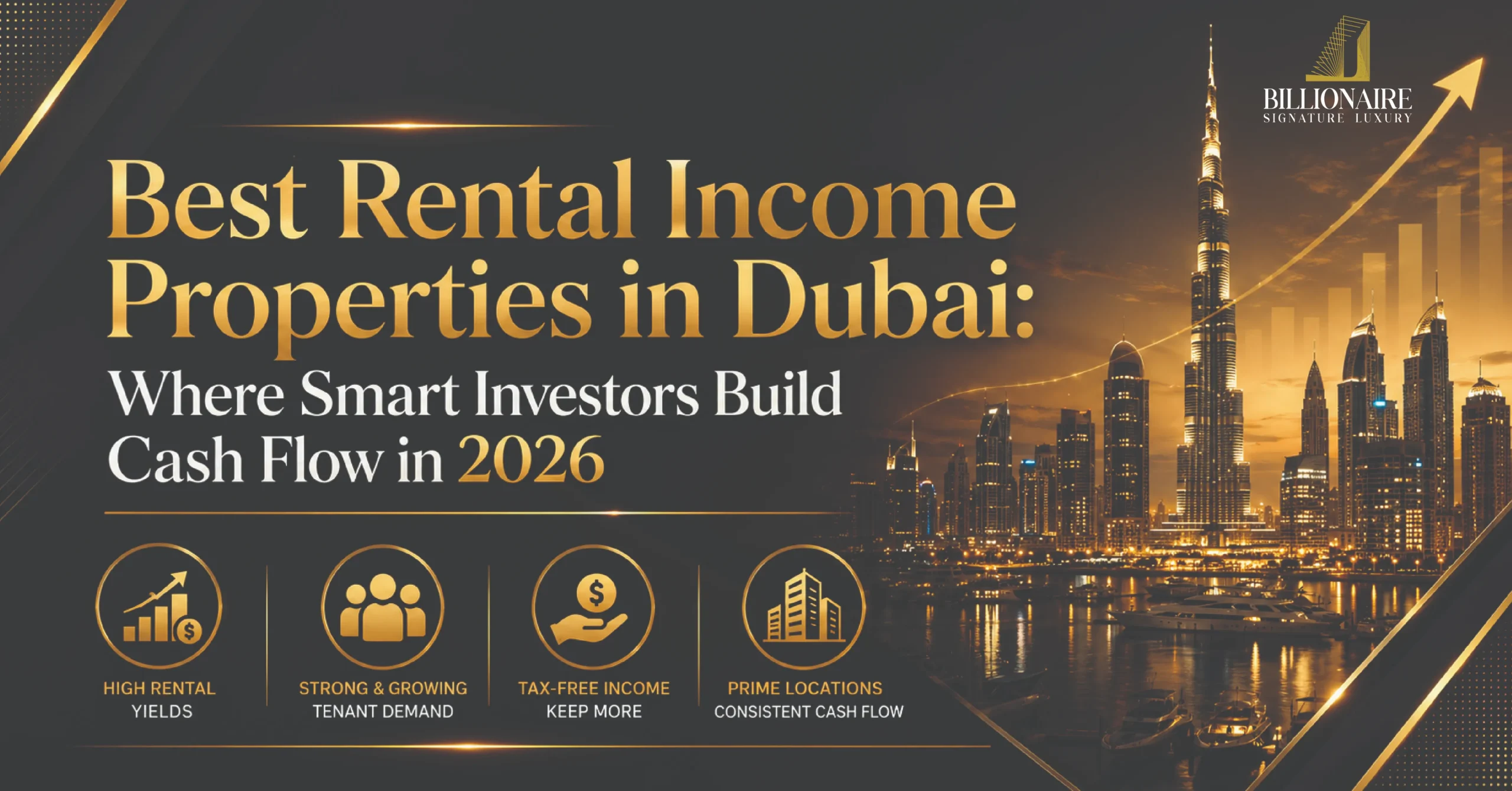
Add to this the complete absence of annual property tax, and the income picture becomes significantly more attractive than equivalent markets in Europe or North America. What you earn in Dubai is what you keep, minus service charges and maintenance. That structural advantage compounds meaningfully over time.
The Properties That Actually Perform
Here is an uncomfortable truth that most property marketing glosses over: not all properties deliver the same rental income, and the difference is not just about location.
Studios and one-bedroom apartments consistently outperform larger units in percentage yield terms in most Dubai communities. This is because they serve the largest segment of the tenant market: young professionals, couples, and single individuals who prioritise location, quality, and convenience over space. Supply of good quality smaller units is often constrained relative to demand, which keeps occupancy high and rents firm.
Larger apartments and villas offer lower percentage yields but attract a more stable, longer-tenure tenant profile: families, senior executives, and multi-year contract holders who are less likely to move frequently. The trade-off between yield and tenant stability is a real strategic decision that depends on your management approach and income objectives.
Where the Real Rental Income Is Being Made in 2026
Jumeirah Village Circle has established itself as one of the highest-yield communities in Dubai, delivering consistent returns of 7-9% for well-positioned units. It is not glamorous, but it is not supposed to be. It serves a large, active tenant base of families and working professionals at price points that keep units occupied year-round.
Dubai Marina combines lifestyle appeal with genuine rental demand from both long-term residents and short-term visitors, delivering yields of 6-8% with the added flexibility of a strong short-term rental market during peak tourism seasons.
Business Bay delivers 6-8% yields driven by corporate demand, proximity to the DIFC, and a resident professional population that values convenience and urban lifestyle. Occupancy rates here are consistently strong because the tenant base is driven by employment contracts rather than lifestyle preference alone.
For investors who are willing to manage or professionally operate short-term rentals, Downtown Dubai and Palm Jumeirah offer premium yield potential during peak season periods, with rates that can exceed long-term equivalents by 30-40% during the highest demand months.
Short-Term vs Long-Term: The Strategic Decision
Short-term rentals can deliver materially higher income in the right locations. But they are not passive. They require active management of bookings, cleaning, maintenance, pricing, and guest communication, either by you or by a professional operator you engage.
Long-term rentals are simpler. You find a tenant, sign a contract, and collect regular income. The yield is typically lower than peak short-term performance, but it is more predictable and requires significantly less ongoing management.
The approach that most experienced investors take is not to choose one exclusively, but to align the strategy with the property and its location. A Marina studio in a building with good short-term rental permissions is a candidate for Airbnb management. A JVC two-bedroom apartment is almost certainly better as a long-term let.
How to Maximise Your Rental Income
Your entry price determines your yield from day one. Overpay for the property, and your yield is compressed regardless of how good your management is. Buy correctly, and the math works in your favour before you have even found a tenant.
Professional presentation matters. Properties that are well-furnished, cleanly maintained, and photographed properly rent faster and at higher rates than comparable units that are not. This is not a minor factor. It is the difference between a two-week vacancy and a two-month vacancy, and it compounds across the life of your investment.
Ongoing management quality drives long-term performance. The right property manager keeps occupancy high, resolves maintenance quickly, manages tenant relationships professionally, and ensures your property is always positioned competitively in the market.
How BSL Group UAE Builds Rental Income Portfolios
At BSL Group UAE, we help clients identify the right assets for their income objectives, enter at defensible prices, and manage their properties through our full-service management division. Our clients do not guess at vacancy rates or hope for the best with tenant selection. They operate with the systems and expertise that produce consistent results.
If rental income is your primary investment objective, we are ready to show you exactly what is achievable in Dubai’s current market.